Alternate Title: Abuse: A Comedy
One sentence synopsis: Tonya Harding deals with her abusive mother and husband, all while
trying to win acceptance through figure skating before and after the
attack on Nancy Kerrigan.
 Things Havoc liked: Like everyone else who was alive and above the age of eight at the time,
I remember the infamous Tonya Harding/Nancy Kerrigan incident from the
1994 Lillehammer Olympics. It was, in many ways, the perfect scandal,
filled with lurid details to titillate and thrill a news audience, women
fighting one another for supremacy, America's sweetheart attacked by a
violent thug, lurid plots among stupid people, overtones of classism,
one of the first big media frenzies. I was there man, every one of us
ate it up with a spoon. Following the Olympics, in which Kerrigan won a
silver medal, and Harding won such infamy, Tonya Harding disappeared
into the tabloids, popping up on news feeds periodically in celebrity
boxing matches, in sex tapes, and in one trashy thing after another. I
cannot say that I thought much about her in the intervening years, but
all of a sudden, here we have a movie about the story of Tonya Harding
from beginning to end, a film I ultimately decided to see purely because
I felt I owed its main actress another shot.
Things Havoc liked: Like everyone else who was alive and above the age of eight at the time,
I remember the infamous Tonya Harding/Nancy Kerrigan incident from the
1994 Lillehammer Olympics. It was, in many ways, the perfect scandal,
filled with lurid details to titillate and thrill a news audience, women
fighting one another for supremacy, America's sweetheart attacked by a
violent thug, lurid plots among stupid people, overtones of classism,
one of the first big media frenzies. I was there man, every one of us
ate it up with a spoon. Following the Olympics, in which Kerrigan won a
silver medal, and Harding won such infamy, Tonya Harding disappeared
into the tabloids, popping up on news feeds periodically in celebrity
boxing matches, in sex tapes, and in one trashy thing after another. I
cannot say that I thought much about her in the intervening years, but
all of a sudden, here we have a movie about the story of Tonya Harding
from beginning to end, a film I ultimately decided to see purely because
I felt I owed its main actress another shot.
You see, I didn't see I, Tonya, because I really desperately wanted to know more about Tonya Harding, I saw it because of Suicide Squad, a movie so bad I still suspect it to have been the result of some gruesome experiment in human psychology. Margot Robbie, who had the singular misfortune of starring in that film as Harley Quinn (a misfortune only slightly lesser than those of us who had to watch her) is an actress I have seen in nothing else to date (save a cameo in The Big Short), and while she was pretty goddamn awful in Suicide Squad, that much could easily be explained by the fact that everything touched by Suicide Squad turned to galvanized shit. After all, Viola Davis and Will Smith are both charismatic actors of considerable skill, and neither one of them could salvage any dignity. I therefore felt, given her increasing prominence, that I owed it to Margot Robbie to find out if she could act at all, an exercise I try to engage in when I encounter actors or actresses who have had the misfortune of making their major debut in a film so bad that nothing positive could be gleaned from it. The ur-example here is Twilight, a film that forced me to seek other examples of Robert Pattinson and Kristen Stewart's acting efforts, determining empirically that while Pattinson can act, Stewart cannot.
 So with all that preamble aside, can Margot Robbie act? Ohhhhh
yes. Yes she can, in fact Margot Robbie, playing a character that none
of us ever got to know except in the pages of a tabloid, is phenomenal
this time around, a treasure of a performance that fully justifies all
of the faith that people placed in her following the atrocity that was
Suicide Squad. Biopics are a dangerous game, as apt to win you
condemnation as they are an Oscar, but Robbie, playing a character
nobody really knows anything about, is exceptional, bringing all the
classless rancor, the bitter devotion to her craft, the wounded
patched-together pride of a victim of nigh-constant abuse, the
serially-unreliable mentality of someone trying to make sense of her own
life, bringing all of it together into a performance that merits the
Oscar nomination that should be (and at time of writing, has been)
forthcoming. It's a career-making performance, comic and tragic all at
once, while still retaining the essence of what the public remembers of
the character, and if that wasn't Robbie performing the
fantastically-difficult skating maneuvers studded throughout, then the
movie certainly fooled me.
So with all that preamble aside, can Margot Robbie act? Ohhhhh
yes. Yes she can, in fact Margot Robbie, playing a character that none
of us ever got to know except in the pages of a tabloid, is phenomenal
this time around, a treasure of a performance that fully justifies all
of the faith that people placed in her following the atrocity that was
Suicide Squad. Biopics are a dangerous game, as apt to win you
condemnation as they are an Oscar, but Robbie, playing a character
nobody really knows anything about, is exceptional, bringing all the
classless rancor, the bitter devotion to her craft, the wounded
patched-together pride of a victim of nigh-constant abuse, the
serially-unreliable mentality of someone trying to make sense of her own
life, bringing all of it together into a performance that merits the
Oscar nomination that should be (and at time of writing, has been)
forthcoming. It's a career-making performance, comic and tragic all at
once, while still retaining the essence of what the public remembers of
the character, and if that wasn't Robbie performing the
fantastically-difficult skating maneuvers studded throughout, then the
movie certainly fooled me.
 I, Tonya, comes to us courtesy of
Craig Gillespie, an Australian director who has yet to feature on this
project, due to his propensity for mostly doing projects that don't look
particularly interesting. The only movie of his prior to this one that
I know anything about is 2007's exceedingly-odd Ryan Gosling vehicle
Lars and the Real Girl, a movie that was effectively a weirder version
of Her, and if you remember Her, that's quite a statement. This one is a
bit more accessable than that one was, but is done in a
fourth-wall-shattering style that emphasizes just how unreliable the
various stories that the characters involved tell of the Kerrigan
incident and everything that led up to it are. The result resembles The
Big Short, or other movies that use unconventional directing techniques
as a tool to emphasize the artificiality of the concepts they're
attempting to get across, and in retrospect, it's probably the only way
to do something like this without turning the entire thing into a
Rashomon-style philosophical treatise, which would be highly unsuited
for the material. It does, however, require a superb cast to be able to
pull something like this off, and fortunately Gillespie has assembled
one. Sebastian Stan, Bucky Barnes from the Marvel films, is utterly
unrecognizable as Jeff Gillooly, an abusive loser who Tonya falls for
due primarily to the fact that she has been conditioned by her
upbringing to expect nothing but abusive losers to be interested in her.
It's deceptively difficult to play a loser on screen, if only because
most successful actors are charismatic, and the camera introduces such
tremendous bias in their favor, but Stan pulls it off, giving us a
character by turns entirely loathsome and yet completely believable,
not a screaming monster but a person whose life is what it was always
fated to be, and whose worst traits go utterly unexamined by himself or
even his victims. But the best performance of all is Allison Janney's,
because she gets to play a true monster. Tonya's mother LaVona,
expertly portrayed by the one-time West Wing alum, is a vile, twisted,
hyper-abusive harpy, an utterly loathsome creature whose every action
and thought drips bitterness and resentment. And yet even here, Janney
puts together a character that isn't just a caricature of an abusive
single mother, but simply a person who is missing parts of their soul,
who acts as she does because she thinks it the only way to properly act.
We hate her all the more because we understand where she is coming
from, and is that not the definition of an excellent villain?
I, Tonya, comes to us courtesy of
Craig Gillespie, an Australian director who has yet to feature on this
project, due to his propensity for mostly doing projects that don't look
particularly interesting. The only movie of his prior to this one that
I know anything about is 2007's exceedingly-odd Ryan Gosling vehicle
Lars and the Real Girl, a movie that was effectively a weirder version
of Her, and if you remember Her, that's quite a statement. This one is a
bit more accessable than that one was, but is done in a
fourth-wall-shattering style that emphasizes just how unreliable the
various stories that the characters involved tell of the Kerrigan
incident and everything that led up to it are. The result resembles The
Big Short, or other movies that use unconventional directing techniques
as a tool to emphasize the artificiality of the concepts they're
attempting to get across, and in retrospect, it's probably the only way
to do something like this without turning the entire thing into a
Rashomon-style philosophical treatise, which would be highly unsuited
for the material. It does, however, require a superb cast to be able to
pull something like this off, and fortunately Gillespie has assembled
one. Sebastian Stan, Bucky Barnes from the Marvel films, is utterly
unrecognizable as Jeff Gillooly, an abusive loser who Tonya falls for
due primarily to the fact that she has been conditioned by her
upbringing to expect nothing but abusive losers to be interested in her.
It's deceptively difficult to play a loser on screen, if only because
most successful actors are charismatic, and the camera introduces such
tremendous bias in their favor, but Stan pulls it off, giving us a
character by turns entirely loathsome and yet completely believable,
not a screaming monster but a person whose life is what it was always
fated to be, and whose worst traits go utterly unexamined by himself or
even his victims. But the best performance of all is Allison Janney's,
because she gets to play a true monster. Tonya's mother LaVona,
expertly portrayed by the one-time West Wing alum, is a vile, twisted,
hyper-abusive harpy, an utterly loathsome creature whose every action
and thought drips bitterness and resentment. And yet even here, Janney
puts together a character that isn't just a caricature of an abusive
single mother, but simply a person who is missing parts of their soul,
who acts as she does because she thinks it the only way to properly act.
We hate her all the more because we understand where she is coming
from, and is that not the definition of an excellent villain?
 If
it sounds like the theme of abuse is coming up a lot in my description
so far, that is because the movie is rife with it, not sensationalized,
not dialed up to some unwatchable level, but inculcated into its very
bones. The story of Tonya Harding, the movie claims, is a story of
long-term abuse, not always cinematic and violent, and not always
unreciprocated, but always there, poisoning everything it touches until
actions that would seem unthinkable to any normal, rational person, are
perfectly normal and indeed not deserving of comment to the characters
that inhabit this world. Tonya is abused by her mother, by her husband,
by the Media, by the US Figure Skating association which is made to
look, probably with very good reason, like a bunch of classic snobs who
never even considered giving Harding a real shot. Months and years of
brutally-difficult work are rewarded time and again with "stylistic"
point deductions and low-seeded rankings, despite Tonya being an
exceptionally gifted technical skater, the only American woman to
perform a Triple Axel jump. Without ever calling things out explicitly,
the movie effortlessly places you in a mindset wherein anything, even
attacking a rival with a retractable baton, seems reasonable, given that
nobody else is playing fairly either. Moreover, despite everything
I've just finished saying, the movie is also riotously funny at parts,
mostly due to just how stupid so
many of the participants in this little farce of a conspiracy were.
Paul Walter Hauser, whom I've never seen or heard of before, plays Shaun
Ekhart, Tonya's bodyguard, a loser among losers, who fancies himself
some kind of CIA-trained espionage expert while living in his mother's
house and plotting the dumbest caper in the history of dumb capers.
Bobby Cannavale, whom I love dearly, gets the job of narrating most of
this to us as a spray-tanned Hard Copy producer, describing in
breathless glee how dumb the plan to assault Kerrigan actually was, with
one conspirator staking out Kerrigan's training arena for three days,
parking in an empty parking lot, and moving his car around it every
fifteen minutes to avoid suspicion!
Why only for three days? Because that's how long it took him to
realize that Kerrigan was actually training in a different arena
entirely in another state.
If
it sounds like the theme of abuse is coming up a lot in my description
so far, that is because the movie is rife with it, not sensationalized,
not dialed up to some unwatchable level, but inculcated into its very
bones. The story of Tonya Harding, the movie claims, is a story of
long-term abuse, not always cinematic and violent, and not always
unreciprocated, but always there, poisoning everything it touches until
actions that would seem unthinkable to any normal, rational person, are
perfectly normal and indeed not deserving of comment to the characters
that inhabit this world. Tonya is abused by her mother, by her husband,
by the Media, by the US Figure Skating association which is made to
look, probably with very good reason, like a bunch of classic snobs who
never even considered giving Harding a real shot. Months and years of
brutally-difficult work are rewarded time and again with "stylistic"
point deductions and low-seeded rankings, despite Tonya being an
exceptionally gifted technical skater, the only American woman to
perform a Triple Axel jump. Without ever calling things out explicitly,
the movie effortlessly places you in a mindset wherein anything, even
attacking a rival with a retractable baton, seems reasonable, given that
nobody else is playing fairly either. Moreover, despite everything
I've just finished saying, the movie is also riotously funny at parts,
mostly due to just how stupid so
many of the participants in this little farce of a conspiracy were.
Paul Walter Hauser, whom I've never seen or heard of before, plays Shaun
Ekhart, Tonya's bodyguard, a loser among losers, who fancies himself
some kind of CIA-trained espionage expert while living in his mother's
house and plotting the dumbest caper in the history of dumb capers.
Bobby Cannavale, whom I love dearly, gets the job of narrating most of
this to us as a spray-tanned Hard Copy producer, describing in
breathless glee how dumb the plan to assault Kerrigan actually was, with
one conspirator staking out Kerrigan's training arena for three days,
parking in an empty parking lot, and moving his car around it every
fifteen minutes to avoid suspicion!
Why only for three days? Because that's how long it took him to
realize that Kerrigan was actually training in a different arena
entirely in another state.
 Things Havoc disliked: The film goes to some lengths to ensure that you know just how
unreliable all participants in this absurd farce are. Everyone has
their own version of what happened before and during the Kerrigan
assault (the movie calls it "the incident"), and none of those versions
stack up at all, particularly those of Harding and Gillooly themselves.
This is fine, indeed it's only to be expected, nor is it surprising,
given how much time it spends humanizing her, that the film ultimately
winds up taking more of Harding's perspective than anyone else's. But
the problem is that about two thirds of the way through the movie,
without mentioning it or otherwise indicating, it basically hews
entirely to the notion that Harding knew nothing about the impending
attack, and if she did know something about it she didn't understand it,
and if she did understand it she thought it was a joke, and if she
didn't think it was a joke she thought the plan would involve threats,
not violence, and if she did think the plan involved violence well it
was only to be expected given her upbringing.
Things Havoc disliked: The film goes to some lengths to ensure that you know just how
unreliable all participants in this absurd farce are. Everyone has
their own version of what happened before and during the Kerrigan
assault (the movie calls it "the incident"), and none of those versions
stack up at all, particularly those of Harding and Gillooly themselves.
This is fine, indeed it's only to be expected, nor is it surprising,
given how much time it spends humanizing her, that the film ultimately
winds up taking more of Harding's perspective than anyone else's. But
the problem is that about two thirds of the way through the movie,
without mentioning it or otherwise indicating, it basically hews
entirely to the notion that Harding knew nothing about the impending
attack, and if she did know something about it she didn't understand it,
and if she did understand it she thought it was a joke, and if she
didn't think it was a joke she thought the plan would involve threats,
not violence, and if she did think the plan involved violence well it
was only to be expected given her upbringing.
Um... right...
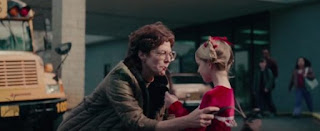 Look,
nobody but Tonya Harding herself really knows how much she was or
wasn't actually involved in the assault on Kerrigan, and given the
nature of human memory and rationalization, probably not her either at
this point. And it is certainly possible,
though not much more, that Harding had nothing to do with the planning
of the assault that put her back in the Olympics after her career was
largely over. But for the movie to turn around so far into a story that
is being told from multiple directions, and suddenly claim
authoritatively that not only was the entire prosecution of Harding
nothing but a political witch-hunt on the part of a classist Figure
Skating world looking to finally be rid of her, but that it knows this for a fact
is just ridiculous on its face. I don't demand that all movies
represent nothing but the unvarnished truth, especially when that truth
is open to interpretation, but when the movie's central thesis is that
nobody knows the truth, it's a bit churlish to suddenly reframe
everything that's happening as
the truth because it casts your sympathetic protagonist in a more
flattering light. And if you're going to do that, suddenly pivot from
an unreliable to an authoritative viewpoint on the events in question,
it's probably a good idea not to misrepresent the few actual facts that are
known about the case. The movie's climax involves a tearful court
hearing, where a barely-controlled Harding begs and pleads for her life
after a stern, unsympathetic judge bans her from figure skating for
life. Powerful stuff, if it had actually happened, but it did not. It
doesn't take much research to know that criminal courts have no bearing
on who can and can't participate in Figure Skating associations, and
Harding was never so-sentenced. Instead, after she pled guilty to
obstructing justice in the investigation of an assault on one of her
competitors, the US Figure Skating association banned her for life,
after their investigation concluded that she knew about the attack
before it happened. Call the investigation a witch-hunt if you like,
but please don't make up criminal penalties that never happened, framed
to make your unreliable protagonist look sympathetic, and then wrap yourselves in the mantle of the one true arbiters of truth.
Look,
nobody but Tonya Harding herself really knows how much she was or
wasn't actually involved in the assault on Kerrigan, and given the
nature of human memory and rationalization, probably not her either at
this point. And it is certainly possible,
though not much more, that Harding had nothing to do with the planning
of the assault that put her back in the Olympics after her career was
largely over. But for the movie to turn around so far into a story that
is being told from multiple directions, and suddenly claim
authoritatively that not only was the entire prosecution of Harding
nothing but a political witch-hunt on the part of a classist Figure
Skating world looking to finally be rid of her, but that it knows this for a fact
is just ridiculous on its face. I don't demand that all movies
represent nothing but the unvarnished truth, especially when that truth
is open to interpretation, but when the movie's central thesis is that
nobody knows the truth, it's a bit churlish to suddenly reframe
everything that's happening as
the truth because it casts your sympathetic protagonist in a more
flattering light. And if you're going to do that, suddenly pivot from
an unreliable to an authoritative viewpoint on the events in question,
it's probably a good idea not to misrepresent the few actual facts that are
known about the case. The movie's climax involves a tearful court
hearing, where a barely-controlled Harding begs and pleads for her life
after a stern, unsympathetic judge bans her from figure skating for
life. Powerful stuff, if it had actually happened, but it did not. It
doesn't take much research to know that criminal courts have no bearing
on who can and can't participate in Figure Skating associations, and
Harding was never so-sentenced. Instead, after she pled guilty to
obstructing justice in the investigation of an assault on one of her
competitors, the US Figure Skating association banned her for life,
after their investigation concluded that she knew about the attack
before it happened. Call the investigation a witch-hunt if you like,
but please don't make up criminal penalties that never happened, framed
to make your unreliable protagonist look sympathetic, and then wrap yourselves in the mantle of the one true arbiters of truth.
 Final thoughts: But I have to say, whatever the film's authorial bent or pretensions of
truth and honesty, I, Tonya is an incredible film, a tightly-crafted,
instantly-compelling, and brilliant-acted piece of 90s absurdity, taking
a story we all knew and giving us even more salacious details about it,
assuming we're willing to acknowledge that doing so makes us no better
than the other people who tried to exploit Tonya Harding for our own
purposes. It is a fantastic movie across the board, one that is
entirely deserving of its buzz, and a fitting place to leave off the
greatest single year I have ever experienced at the movies. With Awards
season finally upon us, I, Tonya, along with many other fine films, is
once more being re-released in theaters, and you all owe it to
yourselves to give it a shot, whether you know the story or not.
Final thoughts: But I have to say, whatever the film's authorial bent or pretensions of
truth and honesty, I, Tonya is an incredible film, a tightly-crafted,
instantly-compelling, and brilliant-acted piece of 90s absurdity, taking
a story we all knew and giving us even more salacious details about it,
assuming we're willing to acknowledge that doing so makes us no better
than the other people who tried to exploit Tonya Harding for our own
purposes. It is a fantastic movie across the board, one that is
entirely deserving of its buzz, and a fitting place to leave off the
greatest single year I have ever experienced at the movies. With Awards
season finally upon us, I, Tonya, along with many other fine films, is
once more being re-released in theaters, and you all owe it to
yourselves to give it a shot, whether you know the story or not.
Thank you to everyone who has followed these reviews over the course of the year now past. It has been quite a run, and I hope you are all ready to hear about it again, because it is finally time to evaluate the best this year offered us, and the worst...
Next Time: Ladies and gentlemen, IT IS TIME!!!

You see, I didn't see I, Tonya, because I really desperately wanted to know more about Tonya Harding, I saw it because of Suicide Squad, a movie so bad I still suspect it to have been the result of some gruesome experiment in human psychology. Margot Robbie, who had the singular misfortune of starring in that film as Harley Quinn (a misfortune only slightly lesser than those of us who had to watch her) is an actress I have seen in nothing else to date (save a cameo in The Big Short), and while she was pretty goddamn awful in Suicide Squad, that much could easily be explained by the fact that everything touched by Suicide Squad turned to galvanized shit. After all, Viola Davis and Will Smith are both charismatic actors of considerable skill, and neither one of them could salvage any dignity. I therefore felt, given her increasing prominence, that I owed it to Margot Robbie to find out if she could act at all, an exercise I try to engage in when I encounter actors or actresses who have had the misfortune of making their major debut in a film so bad that nothing positive could be gleaned from it. The ur-example here is Twilight, a film that forced me to seek other examples of Robert Pattinson and Kristen Stewart's acting efforts, determining empirically that while Pattinson can act, Stewart cannot.
 So with all that preamble aside, can Margot Robbie act? Ohhhhh
yes. Yes she can, in fact Margot Robbie, playing a character that none
of us ever got to know except in the pages of a tabloid, is phenomenal
this time around, a treasure of a performance that fully justifies all
of the faith that people placed in her following the atrocity that was
Suicide Squad. Biopics are a dangerous game, as apt to win you
condemnation as they are an Oscar, but Robbie, playing a character
nobody really knows anything about, is exceptional, bringing all the
classless rancor, the bitter devotion to her craft, the wounded
patched-together pride of a victim of nigh-constant abuse, the
serially-unreliable mentality of someone trying to make sense of her own
life, bringing all of it together into a performance that merits the
Oscar nomination that should be (and at time of writing, has been)
forthcoming. It's a career-making performance, comic and tragic all at
once, while still retaining the essence of what the public remembers of
the character, and if that wasn't Robbie performing the
fantastically-difficult skating maneuvers studded throughout, then the
movie certainly fooled me.
So with all that preamble aside, can Margot Robbie act? Ohhhhh
yes. Yes she can, in fact Margot Robbie, playing a character that none
of us ever got to know except in the pages of a tabloid, is phenomenal
this time around, a treasure of a performance that fully justifies all
of the faith that people placed in her following the atrocity that was
Suicide Squad. Biopics are a dangerous game, as apt to win you
condemnation as they are an Oscar, but Robbie, playing a character
nobody really knows anything about, is exceptional, bringing all the
classless rancor, the bitter devotion to her craft, the wounded
patched-together pride of a victim of nigh-constant abuse, the
serially-unreliable mentality of someone trying to make sense of her own
life, bringing all of it together into a performance that merits the
Oscar nomination that should be (and at time of writing, has been)
forthcoming. It's a career-making performance, comic and tragic all at
once, while still retaining the essence of what the public remembers of
the character, and if that wasn't Robbie performing the
fantastically-difficult skating maneuvers studded throughout, then the
movie certainly fooled me. I, Tonya, comes to us courtesy of
Craig Gillespie, an Australian director who has yet to feature on this
project, due to his propensity for mostly doing projects that don't look
particularly interesting. The only movie of his prior to this one that
I know anything about is 2007's exceedingly-odd Ryan Gosling vehicle
Lars and the Real Girl, a movie that was effectively a weirder version
of Her, and if you remember Her, that's quite a statement. This one is a
bit more accessable than that one was, but is done in a
fourth-wall-shattering style that emphasizes just how unreliable the
various stories that the characters involved tell of the Kerrigan
incident and everything that led up to it are. The result resembles The
Big Short, or other movies that use unconventional directing techniques
as a tool to emphasize the artificiality of the concepts they're
attempting to get across, and in retrospect, it's probably the only way
to do something like this without turning the entire thing into a
Rashomon-style philosophical treatise, which would be highly unsuited
for the material. It does, however, require a superb cast to be able to
pull something like this off, and fortunately Gillespie has assembled
one. Sebastian Stan, Bucky Barnes from the Marvel films, is utterly
unrecognizable as Jeff Gillooly, an abusive loser who Tonya falls for
due primarily to the fact that she has been conditioned by her
upbringing to expect nothing but abusive losers to be interested in her.
It's deceptively difficult to play a loser on screen, if only because
most successful actors are charismatic, and the camera introduces such
tremendous bias in their favor, but Stan pulls it off, giving us a
character by turns entirely loathsome and yet completely believable,
not a screaming monster but a person whose life is what it was always
fated to be, and whose worst traits go utterly unexamined by himself or
even his victims. But the best performance of all is Allison Janney's,
because she gets to play a true monster. Tonya's mother LaVona,
expertly portrayed by the one-time West Wing alum, is a vile, twisted,
hyper-abusive harpy, an utterly loathsome creature whose every action
and thought drips bitterness and resentment. And yet even here, Janney
puts together a character that isn't just a caricature of an abusive
single mother, but simply a person who is missing parts of their soul,
who acts as she does because she thinks it the only way to properly act.
We hate her all the more because we understand where she is coming
from, and is that not the definition of an excellent villain?
I, Tonya, comes to us courtesy of
Craig Gillespie, an Australian director who has yet to feature on this
project, due to his propensity for mostly doing projects that don't look
particularly interesting. The only movie of his prior to this one that
I know anything about is 2007's exceedingly-odd Ryan Gosling vehicle
Lars and the Real Girl, a movie that was effectively a weirder version
of Her, and if you remember Her, that's quite a statement. This one is a
bit more accessable than that one was, but is done in a
fourth-wall-shattering style that emphasizes just how unreliable the
various stories that the characters involved tell of the Kerrigan
incident and everything that led up to it are. The result resembles The
Big Short, or other movies that use unconventional directing techniques
as a tool to emphasize the artificiality of the concepts they're
attempting to get across, and in retrospect, it's probably the only way
to do something like this without turning the entire thing into a
Rashomon-style philosophical treatise, which would be highly unsuited
for the material. It does, however, require a superb cast to be able to
pull something like this off, and fortunately Gillespie has assembled
one. Sebastian Stan, Bucky Barnes from the Marvel films, is utterly
unrecognizable as Jeff Gillooly, an abusive loser who Tonya falls for
due primarily to the fact that she has been conditioned by her
upbringing to expect nothing but abusive losers to be interested in her.
It's deceptively difficult to play a loser on screen, if only because
most successful actors are charismatic, and the camera introduces such
tremendous bias in their favor, but Stan pulls it off, giving us a
character by turns entirely loathsome and yet completely believable,
not a screaming monster but a person whose life is what it was always
fated to be, and whose worst traits go utterly unexamined by himself or
even his victims. But the best performance of all is Allison Janney's,
because she gets to play a true monster. Tonya's mother LaVona,
expertly portrayed by the one-time West Wing alum, is a vile, twisted,
hyper-abusive harpy, an utterly loathsome creature whose every action
and thought drips bitterness and resentment. And yet even here, Janney
puts together a character that isn't just a caricature of an abusive
single mother, but simply a person who is missing parts of their soul,
who acts as she does because she thinks it the only way to properly act.
We hate her all the more because we understand where she is coming
from, and is that not the definition of an excellent villain? If
it sounds like the theme of abuse is coming up a lot in my description
so far, that is because the movie is rife with it, not sensationalized,
not dialed up to some unwatchable level, but inculcated into its very
bones. The story of Tonya Harding, the movie claims, is a story of
long-term abuse, not always cinematic and violent, and not always
unreciprocated, but always there, poisoning everything it touches until
actions that would seem unthinkable to any normal, rational person, are
perfectly normal and indeed not deserving of comment to the characters
that inhabit this world. Tonya is abused by her mother, by her husband,
by the Media, by the US Figure Skating association which is made to
look, probably with very good reason, like a bunch of classic snobs who
never even considered giving Harding a real shot. Months and years of
brutally-difficult work are rewarded time and again with "stylistic"
point deductions and low-seeded rankings, despite Tonya being an
exceptionally gifted technical skater, the only American woman to
perform a Triple Axel jump. Without ever calling things out explicitly,
the movie effortlessly places you in a mindset wherein anything, even
attacking a rival with a retractable baton, seems reasonable, given that
nobody else is playing fairly either. Moreover, despite everything
I've just finished saying, the movie is also riotously funny at parts,
mostly due to just how stupid so
many of the participants in this little farce of a conspiracy were.
Paul Walter Hauser, whom I've never seen or heard of before, plays Shaun
Ekhart, Tonya's bodyguard, a loser among losers, who fancies himself
some kind of CIA-trained espionage expert while living in his mother's
house and plotting the dumbest caper in the history of dumb capers.
Bobby Cannavale, whom I love dearly, gets the job of narrating most of
this to us as a spray-tanned Hard Copy producer, describing in
breathless glee how dumb the plan to assault Kerrigan actually was, with
one conspirator staking out Kerrigan's training arena for three days,
parking in an empty parking lot, and moving his car around it every
fifteen minutes to avoid suspicion!
Why only for three days? Because that's how long it took him to
realize that Kerrigan was actually training in a different arena
entirely in another state.
If
it sounds like the theme of abuse is coming up a lot in my description
so far, that is because the movie is rife with it, not sensationalized,
not dialed up to some unwatchable level, but inculcated into its very
bones. The story of Tonya Harding, the movie claims, is a story of
long-term abuse, not always cinematic and violent, and not always
unreciprocated, but always there, poisoning everything it touches until
actions that would seem unthinkable to any normal, rational person, are
perfectly normal and indeed not deserving of comment to the characters
that inhabit this world. Tonya is abused by her mother, by her husband,
by the Media, by the US Figure Skating association which is made to
look, probably with very good reason, like a bunch of classic snobs who
never even considered giving Harding a real shot. Months and years of
brutally-difficult work are rewarded time and again with "stylistic"
point deductions and low-seeded rankings, despite Tonya being an
exceptionally gifted technical skater, the only American woman to
perform a Triple Axel jump. Without ever calling things out explicitly,
the movie effortlessly places you in a mindset wherein anything, even
attacking a rival with a retractable baton, seems reasonable, given that
nobody else is playing fairly either. Moreover, despite everything
I've just finished saying, the movie is also riotously funny at parts,
mostly due to just how stupid so
many of the participants in this little farce of a conspiracy were.
Paul Walter Hauser, whom I've never seen or heard of before, plays Shaun
Ekhart, Tonya's bodyguard, a loser among losers, who fancies himself
some kind of CIA-trained espionage expert while living in his mother's
house and plotting the dumbest caper in the history of dumb capers.
Bobby Cannavale, whom I love dearly, gets the job of narrating most of
this to us as a spray-tanned Hard Copy producer, describing in
breathless glee how dumb the plan to assault Kerrigan actually was, with
one conspirator staking out Kerrigan's training arena for three days,
parking in an empty parking lot, and moving his car around it every
fifteen minutes to avoid suspicion!
Why only for three days? Because that's how long it took him to
realize that Kerrigan was actually training in a different arena
entirely in another state.
Um... right...
 Look,
nobody but Tonya Harding herself really knows how much she was or
wasn't actually involved in the assault on Kerrigan, and given the
nature of human memory and rationalization, probably not her either at
this point. And it is certainly possible,
though not much more, that Harding had nothing to do with the planning
of the assault that put her back in the Olympics after her career was
largely over. But for the movie to turn around so far into a story that
is being told from multiple directions, and suddenly claim
authoritatively that not only was the entire prosecution of Harding
nothing but a political witch-hunt on the part of a classist Figure
Skating world looking to finally be rid of her, but that it knows this for a fact
is just ridiculous on its face. I don't demand that all movies
represent nothing but the unvarnished truth, especially when that truth
is open to interpretation, but when the movie's central thesis is that
nobody knows the truth, it's a bit churlish to suddenly reframe
everything that's happening as
the truth because it casts your sympathetic protagonist in a more
flattering light. And if you're going to do that, suddenly pivot from
an unreliable to an authoritative viewpoint on the events in question,
it's probably a good idea not to misrepresent the few actual facts that are
known about the case. The movie's climax involves a tearful court
hearing, where a barely-controlled Harding begs and pleads for her life
after a stern, unsympathetic judge bans her from figure skating for
life. Powerful stuff, if it had actually happened, but it did not. It
doesn't take much research to know that criminal courts have no bearing
on who can and can't participate in Figure Skating associations, and
Harding was never so-sentenced. Instead, after she pled guilty to
obstructing justice in the investigation of an assault on one of her
competitors, the US Figure Skating association banned her for life,
after their investigation concluded that she knew about the attack
before it happened. Call the investigation a witch-hunt if you like,
but please don't make up criminal penalties that never happened, framed
to make your unreliable protagonist look sympathetic, and then wrap yourselves in the mantle of the one true arbiters of truth.
Look,
nobody but Tonya Harding herself really knows how much she was or
wasn't actually involved in the assault on Kerrigan, and given the
nature of human memory and rationalization, probably not her either at
this point. And it is certainly possible,
though not much more, that Harding had nothing to do with the planning
of the assault that put her back in the Olympics after her career was
largely over. But for the movie to turn around so far into a story that
is being told from multiple directions, and suddenly claim
authoritatively that not only was the entire prosecution of Harding
nothing but a political witch-hunt on the part of a classist Figure
Skating world looking to finally be rid of her, but that it knows this for a fact
is just ridiculous on its face. I don't demand that all movies
represent nothing but the unvarnished truth, especially when that truth
is open to interpretation, but when the movie's central thesis is that
nobody knows the truth, it's a bit churlish to suddenly reframe
everything that's happening as
the truth because it casts your sympathetic protagonist in a more
flattering light. And if you're going to do that, suddenly pivot from
an unreliable to an authoritative viewpoint on the events in question,
it's probably a good idea not to misrepresent the few actual facts that are
known about the case. The movie's climax involves a tearful court
hearing, where a barely-controlled Harding begs and pleads for her life
after a stern, unsympathetic judge bans her from figure skating for
life. Powerful stuff, if it had actually happened, but it did not. It
doesn't take much research to know that criminal courts have no bearing
on who can and can't participate in Figure Skating associations, and
Harding was never so-sentenced. Instead, after she pled guilty to
obstructing justice in the investigation of an assault on one of her
competitors, the US Figure Skating association banned her for life,
after their investigation concluded that she knew about the attack
before it happened. Call the investigation a witch-hunt if you like,
but please don't make up criminal penalties that never happened, framed
to make your unreliable protagonist look sympathetic, and then wrap yourselves in the mantle of the one true arbiters of truth.
Thank you to everyone who has followed these reviews over the course of the year now past. It has been quite a run, and I hope you are all ready to hear about it again, because it is finally time to evaluate the best this year offered us, and the worst...
Final Score: 8/10