Wednesday, August 19, 2015

Trainwreck

Alternate Title:  Truth in Advertising

One sentence synopsis:     A woman whose life consists of one night stands and casual relationships tries to clean up her act after falling for a sports doctor she was assigned to interview.


Things Havoc liked:  I don't go to see a lot of romantic comedies. It's not a genre I chase down when I have the chance. If I'm being blatantly honest, I don't really know why that is. Yes, most romantic comedies are stupid, shallow, vapid, and borderline offensive, but those terms also describe a number of genres that I do like, so perhaps it's just a matter of not having any major milestone films to compare them to. An action movie that I sit down to see is going to be measured in terms of the giants of the genre, the Aliens, the Terminator 2s, (the Mad Maxes), whereas I've never been fan enough of Sleepless in Seattle or whatever the stalwarts of rom-coms are supposed to be to properly evaluate modern renditions with the classics of yesteryear. But with the September Slump having pushed into August this year, and precious little available to see, I was prevailed upon to take a shot at the latest offering from Judd Apatow.

You all know who Judd Apatow is, don't you? I do, and I go to see Rom-coms about as often as I check out polemical documentaries on the evils of sheep. The king of "Bromantic comedy", writer and/or director of everything from Pineapple Express to The 40-Year-Old Virgin to Funny People, Adam Sandler's last watchable movie, Apatow is one of the reigning High Lords of Comedy nowadays, having somehow caused Bridesmaids to become the biggest R-rated comedy ever (Lord only knows how). Yet rather than draw on his usual stable of Hollywood comedians like Seth Rogan, Paul Rudd, or Kristen Wiig, Apatow this time has decided to give us Comedy Central star Amy Schumer, SNL's Bill Hader, and a whole pile of major figures in sports and wrestling, presumably in the hope that some of them would be funny.

And you know what? They are. And not only that, but their presence livened the movie considerably for me, a depressingly-stereotypical heterosexual man whose appreciation for these sorts of movies is desperately limited, but who can nonetheless appreciate the automatic comedy potential that comes from having a film in which LeBron James plays the role of the concerned friend who doesn't want to see his fragile buddy's heart broken and who stages interventions alongside Matthew Broderick and Marv Albert (I have no explanation) to get the struggling couple back together. These kinds of funny celebrity not-cameos are the sorts of things The Rock used to do all the time (Be Cool was a good example), back before he graduated into a full-fledged actor, sequences where the punch line was that someone like The Rock was acting like a gay narcissist, or a nanny, or something else un-macho. This time we have LeBron complaining that his best buddy Bill Hader isn't keeping up with Downton Abbey, and that he may have to watch it without him. We have Knicks star Amar'e Stoudemire stumbling out of his rehab hospital in an anesthesia-ed stupor because he suddenly realizes that his doctor is running on caffeine fumes before his major knee surgery. We have John Cena, of all people, cast as the meatheaded-but-sensitive boyfriend of the protagonist whose dedication to the gym may be covering for latent homosexual tendencies. All of these are funny ideas, but the surprising thing is that all of the above non-actors are really good at milking the comedy prospects out of them. LeBron, for instance, has a standout scene wherein he and Hader play pickup, half-court basketball while discussing Hader's relationship problems, a sort of scene even I've seen a hundred times in the movies, save that this time the best bud is LeBron James, the greatest basketball player in the world, and the match is allowed to go approximately the way any contest between LeBron James and an SNL comic would naturally go, all without anyone ever acknowledging that anything is strange. Cena, meanwhile, the most popular WWE wrestler in the world (and the record-holder for Make-A-Wish Doundation's pledges fulfilled), goes much further than I would have expected any wrestler to go in making fun of himself, not only appearing as a possibly-gay, 'roided-out gym-fanatic with some of the best lines in the movie ("I look like if Mark Wahlberg ate Mark Wahlberg"), but starring in sex scenes where he can't perform without chanting iron-pumping slogans. And yet what other movie, given a target as over-the-top as John Cena, would have the guts to cast him, despite his pretensions and ridiculousness, as the manifest good guy in a relationship dispute with the main character of the film?

The whole movie, in fact, is filled with this sort of thing, light touches from a highly experienced director who knows how to ring situational comedy out of the slightest deviation from normal reality. Schumer works at a TMZ-style gossip magazine called S'nuff, whose writers sit around pitching ever-more debased concepts to one another and to their boss, played by the incomparably weird Tilda Swinton (whom I misidentified as "that woman whose name I don't know who looks a lot like Tilda Swinton"). "The ugliest celebrity children under 6" is the sort of depraved article I could absolutely see appearing on some kind of Gawker-analogue. Schumer's brother-in-law and nephew (the former played by Mike Birbiglia, who may one day find forgiveness for Sleepwalk With Me) ride the fine line between real-life awkward and only-in-movies awkward. The film even takes the time to introduce Schumer's ever-philandering, vaguely homophobic-and-racist father, played by Colin Quinn, who despite all of the above is very funny as a prototypical New York asshole, albeit far too young to credibly play a nursing home resident alongside Norman Lloyd, who is 100 years old, and still has his comedic timing. All in all, the movie is comprised entirely of these nice, subtle comic touches, ones not everyone will necessarily get (a gag involving a bunch of Jets fans asking Hader who his sports patients are had me laughing out loud even as the rest of the theater stared at me in confusion). I would expect nothing less from Judd Apatow at this point.


Things Havoc disliked:  So... given all that, why didn't I like this movie much?

It's not that I hated it, for I didn't, but for the amount of effort Apatow spends trying to get me specifically to like his movie, I walked out of the theater surprisingly cold to the entire effort. And the reason for that is not the direction or the cameos or the sense of humor or the secondary characters or anything else. The reason for that was Amy Schumer.

Now please don't get me wrong, I didn't think Schumer did badly in this movie. She acts decently well, even when the script calls for sincerity and dramatic weight, something which would cause most hipster-comedians to run screaming out the door. I don't know anything of Schumer's previous body of work, and I don't know what her reputation is as a comedian, but I do know that the character she plays in this film, a role she plays with a fair degree of skill I should add, is an awful, awful person, and I simply wanted her to go away.

I can hear the objections already. "Of course she's an awful person, the movie is called 'Trainwreck'! It's a redemption story!" All true, but all beside the point. The film has her treat everyone she knows, her initial boyfriend (Cena), her newly-acquired boyfriend, her sister and her family, everyone meaningful, with insouciant disconcern bordering on contempt. This is fine, comedies are often about awful people after all, but most of the time, those comedies are not also asking the audience to identify with the awful person in question, at least not through their entire runtime. Identifying with a flawed character is one thing, but an inveterate shithead is another, and this character strikes that chord with almost contemptuous ease. Accusing her sister of being an insensitive bitch who hated her father at the old man's funeral while relentlessly mocking her sister's son and husband to their faces for being awkward, treating her putative boyfriend's job (sports medicine) as a stupid joke and mocking the very notion that sports should matter to anyone, passive-aggressively treating anyone who criticizes her like a shallow, stupid, inferior person who is clearly intimidated by her awesomeness, none of these are game-breaking traits necessarily if the movie were to frame the character fairly, but it does not. Not at all.

What do I mean? The movie keeps to a fairly normal rom-com style of reality, wherein strange and quirky things happen, but nothing in the realm of absolute impossibility. I can see LeBron James hanging out with his favorite sports doctor and doling out relationship advice after all, in between losing NBA Finals games (I kid, don't hurt me!). But periodically throughout the film, characters, and even the entire feel of the movie shift wildly into the realm of ludicrous parody so that the main character can be forgiven of slights that would otherwise be unforgivable. Her sister, the one with the weird family, a character established as having her life at least somewhat together, and having a much deeper respect for the concept of family in general, just so happens to decide, apropos of nothing, to wantonly destroy their father's collection of sports memorabilia and sent her text messages about putting the old man in a worse nursing home (not a "cheaper" one, a "worse" one). Nevermind that the old man is a homophobic racist who insulted her son in public and drove her out of the room in tears, nevermind that Amy herself heaps nothing but scorn on the concept of sport, this gives Amy "permission" to act unforgivably to her and then expect to be forgiven. Similarly, Tilda Swinton, as Amy's boss, plays a character beamed in seemingly from Mars, a raving sociopath, utterly at odds with the tenor of the movie, who tells Amy at one point that the best way to grieve is to simply not do so. I love Tilda Swinton, I'm on record a hundred times saying that, but her character is thunderously at odds with the tone of the rest of the movie, which would be fine if the reason she was included wasn't to offer an excuse for the main character to act like a shithead. The "crisis" of the film (all Rom-coms have the same structure) is provided by Swinton calling Schumer with the most ludicrous, unacceptable demands possible in the middle of one of the only moments where she is required to provide support to someone else. Despite being established as a fiery, don't-give-a-shit sort of person, she acquiesces immediately to running off and leaving her partner in the lurch without a word, something she now has an "excuse" for. Nevermind that she stays away afterwards and smokes pot instead of even trying to explain herself.  Nevermind that the film lets her spin the resulting argument around to make the other guy look like the asshole for demanding to know what happened.  We deus ex'ed up a reason for the character to act like a shithead, therefore you, the audience, are required to like her.


Final thoughts:  I want to stress that none of this is Amy Schumer's fault, at least not as an actress. She plays the character as the script calls for her to play the character, and does a fine and defensible job at doing so, even when the script demands that she put actual pathos into her acting, something a lot of comics more storied than her have repeatedly demonstrated that they cannot do. No, the fault of this glaring flaw is due to the writer of this movie, a woman named Amy... Schumer...

... huh. Okay then. That may explain a few things.

Psychoanalysis aside, Trainwreck is not a bad movie, nor, judging by the reactions it has gotten, is it a movie that will appeal to nobody. But there is always a risk in romantic films that when one character asks the other (as they do in this film), why they or anyone could possibly want them, that the audience will find themselves asking the same question. The main character of a movie like this does not have to be a good person, or all that likeable, but there must be something to convince us as viewers that we should indeed invest ourselves in this character's success, either because we like them or identify with them or both. The film never convinced me to make this leap, and in consequence never succeeded in convincing me that I was watching a happy ending at all. Perhaps I'm simply allergic to the pathologically passive-aggressive, or perhaps the pre-emptive hate mail I got for this review (It is not 'slut-shaming' to suggest that someone who lies to her partner while cheating on him with a dozen other people is an asshole, people) poisoned me on the concept. But while I'm not about to launch moral crusades about how this movie is evil, there is a core of bitter entitlement to it that I find most unpleasant to be around.

Some movies are bad, and some are good, but some are films that, for better or worse, I just didn't like that much. I won't go so far as to call Trainwreck bad. But I won't be bringing it up again as some hallmark of the comedic arts.


Final Score:  5/10


Next Time:  Another Guest Review!  This time by a man who chose... poorly.

Saturday, August 15, 2015

Mission: Impossible - Rogue Nation

Alternate Title:  Exactly What I Deserve

One sentence synopsis:     Ethan Hunt and the IMF must stop a group of international terrorists from destroying the world.


Things Havoc liked:  So... some of my long-time readers will remember that a couple years ago I reviewed the fourth film Mission Impossible series, a movie called Ghost Protocol for reasons that I doubt even the scriptwriter remembers now. If you don't recall this film, you shouldn't feel particularly bad about it, as the movie was an entirely forgettable affair, one of the most by-the-numbers action jobs I've ever reviewed, along the lines of movies like Killer Elite or The Equalizer. The film wasn't awful, just entirely forgettable, to the point where, absent a handful of moments and shots, I don't remember a damn thing about it, something unusual for me and my movie-watching. Middling films like MI:4 are difficult ones to review and to collate in my mind, not in the least because of the question of what to do when their sequels inevitably come out. Movies I love or hate are easy to decide upon when the next installment arrives, but with the prospect of MI:5 on the horizon, I was uncertain as to whether to see it or not. Ultimately it was the request of others that drove me to give it a chance. And so here we are.

So let's start, as is customary, with the high points. I don't recall exactly when Simon Pegg got into the Mission Impossible business, but he was the best thing in MI:4 and he remains the best part in its sequel, with a role that is considerably enhanced over the last time. Yes, he's still sort of comic relief, but he gets to play his role a bit straighter this time, with less stupid pratfall bullshit and more of a sense that, yes, this is supposed to be a superspy, despite everything. Pegg's hallmark has always been a very everyman sort of straight-man comedy (Hot Fuzz aside), and he seems to be almost aware of how absurd this series is, even as he plunges headlong through it. Pegg is also at the heart of the super-tech gadgetry that Mission Impossible has always been heavy on, a sort of combination of Q and the plucky sidekick. I won't call this Pegg's best role or anything, but it's a welcome sight to see entering a movie like this.

There are newcomers this time as well, both new to me and simply new to the series. Rebecca Ferguson is one of the former, and her role is that of the femme fatale, the female assassin/love interest of our dashing hero, Ethan Hunt, though admittedly the Mission Impossible series has always been a bit lighter on the seduction than the Bond films they clearly wish to be. All that means though is that Fergusson actually gets to act, which is a shade more than Halley Berry got to do during her turn as a Bond Girl. Fergusson is perfectly decent in the role, one that actually requires her to engage in her own action set-pieces at times (a knife fight between her and a giant bruiser late in the film is a particular high point), and while I'd hardly write her in for Scarlett Johansson, the field of actually effective action heroines is not so immense that I'm prepared to look gift horses in the mouth, as it were. And speaking of gift horses, we also get Alec Baldwin this time around, whom I love, and have always loved, even in the bad, bad movies that he made a habit of making during his misspent youth. Baldwin plays the director of the CIA, a man determined to get the IMF under some approximation of control by any means necessary, and though this does mean that Baldwin is simply reprising his douchebag-authority-figure role from such films as Glenngary Glenn Ross and The Departed (and 30 Rock), this is a character type that he is good at playing, and that I enjoy watching him play, irrespective of the circumstance.


Things Havoc disliked:  The fact that I keep using phrases like "irrespective of the circumstance" should probably give you a hint.

No, Mission Impossible 5 isn't awful, and no, I don't outright regret seeing it (Pixels was my alternative), but if I'm being brutally honest with myself, I should simply have known better. I went to see this movie because, of all people, my mother wanted to, as she wanted to see Tom Cruise and I had no better idea to suggest instead. As such, the results I received were entirely predictable from the get-go, given that the last movie, while also not receiving a properly failing grade, was so irrelevant to my greater moviewatching career that I announced at the conclusion of reviewing it that I would likely never think about it again, and proceeded to do just that until it came time to write this review?

So what's actually wrong here? The film is just boring. Long and boring, despite a two hour runtime and about eighteen different action setpieces. How this happened is beyond me. Christopher McQuarrie, whose writing and directing credits include The Usual Suspects, Edge of Tomorrow, Valkyrie, and Jack Reacher, all good films, most of them starring Tom Cruise. So what happened here? Was the weight of the mediocrity of this series so immense that McQuarrie couldn't do anything about it? Was Cruise ghost-writing the thing? Did everyone get swallowed by Scientology? I have no idea, and yet here we are.

Part of the problem is the returning cast, particularly two men I'm typically great fans of, Ving Rhames, and Jeremy Renner. Rhames hasn't been in a whole lot recently, and is more or less in this movie just because he was in the first one. He looks tired, uninterested, and simply bored, or perhaps I was simply projecting my own state. He does, however, manage to do better than Renner, who has a fairly comprehensive pedigree for action movies nowadays, and seems to have decided that this was the moment to channel his turn in the fourth Bourne film. I love Renner, but he's awful in this movie, having apparently mistaken the plot for one that is reasonable and speaks to deep truths in our modern world. He speaks in breathless tones on the phone and to his colleagues as though trying to put together the prosecution of the Nuremberg trials, and otherwise does more or less nothing except provide a cardboard cutout for Alec Baldwin to yell at.

But the cast is secondary in a movie like this, even in a good one, so if I'm being properly honest, the real problem here is the action, which is formulaic in all the wrong ways. Setpieces involve the usual Imperial Stormtrooper Academy of Marksmanship bullshit wherein our hero, running in a straight line down a hallway away from the enemy, cannot be hit by bullets, despite the six goons with machine guns firing at him for a minute and a half from ten yards away. A single motorcycle chase through the highways of Morocco manages to generate some interest, due to clever cinematographic tricks to highlight the speed our heroes are making, but all of the other chases, on foot, in cars, underwater, all of them suffer from the same old boring problems that they had in the previous film, fights without stakes, chases without purpose, a gratuitous swimming scene that is padded out by contrivances so obvious that the audience laughed at them before they happened. You know the feeling you get when you're about to get out of an unpleasant situation, a boring conversation or a staff meeting, and then, right at the end, someone does or says something that guarantees you are stuck there for another half hour at least? Half a dozen of the scenes in this movie contained elements that gave me that same reaction.


Final thoughts:   It's hard to write about movies like this, ephemeral movies that have no purchase on one's memory, better or worse. And yet despite the fact that they're basically the same film, I left Mission Impossible 5 far more annoyed than I had its predecessor. Part of that was simply that I wasted my time at a film I knew was unlikely to be good, but part of it was that, in a year such as this, with the glorious, transcendent action movies we have gorged upon for the last six months, there is simply no excuse for making a boring, routine action flick like this one, a movie that could easily have come out in 2004 for all it has learned. Even stupid action films like Fast & Furious 7 (and, if I'm being brutally honest, Kingsman), have evolved far beyond this, with new styles, scripts, pacings, and cinematic tricks designed to thrill audiences who have seen fare like the rest of the damn Mission Impossible series already and want to watch something entertaining. How this series keeps going the way it has, garnering the critical acclaim and audience adoration (my audience applauded the goddamn thing!) is entirely beyond me, but then I'm used, at this point, to being the smartest man in the room when I sit down to watch these weekly films.

Go see Mission Impossible 5 if you're curious, but it is exactly what you think it is. As it was exactly what I thought it would be. I, meanwhile, keep my code of only going to see movies I think might be good for a reason, ladies and gentlemen, and once in a while, it helps to remind myself of just what that reason is.

Final Score:  4.5/10


Next Time:  LeBron James and John Cena compete to see who can follow in The Rock's footsteps.

Sunday, August 9, 2015

Mr. Holmes

Alternate Title:  Elementary Filmmaking

One sentence synopsis:     An aged, retired Sherlock Holmes, tries to recall the fading memories of his last case, the one which led him to retire in the first place.


Things Havoc liked:  I'm back, ladies and gentlemen, and I have another movie for those of you who missed my incoherent screams of anguish. It's about Sherlock Holmes futzing with beehives and has an adorable kid sidekick!

Wait! Wait! Stop! It also has Gandalf!!!

Ian McKellan is a treasure, as everybody on the internet already knows, and that is what led me here, to a quiet, simple movie about everyone's favorite constantly re-imagined detective. McKellan plays Sherlock at various ages between 60 and 93, showcasing the world famous detective both when he was still at the height of his abilities and in the fading twilight of his life, exiled by choice to a cottage in southern England where he keeps bees, drives his housekeeper mad, and desperately tries to find some superfood (royal jelly, prickly ash sap) that will restore his failing memory. McKellan is a wonder to watch in largely any role I've ever seen him in, and that remains the case here, as the movie wisely turns down the sociopathic assholery that seems to have become compulsory in Sherlock Holmes adaptations in the last decade or two, and instead simply turns Sherlock into a grumpy old man, whose experience with feats of deductive genius is so extensive that even the degeneration of his long term memory cannot materially harm it. The movie is full of moments where Sherlock "does his thing" (as one of the characters literally puts it), but the results are, as they always should be, impossible to follow until you suddenly realize how obvious it all was to begin with. Yet the film isn't just about sitting back and admiring Sherlock Holmes (as has also become compulsory), but simply using him as a vehicle to examine regrets and memory, thankfully without literally turning into Flowers for Algernon.

Show of hands, how many of you actually got that reference?

The reason the movie does not degenerate into a piece on failure and death (now you get it), is weirdly enough because the filmmaker (Bill Condon, who may one day find forgiveness for Twilight 4 and The Fifth Estate), supplies cantankerous old Sherlock with a kid sidekick, usually the death knell for movies like this, but in this case salvaged by two factors. One is the actual sidekick in question, a clever boy named Roger, played by unknown Milo Parker, son of Holmes' housekeeper, who bitterly resents his own working class background, and clearly sees Holmes as a symbol of a better, more educated, more intellectual life than the one he is almost certainly destined to have. Unlike movies that fell apart because of these sorts of characters (The Water Diviner comes to mind), Parker doesn't play Roger like a cute moppet, and McKellan's Holmes doesn't seem to know what to do with a kid anyway, and therefore simply treats him like he would any other mere mortal, layering contempt on him if he doesn't match Holmes' exalted intellectual standards, and permitting mild surprise whenever he does. It would be condescending if Holmes didn't treat everyone that way, and as Roger is clearly used to being condescended to (as are most children), one gets the sense that he enjoys hanging about with Sherlock Holmes if only for the novel experience of being condescended to by a professional. All analysis aside, the dynamic is simply excellent. Both McKellan and Parker handle their characters beautifully, and the movie even manages to coax a good performance out of Laura Linney, an actress I have never liked, whose last appearance on this project (2013's Hyde Park on Hudson) was not precisely a triumph.

And that's really all there is to Mr. Holmes, a simple, Sunday Afternoon kind of movie, not a mystery thriller nor a Lear-esque Damn-the-Heavens mediation on old age and death, but a quiet piece with good performances by good actors. Nice touches, rather than staggering acts of genius or shocking plot twists, are the stuff of this film, such as the notion that Doctor Watson, under the pen-name of Arthur Conan Doyle, wrote the stories of Sherlock Holmes in a sort of Hearstian semi-biography, something which leads to the admittedly funny idea of Sherlock Holmes going to see the famous Basel Rathbone movie adaptations of Sherlock Holmes, and then grousing endlessly about the inadequacies he is now expected to live by ("I do not wear a deerstalker!"). I liked the mundane, quotidian uses to which the elder Holmes puts his deductive skills, and the way in which the movie lets the audience figure the riddles out before inevitably spelling them out, and the simple, non-histrionic method in which the film allows Sherlock his subtle victories of intellect and deduction before re-framing the film entirely away from his state as the sharpest man in the room. There's a great deal of depth of feeling to Mr. Holmes, but none of it is shoved front and center onto the screen, as Condon clearly trusts that McKellan and his cohorts are strong enough actors to manage without the need to demolish all subtlety.


Things Havoc disliked:  The film is never boring, but it is very slow, and on occasion one may be forgiven, despite a solid script and excellent actors, for wondering just what the point of a given sequence is. So it is with an extended secondary flashback sequence to a trip to postwar Japan, where Sherlock must come face to face with the aftermath of Hiroshima. Though the sequence did provide a welcome opportunity to see Hiroyuki Sanada in a non-crap movie for once (thank you Railway Man), there really isn't much of a point to this entire subplot, as the film makes nothing of the themes of Sherlock being out of place in the modern world that it seems to be aiming at with this idea. Indeed, for the amount of time devoted to this excursion, there really isn't anything to show for it. Sherlock seeks for a plant in Japan to restore his memory. He finds it, tries it, discovers it doesn't work, and moves on. Vague gestures are made towards other thematic components of this plotline being involved in the rest of the film, but nothing definite really ever comes of it, and given the movie's already leisurely pace, slowing things down further with pointless vacation slides was probably not the best idea in the world.


Final thoughts:   Still, not every movie has to be Mad Max, and Mr. Holmes is honestly quite a good one, despite its pace and the occasional diversion into pointless rambling. Maybe I am a bit too forgiving of Ian McKellan (I'm the one guy who liked Apt Pupil), but I'd rather be wrong about spending a couple hours with actors I enjoy, than right about avoiding them. If you're looking for deep, thunderous drama from your British indie pieces, or simply want a spiritual sequel to the eighteen different interpretations of Sherlock Holmes on television in the last five years, then this may not be your cup of tea. But even in a year as overloaded with blockbuster action as this one, there's always time to stop and smell the beehives, if only to deduce by the flight pattern of the worker bees that summer is ending, and it may be time to start trimming the hay.

Or alternately, time to see what the studios decided to drop at the back-end of Blockbuster Season...

Final Score:  7/10


Next Time:  So... what did they decide to drop at the back-end of Blockbuster Season?

Thursday, July 30, 2015

Antman (Guest Review)

Alternate Title:  "... cause that's how you get ants"

One sentence synopsis:     The General departs for a two-week assault on the Central European countryside, leaving me to suffer through the latest in Marvel’s I.P. content-dredge on my own.

... ahem?

Fine... Retired superhero Hank Pym recruits a young thief to coordinate a heist and pass on his legacy.

That's better.

A Note before we begin:  Due to an unavoidable bout of raving insanity brought about by a Leviathan-related relapse, the General was unable to review this week's movie.  Fortunately, he was able to conscript a bitter, shell-shocked victim loyal and enthusiastic compatriot, more than willing to fill in for a movie like this.  We, the management, are extremely grateful for her assistance in helping us through this fallow period, and would never ever stoop to suggesting that if she complains about being asked to do this again, her next assignment could well involve Tyler Perry...


Things Havoc Corvidae liked:  I should probably add a few more words of explanation here.

So yes, hello, you can call me Corvidae. For all intents and purposes, I am the lieutenant to the General’s movie endeavors. For the last--shit, how long has this been, almost two years now?--I have accompanied him on many, if not most, of the movie-viewing jaunts, an experience which has, believe it or not, been quite rewarding. It has exposed me to many movies I would not otherwise have seen and sharpened my eye for film critique and screenplay storytelling. So, when I found out that we would be missing two weeks of the usual routine because of the General’s extended European vacation, I actually asked--nay, convinced--him to let me write a review in his stead. I thought it would be a nice exercise to stretch my burgeoning film-review chops. Most importantly, though, I argued that I had earned such a privilege, because when it comes to the now-legendary incidents of Under The Skin and Leviathan, I can justly say--much like Elrond in the heart of Mount Doom--

*****I WAS THERE!!!!!!!!!*****


But now I sit here faced with the actual prospect of saying something insightful-at-best and cogent-at-least about the film and have discovered...well...It’s not as easy as I thought. But I’ve had a glass-and-a-half of over-aged chardonnay (Gann Cellars 2007. Would not recommend.) so let’s just plow into this and see what happens.


Antman is the latest in the ever-unfolding Marvel Cinematic Universe (MCU) franchise and the next entry in Marvel Studio’s business plan of “No Fucks Given.” Seriously, when you turn a D-grade property starring a raccoon, a tree, and the lead singer of Mouserat into an international megahit, really you pretty much have carte blanche for whatever the hell takes your fancy, waiting for people to throw money at you just to see if you will continue to pull it off. Which is pretty much what happened to me in this case. See, growing up, my experience with comic books began and ended with a set of tie-in Jurassic Park comic serials I collected in elementary school, which basically read like officially-licensed fan fiction. Comics of the classic schools were entirely out of my purview...until Iron Man came out when I was in grad school. I loved it so much I saw it twice opening weekend, and ever since then I have watched in awe as this entire world has unfolded before me in hit after cinematic hit. It lead me to read up on some of the lore myself, and even go so far as to--gasp!--wander into brick-and-mortar comic book stores asking if the current run of Female Thor I’ve been hearing about is in trade paperback yet.


But even with all that, I entered into this movie with hesitation. I mean...an ant? I will give you hyper-efficient rocket suits, I will give you demi-magical superhumans, I will even give you bizarre strength serums and genetic experiments gone awry.

But...an ant?

And on top of that, they cast Paul Rudd. Now, I know that with the MCU expanding at the rate it is, and with DC starting to make land grabs of their own, Hollywood is rapidly running out of leading-human figures to cast, so much so that Ben Affleck has had to double up. To make things worse, even the excellent B-list and character actors are all disappearing into supporting roles, though usually to outstanding effect (I’m looking at you, Idris Elba, you beautiful man you.)


But, strangely enough, Paul Rudd turns out to be perfect. Antman is a movie that’s, I think, well aware of the ridiculous scenario it presents in a world of ridiculous scenarios, but rather than apologizing, it acknowledges and owns it. Rudd’s entire career follows this behavior, in a way, as he has largely condensed and perfected the character he created in his breakout role of Josh in Clueless, back in 1995. This is a man who knows what he is, knows it’s a little silly, but isn’t afraid of it. The gestalt of this sentiment comes across everytime he opens the helmet of his size-shrinking suit and greets the camera with just enough of a self-deprecating smile. It’s a look that says, “Yeah, I know, but...let’s have some fun, shall we?”


And the movie certainly does. See, Antman isn’t just a superhero film, it’s also a heist film. Rudd plays Scott Lang, a high-level thief who was thrown into San Quentin after being busted for a burglary on some corporate exec. As the movie opens, he’s just been released and is looking to set his life straight. Unfortunately, as is always the case, his efforts to find a normal job are confounded by his friends looking for the infamous “one last score.” When his efforts to forge a relationship with his daughter are blocked by his estranged ex-wife (the ever-entertaining Judy Greer, of Archer and Arrested Development fame) due to his lack of finances or respectability (understandable, considering he’s working at Baskin Robins and sharing a one-bedroom flophouse flat with three other men in the heart of the Tenderloin), he finally agrees.  


Meanwhile, though, is the other half of the plot equation: Michael Douglas as Hank Pym--the original Antman--and Evangeline Lilly as his daughter Hope. Pym is the founder of generic-tech corporation Pymcorp, though he’s recently stepped back from running the business, leaving it to his protege Darren Cross (Corey Stoll). Pym was once the actual Antman, using hyper-shrinking technology he developed himself to fight crime and Soviet threats during the Cold War. Since then, though, he has stepped back from hero-ing--citing difficulties with the technologies and dangerous effects on a balanced mental state--and has kept his identity secret all these years. Cross, as he steps forward to take over the company, is driven both by his suspicion that Pym was more than he ever let on, and his desire to prove himself to his mentor by following in his footsteps, even if it means he has to do it himself. Cross develops an analogue of the shrinking technology, which he openly plans to sell as military technology, and Pym develops a plan to steal the technology from the hyper-secure Pymcorp buildings and destroy it before it can do more harm than what he witnessed himself, decades ago. Which is where noted-B&E thief Lang comes in.


Hijinks ensue, I’m sure you can imagine.


The movie walks a fine line between the gravitas of a superhero film--wrestling with the usual complexities of morality and duty--and the humor implicit in a world wherein technology exists to shrink or embiggen humans (and objects) at will. For the most part it does an excellent job. Lang’s sidekick-crew (a diverse, if somewhat cliched, collection of a Mexican-American, an African-American, and an Eastern-European) also provide comic relief.


As a semi-native San Franciscan, I also can’t help but comment on the role our fair city plays in the movie. There’s been an absolute glut of San Franciso-set movies lately--likely due the world’s attention focusing on Silicon Valley like never before--and the representation has ranged from the decent (Inside Out), to the artfully-outstanding (Big Hero Six), to the uncanny-valley of haphazard accuracy (2014’s Godzilla). Perhaps true to theme, Antman takes the tactic of focusing on the smaller, often-overlooked aspects of the city that only the locals might recognize as being truly typical. As I said, Lang lives in a rundown apartment in the Tenderloin (in a building I know I’ve passed before but can’t place right now because I’m usually hurrying past before someone throws up on my shoes). Hank Pym lives in a Victorian mansion somewhere near the 17th St saddle of Twin Peaks, positioned such that you can just make out the distant lights of St. Ignatius Church glowing through the driving fog the night Lang breaks in, a view I have seen with my own eyes often. Finally, the Pymcorp building itself is located on the west shore of Treasure Island, a place rarely visited by tourists but hotly contested for large-scale developmen, so it makes perfect sense that a megacorp in this world would have claimed it for itself. In fact, except for the irritating-yet-understandable conceit that Langs’s journey to the city from San Quentin somehow takes him all the way over to the Marin Headlands and back along Conzelman Drive, the landscape of the city, and how it maps to the lives of the people occupying it, is perfectly believable.


Things Havoc Corvidae disliked:  Unfortunately, not everything settles in quite so easily.


So, from what I’ve gathered, it seems that something...happened during the production of this movie. According to Wikipedia, one of the driving factors to create it was Edgar Wright, of Shaun of the Dead and Scott Pilgrim fame. He apparently has been a huge fan of the Antman stories since he was a kid and initially developed an idea for an off-beat, slightly-edgy interpretation of the character way back in 2003. He was a passionate advocate for the project, writing the script and working through multiple rewrites and planning delays. Finally, everything was a go and work on the film started around 2013...and not long after, he was taken off it entirely. The only explanation he has apparently given is that Disney--whom I keep forgetting now owns Marvel and then subsequently force myself to forget again--wanted to, quote, “go in a different direction.” The implication, of course, is they wanted something more “family friendly” than Wright’s other works.


And yes, it is a shame, because what we have is a movie where you often see glimpses of the fast-cut humor he obviously originally intended, but get the sense that it’s not...quite...right. Some jokes obviously made it through the transition, but quite a few comedic punches are telegraphed, oddly timed, or flatly explained in ways that ruin the impact.


And speaking of explanation, this movie has a lot of it. The technology is weird even for the MCU, so yes I can accept that we need to have a few info dumps about it, but with all that exposition, I was still unsure whether or not I “believed” it. I mean, obviously I’m not looking for a PLoS One paper on shrinking technology and digitally-assisted ant telepathy, but if you’re going to have huge chunks of time of Michael Douglass talking at me, he’d better say something that makes me connect with it emotionally (excitement, trepidation, whatever). At times I felt like I was getting the audiobook version of the Wikipedia article of the plot of movie.


This wasn’t helped by the fact that much of the plot advancement is done through montages. Now, don’t get me wrong, I love a good montage, but in this case I feel the movie relies on them a little too heavily. Montages show a little improvement with every shot, yes, but the viewer doesn’t experience the character advancement to the same degree as she would a real-time scene. During the movie, we have a few quick scenes of Lang screwing up with the shrinking-and-communication technology, then before you know it, he’s an expert at it. Again, not breaking the laws of these kinds of movies in any egregious ways, but it means that seeing him excel in the breakneck battles toward the end of the movie felt less like a dramatic accomplishment and more like, “I guess this is what we’re doing now.”


Speaking of the action scenes, these were obviously supposed to be the big showpiece of the film, as Antman flies through bullet space/time and back into the macro world with the fluidity of a gymnast, but honestly I was just...bored with them. I saw the movie in 2D (cause ain’t nobody got the extra cash for that shit) and I get the sense that these sequences were optimized for the 3D version, leaving the 2D version S.O.L. Specifically, the camera follows Antman tightly as he flips through the air, outrunning bullets and taking full-grown men down with one micro-punch. He is always centered in the screen, even as the camera moves through three-axes, and most of the background kind of fades into a false vanishing point behind him, indicating to me that the depth of the shot was supposed to be most of the texture, but without it it’s just a vignette of a dude flipping around. I mean, it’s fine, but it just...didn’t do anything for me. By contrast, another fight scene with functionally-similar staging, that of Nightcrawler popping in and out of reality in his attack on the White House in the opening for X-Men 2, uses far-simpler camera work and remains one of my favorite action sequences of all time. You really get a sense of the tension of the fight when you the viewer don’t know where he’s going to pop from next. And yeah, part of the point of Antman is to see him be small, but following him judiciously through every moment of the fight is about as interesting as following him through every step of his morning routine, especially when most of what he’s doing is just flying through the air (in the fight, that is, not the morning routine).


Perhaps, though, my irritation with the action scenes comes from a long-standing movie pet-peeve of mine, something I’ve decided to dub “Excitement-Exposition.” You know what it is, it’s those scenes of ramping excitement where sometime in post they went back and added in voice-over of the actor or actors yelling inanities like, “Yeah!” “Let’s go!” “It’s now or never, guys!” “Yeah, guys!!” “Guys lets do this!!!!” “GUYS!1!1!!” It’s especially rampant in kids movies, and the fact that this movie has an unnecessarily high amount of it is what makes me believe the rumors that Wright got dumped for a more family-friendly treatment.

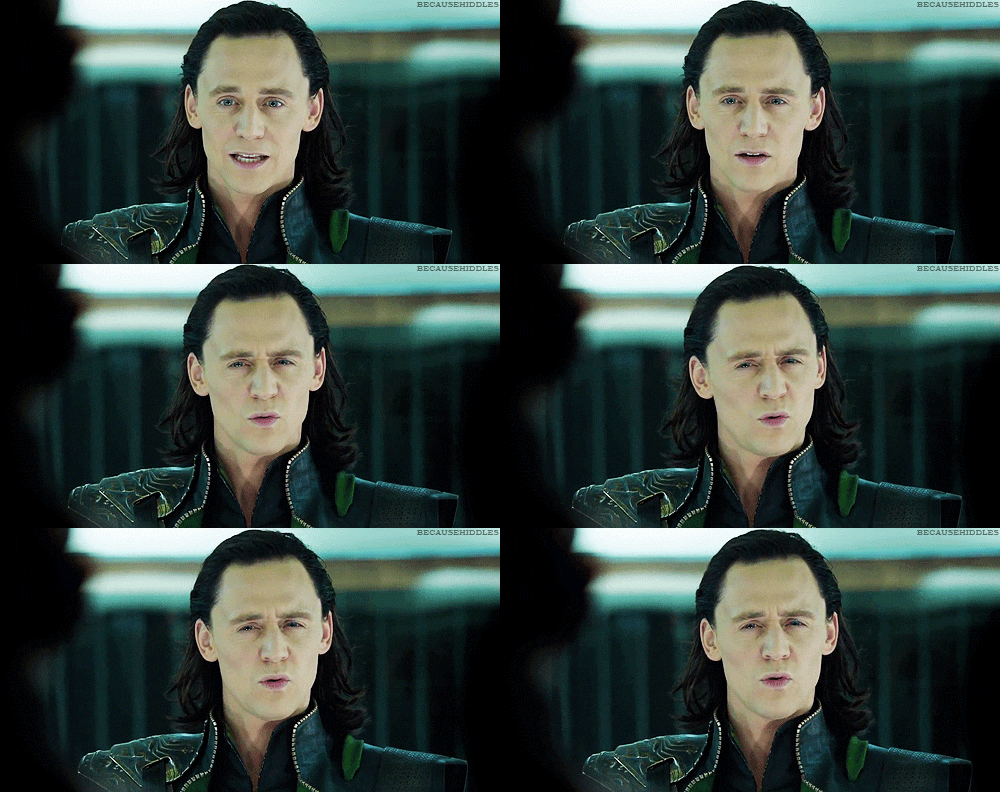
The last thing I’d like to rant about is the villain, Cross. Frankly, he’s terrible. He’s a mustache-twirling caricature, killing in cold blood and selling his knock-off technology to Hydra simply for teh monies. There is some discussion about his deeper character motivations, specifically that he wanted to be Pym’s protege but Pym kept him at arm’s length, creating hurt and frustration. Also there’s sort of a hand-wavey mention that using the shrinking technology too much makes someone go crazy, but...come on. As Havoc himself says, the MCU is a franchise built upon the power of its villains (I’m looking at you, Loki, you beautiful ice-giant you) so this was just disappointing. Corey Stoll does a decent job with what he’s given, bringing enough of a sinister presence to the screen to carry each scene through, but I couldn’t get past the fact that, like many other things in the movie, it should have been better.


A Special Note:   Before I conclude, I’d like to take a moment to talk about something that struck me rather specifically, but which doesn’t fit neatly into like or didn’t-like. It’s not even really an issue of “like,” more a point of construction that I feel bears commenting on.


Pym’s daughter Hope (Evangeline Lilly, of Lost and The Hobbit), represents a new factor in modern comic movies. She has estrangement and Daddy/Daughter issues with Pym senior, (which isn’t new), and she is also somewhat of a romantic interest for Lang (which definitely isn’t new). But she is also someone who desperately wants to follow in her father’s footsteps. There estrangement comes not from her wanting to be free of him, but because, like Cross, she’s mad she’s been kept at arm’s length.


Lilly herself is merely alright at the role. There are complex motivations to the character and I don’t feel she pulled them off well in all cases. Hope works as an administrative assistant to Cross and basically secretly double-crosses him when she reconciles with her father and agrees to help him and Lang break into the company. But when she is on-screen in that role, I didn’t really get a good sense of her duplicity; she is calmly and politely his assistant. For half of the movie, I found myself suspecting her of triple crossing, secretly siding with Cross while pretending to help her father. Spoiler alert, this is not the case, but the fact that I kept expecting it I think speaks to her acting rather than the writing.

But then it also could be implicit suspicion of her haircut, which, with the addition of dem cheekbones, reminded me waaaay too much of Kate Blanchett in Indiana Jones 4 and the associated PTSD memories therein. Also it’s not really flattering on either of them.


Girl, wut.

But back to the point at hand, and right now I’m going to break type from Havoc’s usual M.O. and actually discuss points of a spoiler-y nature, so be warned.

**SPOILER SPOILER SPOILER**


Around the second-act climax, we discover the real reason Pym gave up the technology and became so afraid of it. Apparently back in his day, Antman wasn’t a solo act. He partnered with his wife, who had a similar shrinking-suit and went by the superhero handle of The Wasp. During the Cold War, at one point a Soviet missile was launched at the US and the two of them had to stop it, by the Slim Pickin’s strategy of physically attacking the missile itself. Something went wrong, and time was running out, so without hesitation, Wasp removed this regulating device from her suit and dropped into the “subatomic” realm to slide through the metal plates of the missile, destroy the electronics, and save everyone. Unfortunately, though, without the regulator there was no coming back. Wasp was lost forever. Pym reveals this to Hope in an emotional scene of reconciliation, but my emotional reaction was one of awe.

Because this is the opposite of a fridging”.


Wasp died heroically, of her own choice, which is, in my understanding, the rare exception case of women in comic books, even the superhero ones. Women in the major serials have tended to be killed suddenly and senselessly as emotional plot devices, stripped of agency on both an individual and meta level. No one argues that women in comic stories shouldn’t die at all, but the way those deaths are portrayed does mean a lot. I could go dredge up a bunch of comic-theory articles I’ve read on this to support my point, but instead I’ll cite my own anecdata as proof: I had never even heard of Wasp before this movie, she only had about 10 seconds of screentime in a flashback sequence, but even in that short period of exposure I was fucking. proud. of her.


This brief emotional resonance lasted through the rest of the movie, and came in particularly valuable at the end. And I mean the end end, in the after-the-credits stinger sequence. Pym takes Hope down to his basement and the secret room Lang broke into at the start of the movie. From there he reveals another secret room, storing another copy of the shrinking-suit, albeit with wings, just like the one Wasp had. Pym tells Hope he made this upgraded suit for her mother but never got a chance to give it to her, and has locked it up out of grief ever since. He says that after everything that has happened, he is now ready to pass it on to her, that it’s her birthright, and he knows she can do great things with it. Hope looks at the suit, the camera pans in, she smiles a brief, joyful smile, and says, “It’s about damn time.”

In those four words, I heard so much more than a daughter making a crack at her father. The implication is clear: Hope is to be a superhero, a female superhero. Yes, the MCU has Black Widow, but while she is unquestionably a hero, she is not a superhero. Comic stories represent a kind of modern mythology, especially as these movies have vastly increased their cultural saturation in the modern consciousness. I will remind you that I was completely ignorant of Marvel canon before the movies started coming out, and I am sure I am not alone in discovering it through the movies. To be elevated to the ranks of superhero is akin to demi-godhood, so the fact that we have gone so long without major female representation in the movie pantheon...hurts. It really, honestly hurts. It feels like we’re B-string characters (aka, second-class citizens) in a shared fantasy world, which is especially frustrating considering such worlds were specifically constructed to escape from and rise above the limitations of the actual world.


To further elucidate the frustration, let’s cross the line and look at the other major half of the pantheon: DC. Wonder Woman is not only one of the best-known female superheros, she is one of the best-known superheroes of all time. I’ve never read a single issue or even seen a single episode of the 70’s tv show, but I recognize that spangled outfit just as easily as any emblazoned-S or round-shield-with-a-star-on-it. People have been clamoring, absolutely begging for her to have her own movie, and DC’s knee-jerk response has been, “Oh, America isn’t ready for it.”


Really? Fucking really!? Marvel over here made a movie starring a houseplant and a fucking genetically-engineered mustelid and it made 700 million dollars. Branching out of comics, the Hunger Games movies--starring Katniss Everdeen and a completely unnecessary love triangle that’s gotten thankfully less screentime than in the books--has made 2.2 billion dollars, and the fourth movie isn’t even out yet!!! So don’t go crying to me, DC, about America not being ready. Cause America IS fucking ready, hell the whole goddamn WORLD is fucking ready.


So yeah, even if Evangeline Lilly isn’t great, even is Wasp is part of an ensemble rather than having her own spotlight, I will goddamn take it, and I will goddamn take it gladly.


Because it’s about damn time.


Actually Final Thoughts:  Overall, I think this is a fine movie to help expand on the Marvel portfolio, but missing some of the richness and edginess that is typical of the other movies so far. But I only judge it harshly because of the high bar set by its brethren. When I walked out of the theater with my viewing-partner (the Movie Sergeant?) we agreed that this is somewhere in the B-class of the canon. Not as mind-blowing as Avengers or Captain America: Winter Soldier, much better than Ironman 3, and worlds better than almost anything comparable available at the moment (I’m looking at you, Pixels, you ass-wipe excuse for family entertainment). 


Final Score:  6.5/10


Next Time:  Much to the disappointment of all concerned, I'm sure, we will not be reviewing the aforementioned ass-wiping excuse for family entertainment.  I think instead we shall look for something a bit more... elementary...

The General's Post Summer 2018 Roundup

Let's get back into the swing of things, shall we? The General's Post Summer 2018 Roundup Ant-Man and the Wasp Alternate Ti...