Showing posts with label 4 (Bad). Show all posts

Sunday, September 17, 2017

Logan Lucky


Alternate Title:  Ocean's 5 1/2
                                                                                                                                                            
One sentence synopsis:  Two brothers in West Virginia assemble a team to rob a NASCAR speedway during one of the biggest races of the year.


Things Havoc liked:   I can take or leave Steven Soderbergh. The man makes good movies, at least on occasion, from Ocean's 11 to Magic Mike to Erin Brokovich, but he also makes a whole lot of meandering crap such as Bubble, Che, or Eros (don't ask), and seems to regard filmmaking as an occasion to shower everyone with his insightful views on the world, such as his many public resignations from directing (Logan Lucky being the fifth consecutive "last film" of his, with a sixth in the works for next year), his predilection for pseudonyms (such that nobody's actually sure who the screenwriter of this film is), and his fervent support of internet censorship as a means to save the soul of art (???). That said, when it comes to procedural heist-comedies, at least nowadays, Soderbergh is pretty much the man you look to to get things done. So leaving aside Soderbergh's hangups for the moment, I decided that this one, a redneck-themed remake of Ocean's 11, sounded promising, particularly when it came to the cast.

And what a cast it is. Channing Tatum, a long-time Soderbergh regular, and Adam Driver (of Star Wars), play the Logan brothers, a pair of blue-collar West Virginians, who like all West Virginians in all movies, are fated to suffer under the cruel arm of "the man" while evidencing down-home folksy character and virtue in contrast to the slick hucksterism of the city folk that surround them. Tatum, sadly, gets stuck with not much more than the above character description, but Driver gets a bit more, as a none-too-bright Iraq war vet with a prosthetic arm who gets dragged into his brother's hair-brained scheme for getting rich by means of robbing the Charlotte Motor Speedway on the day of an enormous NASCAR race. Driver's an actor I've become a big fan of in the last couple of years, as every performance he gives is so strikingly different from the previous. This time he plays what amounts to the role of a Steven Soderbergh heist character with stonefaced aplomb, and it's perfect.

Surrounding Tatum and Driver are other actors having a grand old time. Brian Gleeson (son of Brendan) and Jack Quaid (son of Dennis) play the Bang Brothers, two redneck idiots with pretensions of religious scruple who are among the funnier things in the film, and whose older brother is played by Daniel Freaking Craig, James Bond himself, as a safecracker and felon brought along to bring his particular knowledge of homemade explosives into the mix. Craig is goddamned amazing in this movie, a screamingly-funny old lecher of a bomb expert who steals every scene he's in and runs away with them. His role is effectively that of Don Cheedle in the Ocean's movies, but an Appalachia layered over. If you've ever wanted to watch James Bond hit on everything in sight... well you'd watch a James Bond film most likely, but if you wanted to watch him do so in a comedy, this is probably your best bet. If nothing else, Daniel Craig wins his way onto the ever-elongating list of British actors whose American accents are undetectably flawless. It must be all the warm beer...


Things Havoc disliked: So, the whole point of a heist film is to watch the heroes work. To see them undertake a seemingly-impossible task and accomplish it through clever planning, outsmarting their rivals, dumb luck, or whathaveyou. That's the whole reason that heist movies make such great comedies, the entire purpose of the film is to showcase how much smarter one group of characters is than another, and humiliation is the foundation of most comedy. You'd think that Soderbergh, of all directors, would know all this, having now made three Ocean's films (with a fourth in the works), to say nothing of things like Traffic or The Good German, which while not comedies, had labyrinthine plots full of people outwitting one another. And yet, judging from the evidence, either Soderbergh has entirely lost the plot or I have, because I have no goddamn idea what happens in this movie.

Heist plots are complex. They have to be, in order to hold the audience's attention, but the point of the entire exercise is to marvel at how clever the characters (and by extension, the filmmakers) are once we see just how elaborate the plan was, that's the been the genre's mainstay since The Sting for God's sake. Yet the whole last half of Logan Lucky makes no damned sense, not in the more common manner of the characters acting out of character, but in the sense that I literally had, and still have, no idea whatsoever of what was intended to be happening. Once the plot is underway we rapidly lose track of what's going on, to the point where it's not made clear at all if the heist is a success, a failure, or some mixture of the two. To be fair, a certain amount of confusion on those points is only natural to the genre, as a means to build tension if nothing else, but it's customary to at least let the audience in on what the hell the plan actually was before the movie ends. I've seen a lot of movies in the last six and a half years, many with plots far more labyrinthine than anything this movie puts together, but I still wasn't sure of what the hell had happened in this thing until I read the Wikipedia summary in preparation for this review. And even then, I wondered how the article's author had managed to puzzle it out. It's not a matter of artifice or winking or the filmmaker trying to show off how much smarter he is than the audience (which would be bad enough). Necessary information to the interpretation of the events on screen is simply not provided.

And it would be bad enough were the plot simply impenetrable, but there's a lot of strangeness surrounding this film, a lot of fat that went untrimmed, so to speak. Fairly major actors, such as Katie Holmes and Hillary Swank, the former of whom plays Channing Tatum's ex-wife, the latter an FBI agent, are barely in the film, to the point where one wonders if there wasn't a massive editing fiasco somewhere in the movie's production. Holmes is there more or less just to make Tatum look long-suffering and saintly, while Swank only enters the film at the very end, with a role that feels rather like its missing two thirds of its character arc (the awful Louis Gossett Jr. impression she adopts throughout does her no favors either). Seth McFarlaine, of all people, also makes an appearance as a stuck-up British racer straight out of a Ricky Bobby movie, for no reason other than to be annoying and get punched once or twice. Meanwhile the film takes an inordinate amount of time dealing with Tatum's family drama, with his ex-wife (Holmes), his adorable daughter , his ex-wife's husband who is of course an abrupt douchebag with more money than him, etc, etc. Admittedly, this isn't the first heist movie to drum up stock family drama to give the hero a reason to steal things, Ant-Man did much the same, but the difference is that Ant-Man established the family and then left them out of the picture for a while so that the heist could take place. This movie, on the other hand, is the first film I can remember that combines waacky heist hijinx with the tired old question of whether Dad will be able to make his daughter's recital/talent show contest, as though the prospect of goofballs robbing NASCAR wasn't a big enough sell, and what we're really here for is the inevitable moment where the father races in at the last minute and shares and understanding nod with his long-suffering child. Awwww.


Final thoughts:   Logan Lucky is a frustrating movie, as it's nowhere near badly-made enough to actually be bad, but all that means is that we feel resentful that the actually good movie we can see signs of doesn't show up. Craig and Driver are excellent in the thing, don't get me wrong, and some of the fifty-three tangents that the film flies off on are actually pretty funny (the demands that the prisoners make during the prison riot are inspired). But the whole thing plays like a mass of dead-ends, truncated plot elements, and tired cliches, layered over with a thick helping of utter bewilderment as to what is actually going on. I know the film has been praised immodestly by critics and audiences alike, but I'm of no use to anyone if I fail to give my honest opinion. And my honest opinion is that this movie, like so much of Soderbergh work, enthusiastically fails to work.

Still, if you're a hardcore Daniel Craig fan, and frankly who isn't, it's not the worst thing you'll have been forced to put up with.


Final Score:  4.5/10


Next Time:  Hell or High Water 2:  Hotter Hell.  Higher Water.

Sunday, June 4, 2017

Colossal


Alternate Title:  Gone Kaiju
                                                                                                                                                            
One sentence synopsis:  Following a traumatic breakup and dealing with spiraling alcoholism, a woman returns to her hometown to reconnect with old friends just as a tremendous monster begins attacking a city on the far side of the world.


Things Havoc liked:  I had an astoundingly hard time coming up with the synopsis above, because Colossal, whatever else it might be, is a really weird movie.

A personal project directed and written by Spanish director Nacho Vigalondo (none of whose previous work I am familiar with), Colossal was a movie I went to see entirely on spec. A woman named Gloria (Anne Hathaway), unemployed and a raging alcoholic, breaks up with her boyfriend (Beauty and the Beast's Dan Stevens) in New York City, and moves back to her hometown somewhere in small town middle America. There, she meets an old childhood friend (Jason Sudeikis), who gives her a job at his bar to get back on her feet, and seems to be interested in kindling a relationship, introducing her to his friends around town and helping her put her place in order. What sounds like a setup for a particularly boring romantic dramady is salvaged however, by two complicating factors. One of these factors is that a two hundred foot reptilian monster begins assaulting the city of Seoul, South Korea, smashing things, killing people, and vanishing into thin air from whence it came. Over the course of several nights of these rampages broadcast on live news and YouTube, Gloria begins to realize that the monster is mirroring her own actions whenever she stumbles home drunk at eight in the morning through a disused playground somewhere in town, and that she is consequently responsible for the murder of hundreds and the destruction of much of Seoul. The other one of these factors is actually important.

But... before we get to that, let's talk about what we've got here. All of the above actors, particularly Hathaway, are sublime. Of course Anne Hathaway is always sublime, even in bad movies like Bride Wars or Alice in Wonderland. Her character is a blind drunk, accustomed to getting away with murder (metaphorically, one hopes) by acting cute and batting her eyes, and pivoting instantly to hyper-serious when confronted with real consequences, such as being thrown out of her home or realizing that she may have started World War III by accident. A great early sequence has Hathaway effortlessly expressing total desperation, shock, and misery, all without a word, after her boyfriend throws her own of their shared apartment and her drunken friends carry on carousing behind her, oblivious. Given the weirdness of a premise that requires her to discover that she can control Godzilla, she, and the movie, plays things very down to earth, as she struggles to find a way to make things right without the wider world discovering what is actually going on. Vigalondo's direction is light on effects and heavy on quotidian observation (he wrote, smugly), with the emphasis firmly on the characters and their reactions to what, in a worse movie, would be a world-shattering discovery leading to super-heroism or chase scenes, and in this movie leads to slurred conversations in bars while watching events play out on television. In fact, one of the funniest things I've seen in years is a CNN report that plays a YouTube video of one of the Kaiju "incidents", complete with internet memes and embellishments. I almost choked.

But I said a moment ago that there was another factor that was actually important. What factor is this, you ask? It's the character of Jason Sudeikis' Oscar, who starts the movie off as a friendly, neighborhood bar-owner, willing to help Gloria out with a job and spare furniture, and ends it as... well... one of the most toxic, abusive, controlling people that I have ever seen applied to screen. It's not that Oscar is a monster, although he is, it's that the movie does a sterling job of portraying what an abusive person actually looks and acts like, rather than the cartoon psychopaths that are generally put on screen. His behavior is cyclical and self-delusional, with subtle warning signs initially before spiraling into full-blown narcissistic delusion and aggressive, controlling behavior, fueled, in-part, by his own incipient alcoholism and circumstantial opportunities (the aforementioned Kaiju situation) to force his fantasies into reality. Sudeikis, an SNL alum, is an actor I've known about forever, but I don't think I've ever seen before this, at least not in movies, and he's amazing. This is a role that most directors would fill with guys like Vince Vaughn or Billy Campbell, tough-looking creepers who can loom menacingly and appear monstrous at the drop of a hat, with the usual consequence that one wonders just how the abused protagonist couldn't see this coming. But this film has Jason Sudeikis, of Mother's Day and Zach Galifianakis movies, a guy whose established movie persona and look are about as threatening as a bowl of soup, turning on the repressed rage and toxicity, rather than unconvincingly turning it off. It's an incredibly good performance, a star-making performance, helped by a restrained script that only provides the barest glimpses of what must be going on underneath the surface of the character, letting the audience figure it out for themselves.


Things Havoc disliked: So... here's the thing...

Some films are just bad. That's hardly a shocking statement. Some are the product of bad scripts or writing, some of terrible performances, some of awful direction, a rare few are victims of all of the above. Over the years I've been doing this, in fact, I've come to appreciate that there are an infinite number of ways to make a bad movie, and in the aftermath of one, it is often not that easy to sit down and parse out what actually went wrong. That's one of the reasons (beyond simple procrastination) why these reviews take so long. You need to give a movie time to percolate, time to settle in your mind. Sometimes you simply need to take the time to clarify your thoughts on a film before you can start speaking intelligently about it. And this is often the case for films, like this one, that are objectively very well made, with good acting and good writing and a good director overseeing it all, and yet which, for whatever reason, I found I didn't like.

Why? What more could I be asking for beyond a bunch of good actors acting well together in a refreshing story that occasionally had me howling in laughter? Initially, I thought that the problem was that the movie reminded me too much of films like Enough, the 2002 Michael Apted "thriller" that starred Jennifer Lopez as a woman fleeing her cartoonishly-evil ex-husband, who would sneer at the camera before monologuing about how deliciously evil he was and how helpless she was to thwart him. But as I mentioned above, that comparison isn't fair, as Sudeikis' performance (and, frankly, Vigalondo's directing) is miles beyond the cheap mawkishness of that early-00s snoozer (there's a reason the 1997-2004 period is now regarded as the Dark Age of Cinema). What, then, was the problem? Was there something more fundamental in this film that made me react this way, some deep-rooted issue of script or premise? Or was it instead a subjective matter, and whatever it was had nothing to do with the movie at all, just a facet of the baggage that all critics, no matter how objective they try to be, bring into the theater with them?

Maybe. Or maybe the problem lies, not with Enough, but with a movie from 2014 called Gone Girl.

Long-time readers will remember Gone Girl, the David Fincher film based on a Gillian Flynn book, the one that starred Rosamund Pike and Ben Affleck at the top of their form, with a labyrinthine script involving insanity, betrayal, murder, manipulation, and the hunger for scripted villains by mass media. It was, by many standards, a great film, well created and shot, and written crisply enough that even Tyler Perry wound up looking good. And I hated it. Not because of any of the things above, but because I concluded, following a similar agonizing process to the one above, that it was a shallow, manipulative piece, coded in the language of misogynist sexism, one that romanticized all of its men, no matter how awful, and condemned all of its women, no matter how unbelievable. It was a movie that pretended to show the steamy underworld of obsession and manipulation, but refused to play fair with its characters, with the audience, or with the scenario it had set up, preferring instead to deal in thin stereotypes hidden by good performances and direction. At the time I reviewed Gone Girl, I said that I rejected the film, in part because "If a movie was made this way about men (and there have been some), I and others would be trumpeting outrage to the skies." And readers, I'm sad to report that the time has come, because Colossal is that movie.

The problem isn't Sudeikis' character, not really. He's an obsessive, evil, manipulative person, willing to commit horrific acts so as to control Gloria's life, but that much isn't sexism any more than Norman Bates was, it's a character of terrible depths played brilliantly, and one we don't often get to see, at least not with this spin. No, the problem, as always, is in the context in which we get to meet this character, because this isn't a simple story of girl-goes-home-and-is-manipulated-by-monster, Kaiju-laden or otherwise, and the movie treats it like it is. Gloria, lest we be reminded, is herself a blind drunk, one who, even after discovering this miraculous capacity to control the actions of Godzilla, drunkenly plays with the notion and shows off to her friends, resulting in the deaths of thousands and the obliteration of large portions of Seoul. It would be one thing if the story were one of Gloria learning from her terrible mistakes and taking back control of her life, while Oscar slides deeper into the throes of his own demons, but it's not, not really. Instead, Gloria is instantly forgiven everything that she's done wrong because... well because she's the heroine, I guess. She cures her raging alcoholism, a disease that has led her to kill thousands of people, offscreen, suddenly no longer suffering from it because she apparently decided not to. She does this, despite still working in a bar, surrounded by alcohol, an environment no alcoholic on Earth has sufficient willpower to resist. And just as she does so, everyone else in the movie swallows their evil pill, so that she can appear more saintly. Not only does Oscar take a turn from "weird and creepy" to "utterly irredeemable" (which is fine), but her ex-boyfriend (Stevens), the one who broke up with her in the beginning of the film because he didn't know what else to do, and has spent the movie calling her up and begging her to get help, even apologizing for sounding so superior and lecturing about it, the one who turns up in her hometown, having faked a buisness trip for the purpose, because he's afraid that she may be in real trouble (which she absolutely is), this boyfriend suddenly turns around and becomes a negging, verbally abusive, dismissive egomaniac, denigrating her attempts to do exactly the things he had previously been begging her to do, just so that when she inevitably tells him off and excises him from her life, the audience can feel good about cheering.

But that's not the only character this happens to. Consider Tim Blake Nelson, a wonderful character actor whom I've adored in films like Holes, Syriana, and O Brother, Where Art Thou. He plays Garth, an ex-drug abuser and friend of Oscar, whom Oscar turns on one night in a drunken rant, exposing his past as a drug addict and belittling him mercilessly. He tells Oscar off, and... is never seen again. Despite the fact that his character has been set up heavily as an important part of the story, and the fact that he knows the secret about the Kaiju, one of the most explosive in the history of mankind, he vanishes outright from the rest of the film, something the film tries to frame as moral cowardice, and I am tempted to re-frame as the film being afraid that having a male character who isn't an abusive monster will undercut their heroine. For proof of this, look no further than Austin Stowell, of Whiplash and Bridge of Spies, Oscar's other friend, with whom Gloria has a brief fling, prior to him turning into a doormat and an enabler for all of Oscar's worst habits, actively abetting him in the murder of thousands of people with no reason given beyond the fact that, well, he's a man, and you know how they are. I don't mind that these characters are all flawed, or addicts, or stupid, or abusive, or even monstrous. I've loved many a film with many a character that evidenced all of those things, some with much less acting skill than is on display here. I mind that the movie is coded such that they are those things because they're men. And that Gloria, no matter what she does, no matter who she kills, is not any of those things, because she isn't.


Final thoughts:   It should be noted that the people I saw this movie with had no such experience, and thought the movie was interesting and well made, and rated it highly. I do not claim that they are necessarily wrong, but I will note that I felt the same way about Gone Girl when I left the theater, and that it was only after much time and conversation with those who had reacted negatively to that film's latent misogyny that I came to realize that I hated it. I would not go so far as to say that I hated Colossal the same way I ultimately did Gone Girl, but I did not like it, not when I saw it and even less now, with several weeks' distance to think about the matter. The issue isn't just that it stereotypes men as abusive, manipulative monsters, although it absolutely does this. It's that in doing so, it also manages to imply that the only way the audience will empathize with a woman in the throes of an abusive relationship is by making her literally the only likable person in existence, beatifying her by proxy despite the fact that she manifests many of the same behaviors as everyone else. The only difference is that, as a woman, she's infallible, while men are the scum of creation. And if you think I'm laying this on too thick, consider for a moment that the character is named Gloria, and that one of the final scenes has her literally walking on water.

Enough then. I don't expect that many people will hate Colossal, in fact I expect quite the opposite, as the movie is unquestionably well made and acted by all concerned. I don't begrudge those who find value in the exercise as a result, but I cannot number myself among them. I mentioned in the Gone Girl review that a good film can be made about any subject, but only if it made with honesty, and like that film, Colossal is a crude simplification that gathers airs of depth because of its evident technical virtues. I denounced Gone Girl because of its insidious misogyny despite these virtues, and I will not refrain in this case simply because the shoe is on the other foot. To do anything else would be dishonest, and that would make me no better than the film itself.

Final Score:  4/10


Next Time:  Magic, Mayhem, and Mad Science.

Wednesday, May 3, 2017

Ghost in the Shell


Alternate Title:  Whites in the Film
                                                                                                                                                            
One sentence synopsis:  A special forces operative with a cyborg body confronts the truth of her own past in a techno-futurist Tokyo.


Things Havoc liked:  Anime is not, by and large, my thing. Oh I've seen the classics, Akira, the Miyazaki films, Paprika, and so forth, but the conventions and cultural stamps of Anime just aren't really what appeal to me, absent a handful of exceptions. One of the biggest of these exceptions, however, was Ghost in the Shell, an animated series (and pair of films) about an anti-terrorist unit in nano-tech-era Tokyo, one that not only included excellent action and cool technological gadgets, but also involved byzantine political plots, and lengthy discussions on the ethics, philosophies, and new questions brought about by the logical extremes of the information age. Though, as I mentioned, the series spawned its own animated films, rumors of a live action Hollywood adaptation have abounded for years. And now they've been finally brought to fruition, albeit in a form guaranteed to piss off a huge segment of the population that would naturally be inclined to see the movie. Well done, you geniuses of Hollywood, well done.

So let's start with what works, shall we?

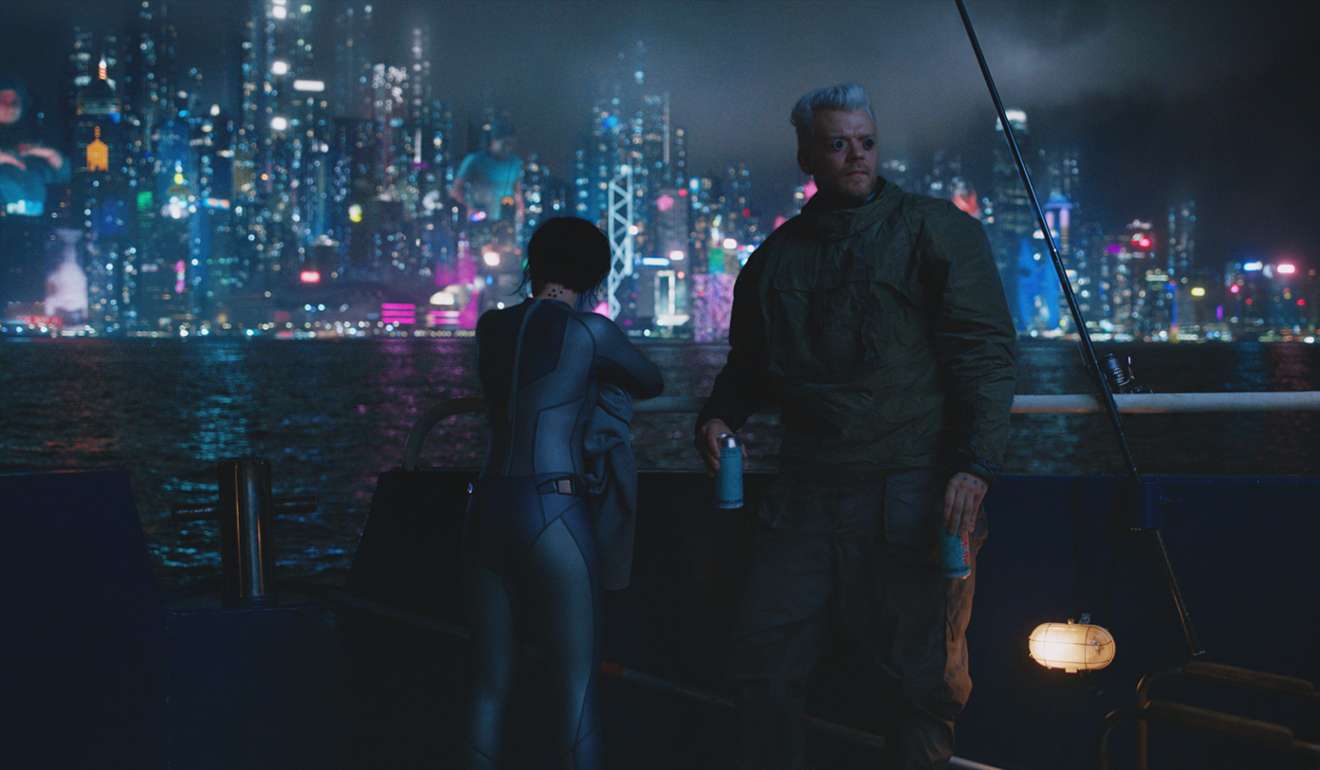
Ghost in the Shell, directed by Snow White and the Huntsman alum Rupert Sanders, is first and foremost a gorgeous film, stunningly beautiful in sequence after sequence. Much of the credit for this belongs rightly to veteran cinematographer Jess Hall, of Brideshead Revisited, Hot Fuzz, and a handful of other films. It showcases a futurist society in all its splendor and sleaze, but unlike the usual cyberpunk ultra-metropoli that one encounters occasionally in the movies, this one is filmed (usually) in the full light of day, or the sharp neon-tinted glow of a lit night. It's as if Wes Anderson decided to re-shoot a Ridley Scott film, it's that stylistically impressive, with a full color palate and plenty of set-piece imagery drawn, not merely from someone's vibrant (or depraved) imagination, but also from the anime itself. Indeed, several shots and even whole scenes are re-created from the original anime film shot for shot, including a couple of the most visually memorable ones from the entire enterprise, including a battle between a gun-wielding terrorist and an invisible assailant, filmed on a flooded street, and a sequence inside a ruined zen-temple-turned-arena featuring the aforementioned assailant and a walking tank designed to resemble a spider. The color palate is rich and deep and vibrant, with garish imagery that could have been rotoscoped off of a high-quality cartoon, contrasted with inky shadows and stark relief shots. Given that most cyberpunk seems to take place entirely within a New Jersey trash dump at three in the morning during Hurricane Sandy, this sort of thing is a welcome addition to the genre. So gorgeous was the imagery in this film, that I broke a cardinal rule of mine and saw it in IMAX 3D (the fake kind), and was not disappointed, though as always the 3D merely served to not suck the life out of the film, rather than adding much.

There are other matters of use here as well. The score, by veteran film scorer Clint Mansell, is superb, an electro-choral orchestral soundtrack that sets a techno-futurist patina on the entire proceeding. I've been a massive fan of Mansell's work since Requiem for a Dream, and he does not fail to deliver here, particularly during intense action sequences, which are not scored with pulse-pounding thriller beats, but with strange ethereal music, as though the action were but the surface elements of the true depths being portrayed. The actors themselves, meanwhile, vary widely in quality and usefulness, but particular mention should go to Danish actor Pilou Asbæk, who plays Batou, the second in command of the counter-terrorist unit the movie circulates around, as well as legendary Japanese actor/filmmaker "Beat" Takeshi Kitano, who plays the Section chief of the selfsame organization. Asbæk's character is not quite (or at all) the same as the one in the show I so loved, but I've never permitted myself to condemn a film for not being like another film I would have preferred to see, and his portrayal is actually fine, in keeping with the style of the movie this is, a monotone professional soldier and world-weary loner who keeps to himself and watches his teammates' back. As to Kitano, his character of Chief Aramaki was my favorite in the show, an old man whose experience in penetrating political and terrorist conspiracies to get to the truth of the matter was unparalleled. Kitano doesn't get to do a lot of that sort of thing, but he still gets several awesome sequences in his own right, where the movie laboriously reveals that he was five steps ahead of his opposition all along. It's nothing revolutionary, but I just so enjoy watching Kitano do his thing, that I couldn't help but enjoy every moment he was on screen.


Things Havoc disliked: Let's talk about the elephant in the room here.

Motoko Kusinagi, the main character of every version of Ghost in the Shell that there is, is Japanese. Scarlett Johansson, the actor who was selected to play her in this movie, is white. Not surprisingly, this has attracted a hell of a lot of criticism from a number of sources accusing the studio of whitewashing the movie to suit their own racist, or at least mercenary, ends. This is not the first film I've come across that has done such a thing. Both The Flowers of War and Doctor Strange were pilloried for supposedly placing white actors in Asian roles, to say nothing of the furor that erupted over Cloud Atlas. With all three of the aforementioned films, I denounced this interpretation, in the first case because it was bullshit (the character in question was white), in the second case because the movie could not have been made without making a change of the sort (such is the reality of PRC censorship), and in the third because the very purpose of the movie was to break the laws of race and gender. I believe I consequently have plenty of standing as not being some sort of easily-offended keyboard warrior looking to show off my progressive credentials to my echo chamber. And as such, I'd like you all to gauge my criticisms in context when I say that casting Scarlett Johansson as Major Kusinagi in a Ghost in the Shell movie is utter bullshit.

Forget, for a moment, that Scarlett Johansson is simply not a good actress, or at least is a very limited one. Forget that her vaunted "cyberpunk credentials" are based around a set of godawful movies that start with Lucy and get worse from there. Forget the thin excuses about whether a movie that didn't have a recognizable name at the top of the marquis would appeal to American audiences (because Lord knows the one we got with that name still managed to bomb severely). This casting decision is bullshit because it is not the only one in the movie. Not only is the main character of the film switched over inexplicably from a Japanese character to a white one, but so is everyone else in the goddamn film. The main villain, the secondary members of the squad, the scientists and businessmen at the heart of the conspiracy, everyone with a speaking role has been re-cast from their original race. In fairness to the filmmakers, not all of the re-casts are with white actors, yet somehow, as if by accident, all the characters that have nothing to do with anything, the bit characters that barely have lines or any purpose in the film, those are the ones with black and Hispanic and Asian actors, while all the actual roles, including multiple major characters from the original series/films, all just happen to have white people in them. Trying to play this off as nothing more than a co-incidence is worse than simple run-of-the-mill racism, it's the sort of racism that insults your intelligence while it's doing it.

And you know what's worse? The movie knows all this. Why else would they have basically built the entire plot of the story around the question of Kusinagi's origins, and how it is that she came to look like Scarlett Johansson, throwing out all of the byzantine plots, political intrigue, and cyber-philosophy that was at the core of the original series. Horrible as I found this decision, it isn't in and of itself a bad thing. There are movies (World War Z comes to mind) that have entirely discarded their source material and still made something great, and there is a version of this film I can imagine wherein the fact of casting a white actress to play a Japanese role would be used as an examination of the fetishization of white women in Japan. But this film is written by none other than Ehren "Fucking" Kruger, one of, if not the worst writers in all of Hollywood, and given that Tyler Perry and Adam Sandler still have careers, boy is that saying something. The writing in this film is consequently terrible as one might expect from the pen of the auteur of such works as Transformers 2, 3, and 4, The Brothers Grimm, and The Ring Two. Every line in the film is stilted, robotic, and entirely functional, serving to inform the audience that a certain character is the designated evil business leader, or the designated conflicted scientist, or that the plot is about to enter action section 4b (sub-paragraph nine). An example midway through the film comes when Johansson inexplicably walks into the home of an older Japanese woman, who, without prompting, invites her to have a cup of tea, and talks about how she rarely has visitors now that her daughter, who would be about Johansson's age, disappeared under circumstances that nobody knows about, and how much she misses how she used to do things that Johansson also does. WHERE COULD THIS PLOT POSSIBLY BE GOING, THE WORLD WONDERS?! As a result of all this, the entire film feels flat and empty, a soulless exercise in violence and pretty pictures, where every scene serves simply to get us to the next scene along the painfully pre-established "revelations" that anyone with half a working brainstem will have figured out five seconds into the film, and must then spend the next hour and forty-six minutes waiting for the movie to catch up. We get no sense of the character of the Major, of the villain, of anyone really, for the simple reason that nobody preparing the script had the skill to give them any.


Final thoughts:   Ghost in the Shell is a frustrating film, far more so than it really deserves, to be honest. It would be easy to dismiss it as the product of studio-sanctioned racial games, along the lines of the abortion that was The Last Airbender, or even simply as a low-rent animesploitation flick like Ultraviolet. But the sad part is that the movie does have virtues locked away inside it, namely its gorgeous style and distinctive visual world, one realized in loving, painstaking detail by aficionados of the genre and the source material. Yet all the efforts of a great many talented people have been committed in service of a film that is, when you get past the outrage, simply bad, a victim of awful writing, poor scripting, terrible casting, and hackneyed production overall.

At time of writing, Ghost in the Shell is in the process of losing Paramount roughly 60 million dollars, which is only appropriate given what it is. And yet what gets me is that the nominal argument for doing all of this crap has always been that in order to attract an audience, such films need to whitewash simply to get a big name actor. Leaving aside the question of whether this is a moral act or not, the fact that the movie did this and then lost a pile of money anyway, just like all the other movies that have done this (Last Airbender, Gods and Kings, 21, Aloha) should serve to torpedo this particular line of argument. Of course Hollywood is a place where people need a long time and a lot of failures to learn their lessons. But if Ghost in the Shell can serve as a stepping stone in that particular path, then maybe there was a point to the entire exercise after all.

And if not, well, maybe the DVD version will let you mute the dialogue.

Final Score:  4.5/10


Next Time:  A daring and fearless look into the philosophical nature of man.

Sunday, November 13, 2016

The General's Post Fall Roundup

And now, a note from the General

Hello again, ladies and gentlemen. Following a long break in which I had to re-charge my batteries and participate in other, non-cinematic activities, I have finally returned to the fold to do a little bit of catching up. The movies below were ones that I saw whilst taking my little break, and as I would not dream of forgoing the chance to tell you all what I think about them, I have provided my customary little summaries below. Here's to Oscar season at last, and a final race to the end of 2016!


The General's Post Fall Roundup


The Lovers and the Despot

Alternate Title:  This is Still a True Story

One sentence synopsis:    A South Korean Actress and her ex-husband, a famous Director, are abducted by North Korean Kidnappers and forced to make films for Kim Jong Il.


The Verdict: As you may recall from my completely honest and entirely reasonable review of Sony's hacked film The Interview, North Korea and I have a tempestuous relationship when it comes to movies (something I'm sure they share with nobody else). Yet despite all my attempts at hyperbole and outrage at some new gyration of the hermit-kingdom's antics, North Korea is a stranger place than any of us can possibly imagine, with a whole host of strange and inexplicable behaviors that exceed those of rogue states and enter those of Bond villains. This is a country that once nearly started a war over who was allowed to cut a tree down in the Korean DMZ, who spent a month and a half breathlessly reporting on the progress of their invincible armies' conquest of the United States, and who blew up part of the South Korean cabinet for reasons I don't think anyone has ever figured out. But like a lot of strange cult-of-personality regimes, North Korea does have a slight bit of method to their madness, particularly their obsession with art and the political implications and international prestige purposes thereof. And so it was that we come to the story of a kidnapping.

The Lovers and the Despot is the story of South Korean actress Choi Eun-hee, once one of the greatest box office draws in all of South Korea, and her philandering, artistically-obsessed, outspoken director-husband, Shin Sang-ok, once touted (briefly) as Korea's answer to Japan's Akira Kurosawa. In the late 70s, amidst political turmoil in South Korea and dwindling fame as an actress, Choi was lured to Hong Kong under the guise of a film project, and kidnapped by North Korean agents under what appears to be the personal order of Kim Jong-il himself, who set her up as a kept guest and asked her to make films for North Korea, whose film output was so stagnant and poor quality that even Kim himself regarded their movies as nothing but tripe. Initially reluctant, she was eventually convinced to participate in this mad scheme after the arrival of her ex-husband Shin, who was either kidnapped himself, or made his way there voluntarily (reports vary). Together, they were compelled to re-marry, and became the leading couple of North Korean cinema, working there for eight years, attending film festivals and making a great many movies, before finally making their escape to the American embassy in Vienna.

Too weird to be true? This is North Korea, who once sent special forces commandos to beaches in Japan to kidnap teenagers and force them to teach Japanese to their army units. But what's compelling about this documentary isn't how strange it is, to be honest, but how... normal it is. Choi and Shin got it into their heads to record their conversations with Kim Jong-il (the first such recordings ever to be made), and what we consequently have is a candid, unscripted look at one of the most secretive and strangest figures in the late 20th century, the most awkward dictator in history, who comes across like a drooling fanboy intimidated by the artistic talents around him (Hitler is supposed to have acted similarly among stars of stage and screen). One might expect that the films Kim demanded would be nothing but propaganda, but no. Kim wanted prestige, particularly international prestige, and seems to have given his pet filmmakers carte blanche to do whatever they wanted, ignoring the dictates of his own propaganda ministry, including the first love story ever filmed in North Korea, lush medieval epics, and even a Godzilla movie (yes, there is a North Korean Godzilla movie in existence. I must have it.) Though the film never softpedals the horrors that North Korea was and remains capable of, they also make clear what sort of exhilaration can come from being the favorite of an absolute God-Emperor like Kim, particularly for filmmakers whose stars were already in decline back home.

The Lovers and the Despot his not a perfect documentary, as the story it tells winds up being just about what you think it's going to be, save in details, and because frustrating gaps still remain in it, such as the question everyone seems to be tiptoeing around as to whether Shin was or was not kidnapped. But it is still a look at a subject it is rather hard to get a good look at, and yet another tale from the hermit-kingdom of North Korea to make one marvel at just how strange the world can be at times.

Final Score:  7/10


o-o-o-o-o


The Magnificent Seven

Alternate Title:  The Mediocre Several

One sentence synopsis:   Seven disparate fighters in the Old West team up to stop a mining baron from destroying and slaughtering a small town of pioneers.

The Verdict:  Speaking of Akira Kurosawa, we have before us a remake of a remake of his greatest work. Goody.

Seven Samurai was a tremendous movie in every sense, and like most tremendous movies in every sense, has been copied a thousand times by every filmmaker who comes along looking to kick-start their career. John Sturges, of Ice Station Zebra, Gunfight at the O.K. Corral (a musical version of the Wyatt Earp story), and The Great Escape, did so in 1960 with the original Magnificent Seven, a movie that starred Yul Brynner, Eli Wallach, Steven McQueen, and Charles Bronson, and should really have been more awesome given the cast I just cited. But that was the early sixties, and here we are in the Year of our Lord, 2016, with an Antoine Fuqua-directed remake. Given that the original Kurosawa film all the way back at the beginning of this chain was one of the best movies ever made, is there a chance that the man behind Training Day could produce magic out of this?

No. No there was not. You see, Antoine Fuqua is just not a good director, Training Day notwithstanding. With the exception of his one great masterpiece, a movie that coincidentally (or not) also starred Ethan Hawke and Denzel Washington, all he's ever made is a slew of crap such as The Replacement Killers, King Arthur, Olympus has Fallen, or The Equalizer. His version of the Magnificent Seven is par for the course in every way, a big, stupid action fest in which characters do dumb things for no reason other than the notion that they might look good on screen. I usually call this "xXx-syndrome", save that unlike xXx, this movie doesn't actually get the stunts correct, letting signature moments and scenes either run on way too long (such as a sequence wherein eighty-six bad guys to not shoot Chris Pratt for no reason at all, thus getting themselves killed), or not long enough (such as a culmination fight between Martin Sensmeier's Commanche warrior and a rival evil Indian, which ends in about five tenths of a second). How Fuqua, who has a twenty-year history with directing action movies, hasn't figured out certain basic truths yet is beyond me, but you cannot produce tension by having a hero effortlessly slaughter thirty mooks without breaking a sweat, nor are audiences so innocent in these days that they can't figure out that a hero who smiles and says goodbye to his love interest before mounting his horse and riding towards the villains to the accompaniment of stirring orchestral music has finally lost his character-shield and may now reach a sticky end.

Yes, the cast is pretty decent, at least as a theoretical cast, and not as an actual one. Denzel Washington and Ethan Hawke are about as good as they ever are, even in an Antoine Fuqua movie, which as we've established, is nothing new for them. The former plays the leader of the titular seven, and survives the film, as is customary for Washington, by downplaying everything and acting like the only adult in the room, while Hawke plays a Louisiana gunfighter of some repute (but no accent), who actually does a decent job alongside companion and life coach Lee Byung-hun, who gets the James Coburn role from the original as the quiet, knife-wielding assassin. Chris Pratt on the other hand, whom I love dearly in all manner of movies, is just not very good in this one, which makes no sense to me, given that the role of a cocky hotshot cowboy should have been right up his alley. I blame the direction, frankly, as Pratt's character is way too over-saturated in the film, with everything he does buttressed by shot selections, and especially a score (the late, great, James Horner, of Titanic, Braveheart, and, The Land Before Time, and The Wrath of Khan) which seems designed to make absolutely certain nobody in the audience can mistake him for anything but the designated charming rogue. Everyone else in the movie is completely forgettable, including Peter Sarsgaard as a typically slimy villain, save only for Vincent D'Onofrio, a man I generally have little good to say about, but who here plays a mountain man who has plainly gone crazy in the wilderness, and who, in a movie filled with over-choreographed stuntwork, stumbles blindly about like a drunken bull, screaming incoherent gibberish and murdering people with an axe. It's something.

Enough said, really. The Magnificent Seven is a boring movie that rises just enough off the strength of its cast to barely hit the mediocre bar. It's a film that will, I expect, be completely forgotten until it comes time to make yet another remake of Seven Samurai, which judging from the state of Hollywood, should take about ten minutes.

Final Score:  4.5/10


o-o-o-o-o


Queen of Katwe

Alternate Title:  Zugzwang

One sentence synopsis:    An impoverished girl in the slums of Uganda is taught to play chess by her youth worker and becomes an international prodigy.


The Verdict:  When the trailers fail me, and they so often do, I find myself having to go see movies "on spec", by which I mean basing my decisions around who's in the movies, who made them, and what they're about. So if you want to know why I went to see a Disney movie about chess prodigies, look no further than the cast, which includes David Oyelowo and Lupita Nyong'o (the former of a bunch of recent films including Selma, the latter of 12 Years a Slave), and the director, Indian-American filmmaker Mira Nair, of Salaam, Bombay! and Monsoon Wedding. FIlming on location in the Katwe slums of Kampala, Uganda, Nair used all local actors (save of course for the above-mentioned marquis ones) to produce a film about poverty and escape provided by chess. I felt I had to try it.

And... no. No it didn't work. And I feel bad about reporting that it didn't work, because like all movie critics, I like the concept of the story and want to give the film a pass for it, but this is not charity and I am not trying to praise movies because of their social content. The base fact is that when you hire non-actors for your movie, you're liable to get all sorts of things, but unlikely in the extreme for any of those things to be "acting". Nobody in this movie, save for Nyong'o and Oyelowo, can act. Nobody. Not the lead actress, a young Ugandan named Madina Nalwanga, not the many other children involved in the film, who have no idea what they are doing in front of a camera and have not been instructed, not even the other adults in the movie, who seem to have been told to overact as much as possible so as to make sure that the audience knows what they're saying. The script, meanwhile, is the most basic Disney-sports-movie fare you can imagine, following the exact same trajectory as Cool Runnings (for instance) save without the local color and humor that made that movie so watchable. Most of the film, indeed, seems to be filler material, as characters narrate each others' actions to one another in slow, laborious scenes that lack any punch or interest. If it weren't for the pedigree of the filmmakers here, I frankly would have called this a first-time effort from an amateur director. Maybe there were budgetary restrictions, maybe the biographical nature of the film got in the way, or maybe nobody was willing to take any risks with a "heartwarming, feelgood movie," but the overall effect is surprisingly poor, and leads to long stretches of the film rendered boring as paste by the simple fact that nothing is allowed to happen.

I don't want to pile it onto a basic movie like this one too thick, as the film is hardly some kind of crime against sense and cinema, but spec only gets you so far. If you want praise from me, you need to actually make a good film. And Queen of Katwe is not one.

Final Score:  4/10


o-o-o-o-o


The Accountant

Alternate Title:  Number Crunching

One sentence synopsis:   A math savant with high-functioning Autism uncovers a conspiracy to defraud a major robotics company and murder the only witness.


The Verdict:  In 2003, Ben Affleck, then in the middle of the tailspin portion of his career, appeared in a superhero movie by the name of Daredevil. It sucked, miserably, and contributed to such a nexus of failure that year that Affleck abandoned superhero movies entirely in favor of more challenging work in more interesting movies such as Hollywoodland, Gone Girl, The Town, and Argo, the latter two of which he directed, and the last of which earned him an Oscar. In defiance of expectations from the last decade, Affleck is now a successful, respected, actor and director, a powerful man in Hollywood, capable and apparently willing to chose his own scripts. And yet the superhero bug never really seems to have left him. Hollywoodland involved him playing Superman after all (sort of), and this year, Affleck engaged in the double-whammy of playing not one but two superheros, first as Batman in DC's flagship Batman v. Superman, and second as an autistic killing machine in the movie we have before us here. The former, I need not tell you, was a disaster on the level of the Hindenburg explosion. How was the latter you ask?

Actually... pretty good.

Yeah, this one surprises me too, guys, but The Accountant, a movie in which Ben Affleck plays an autistic savant who happens to have been trained by his special-forces father to be a unstoppable killing machine as well as a mathematical prodigy, is a damn fine little movie, not because it makes a whole lot of sense, but because it involves good actors doing what they do best while good cinematographers capture them doing it, and that's a formula that will take you far with me. Ben Affleck is one such good actor, playing a role that could easily have been either silly or offensive, and in fact which ten years ago probably would have been both. His character's concept is manifestly ridiculous, but Affleck plays it sermon-straight, as a high-functioning autist who has developed a lengthy and complex series of coping mechanisms to deal with the nature of his condition, from sensory-overload chambers to repetitive tics. I would not call the movie the most er... realistic take on Autism and its many varieties, but the filmmakers clearly knew that they were treading on thin ice with this one and took active steps to make the movie into something like what Arnold Schwarzenegger would make if you told him to create an Autism Speaks commercial.

The rest of the cast is just as good, from the always-enjoyable J. K. Simmons, playing a treasury department director who has been chasing the mysterious "accountant" for decades, to John Lithgow, playing the head of the robotics company that all of this winds up landing upon, and Anna Kendrick, as a young in-house accountant who serves as a sort of "sidekick" (I hesitate to say love interest, given the workings of the film). But the real meat of the movie is the action, which I am satisfied to report is some of the best I've seen all year. There's been a trend over the last eighteen months or so of action directors finally starting to eschew the whole Jason Bourne-style shaky-cam style of cinematic combat for a cleaner, more focused style that I choose to call the "John Wick". The Accountant follows this trend, shooting the combat in glorious stable vision, allowing the characters to slice, shoot, stab, and smash each other with crisp, perfectly cinematic execution. The concept may be demonstrably goofy, but the film seems to know that, using the ridiculous contrivances that are the bread and butter of movies like this with something of a wink and a nod, as though the filmmaker were patting the audience on the back and asking them to bear with him so that he can tell his ridiculous story.

The Accountant is hardly a perfect movie, everyone seems to spend the entire run-time expositing the plot, and the ending makes even less sense than the absurdity of the setup would have you believe, but thanks to the strength of its cast and its style, it holds together surprisingly well. In a year that has already given me some of the worst action/superhero movies that I have ever seen, sometimes a mere "good" film is all that you can ask for.

Final Score:  7/10


Next Time: Time to get back in the swing of things with a proper Superhero movie.

Sunday, September 25, 2016

Don't Think Twice


Alternate Title:  The Delusion of Spontaneity
                                                                                                                                                            
One sentence synopsis:   Six underground improv comedians find their troupe turned upside down when one of them is picked to join the cast of an SNL-style network sketch show.


Things Havoc liked: "Dying is easy," said Edmund Gwenn (Santa, from the 1947 Miracle on 34th St). "Comedy is Hard." Or maybe he didn't say it, and Jack Lemmon or Gregory Peck or Milton Berle made it up. Nobody's really sure. But whoever said it was absolutely right, because comedy is fraught with peril. A bad drama, for instance, or a horror film that fails to horrify, can at least take solace in being unintentionally hillarious, and thereby become a staple of midnight screenings and cult followings forever (consider Plan 9 From Outer Space, or The Room). Such infamies are not what one sets out to make, generally speaking, but they can still provide entertainment and joy to their audience. A bad comedy however, leaves one with nowhere to go, because it fundamentally isn't funny. There is no safety net, no backup plan for comedy. It fails or succeeds entirely of its own merits, as what it was intended to be. The prospect must be terrifying. And yet people keep throwing themselves into comedy, including several that I have now seen repeatedly in these little weekly excursions of mine to the theater.

One such person is Keegan-Michael Key, the taller half of the comedy duo Key & Peale, who graced us earlier this year with their first foray into filmmaking, Keanu. Keanu was a fun little movie, and so I decided that it was a good idea to see what he and a number of other talented comedians had to offer, among them Kate Micucci, of half a dozen TV shows that even I know about, and Tami Sagher, a comedy writer for 30 Rock, MadTV, and Inside Amy Schumer. Top everything off with a 99% Rotten Tomatoes rating (I'm not kidding), and it seemed like a good time.


Things Havoc disliked: So... you know how I was talking about bad comedy a minute ago? Yeah...

Don't Think Twice is a bad comedy, but more than a bad comedy it's a continuation of a trend that has become a full blown epidemic this year, of movies that every critic on Earth rates highly turning out to be pieces of crap. Sometimes they're just mediocre, sometimes they're unwatchably awful, but always they're the sorts of movies that the critics like to fawn over because it makes them seem superior to the unwashed masses. Normally I just remark on this when it happens. Taste is subjective, after all, and critics can simply be wrong sometimes. I'm the guy who praised Suckerpunch, remember? But subjectivity ceases to be a defense when literally everybody praises the movie in immodest tones, like it's the second coming of the medium of film, and all those who fail to see it are dooming themselves to lives of deprivation and despair. Kubo got this kind of reaction, and High Rise, and The Lobster, and Hail Caesar, and I am getting very, very tired of it. I try to see movies because they appeal to me, because they look interesting or daring, and not to be influenced by the critical opinion on a movie, but it's hard to ignore sometimes, particularly when every other critic in the world is lauding something to the skies and pronouncing it the finest film to ever grace the screen. And for the same critics to then turn around and declare that the aforementioned films are better than things like Deadpool or Triple 9 because the subject matter of the latter is not as artistic or intellectual is flat out dishonesty. One bad film I can forgive. Three I can understand. But a dozen movies in a row starts to look like either incompetence or gross bias on the part of those who get paid for this sort of thing.

*Sigh* So, the movie...

Don't Think Twice is an improv comedy, about a troupe of players in New York who are distinctly small-time, but have the passion (maaaan). And because many of the comedians involved are good comedians (I haven't mentioned Gillian Jacobs or Chris Gethard yet), you'd expect some decent improv at least. Well no such luck here, because the improv on display from these starving artist players is shit. Boring, unfunny, uninteresting shit. And I don't wanna hear about how hard improv comedy is, because I've seen much much better stuff from local troupes around here in San Francisco, to say nothing of things like Second City or Whose Line is it Anyway. Hell, the comedians here had it easy! They could have either scripted the stuff, or if that was too artificial, done what a lot of troupes do and done a lot of improv, so as to cherry pick the best bits to be shown in the film. Instead, we get "comedy" that would be booed off the stage at a third rate amateur club. There is one, I repeat one funny bit in the movie (a routine involving the appearance of imaginary friends to a twice-divorced man in his fifties). All the rest of the comedy is barely chuckle-worthy, the kind of stuff you laugh politely at if you are related to the people involved, and otherwise check your watch a lot. And yet, we are expected to believe that this awful material of theirs is good enough that the players involved (but only some of them) are invited to audition for "Weekend Live", an SNL-knockoff looking for new talent. Admittedly, this conceit does allow for Seth Barrish, a veteran film and stage actor, to do an absolutely dead-on sendup to SNL's Lorne Michaels. But mostly, it's used for, of all things, melodrama.

Oh. My. God. Is there melodrama in this movie. You see, only one of the six players in the troupe (Key) can join SNL, and once they do so, what happens but terrible rifts and falling out. You see, it's not good enough for the other comedians to get jealous of the success of their friend, they have to have BIG DRAMATIC SPEECHES about how their friend has changed, how success has gone to their heads, how they have forgotten their roots (maaaan), and are now soulless and lost. Yes, these speeches are intended to showcase the insecurities of the other troupe members more than reflect the reality of the film, but they are so far over the top that they destroy the entire dynamic of "plucky group of friends trying to succeed at comedy" that the film has been desperately trying to build. Nobody capable of literally punching their friend in the face for having failed to secure them a guaranteed audition could possibly have been stable enough to have been a member of a troupe like this in the first place, and I don't care how "quirky" the film wants to make all comedians look. This is a movie about assholes acting over-dramatically and occasionally pausing so that you can laugh. Sound fun?

And whose fault is all of this? Well I can't know for sure, but my guess would be Mike Birbiglia, a claim I make based on the fact that he produced, wrote, directed, and stars in this movie. We met Birbiglia way back when in Sleepwalk with Me, a movie whose biggest flaw was simply being too awkward. Well Birbiglia has graduated now from being uncomfortably awkward to painfully awkward, with a good heaping scoop of narcissism piled on. Not content with mining the vein of betrayal (maaaan), Birbiglia has to give everyone a series of melodrama staples to pout and stare sadly out windows about, from the cast member whose father is dying, to the cast member who is living off her parents, to the cast member who is a slacker and depressed, to the cast member struggling to grow up. In a film that was toned bittersweet, where the comedy was an intentional juxtaposition with the misery of the characters' lives, in short in an actual drama, this might have worked. But Don't Think Twice is pitched, paced, written, and shot like a slapstick comedy without the slapstick, and consequently falls flat on its face. Only this time, there's nobody to laugh.


Final thoughts:   I am probably angrier at this movie than I should be, because the base fact is that Don't Think Twice isn't an awful film, just one so painfully mediocre as to render one exhausted with the entire thing. But what annoys me about this movie isn't simply that it failed, it's that it represents arrogance at every level, arrogance necessary to stuff a comedy full of melodrama in the belief that one's life (or facsimile thereof) is so fascinating that everyone will immediately hold tremendous sympathy for all of your travails. This particular type of arrogance has bitten Birbiglia before, and this time it proves so insurmountable that the entire film is wrecked upon it. And as to those who called this movie "Laugh-out-Loud funny" or "genuinely moving", all I can suggest that you stick to your "counterprogramming" and railing incessantly against how dumbed down Hollywood has become, go see your quirky indie movies made by the right directors and praised by the right publications, and leave me to watch actually good movies in peace, if ever there are any to be found in this miserable year.


Final Score:  4/10


Next Time:  Let's see if the Greatest Actor in the World is up to the task of turning things around.

Wednesday, August 17, 2016

The Infiltrator

Alternate Title:  Zzzzzzzzzzzzzzzzzzzzzzzzzzzzzzz

One sentence synopsis:    A US Customs Agent executes an undercover sting designed to bring down Pablo Escobar's drug cartel.


Things Havoc liked: I do like the format I customarily use for movie reviews, the "Things I liked" and "Things I Disliked" and so on, but I will admit that recently it's begun to feel a bit more constraining...


Things Havoc disliked: ... especially for movies like this one.

I'll be quick here, guys, The Infiltrator is a bad movie. Not an awful movie, not a disaster of a movie, not a movie that deserves to be written about in breathless horror, or savage, Churchillian rhetoric, just your run-of-the-mill, everyday, mediocre-to-bad movie, the sort that studios push out by the dozens every year. Its greatest sin is being boring and derivative, and taking few to no chances. It did not cause me to doubt the existence of a loving God, nor to consider the pros and cons of arson. It just made me want to be elsewhere.

But what is this movie, about which I assume none of you have heard anything? Well, it's a drug cartel drama about a man named Robert Mazur, an agent with the US Customs Service who, in the early-mid 80s, went undercover within the drug cartels operated by Pablo Escobar. Robert Mazur was a real guy, who wrote a real book on which this movie is based, and for the purposes of playing him and his associates in this movie, the filmmakers have acquired the services of Brian Cranston, who in a daring departure from his previous roles, is here playing a guy mixed up in drugs while trying to maintain his normal, middle-class life. He is joined by John Leguizamo, once one of the most annoying human beings on Earth, and Diane Kruger, as fellow undercover agents, and must go up against Benjamin Bratt, playing the head of Escobar's operations in Miami.

Honestly though, all of the above people are fine. Yes, Cranston is slumming it here (he was doing the same in 2014's Godzilla), but the fact that he can play this stuff in his sleep doesn't change the fact that he can play it. Leguizamo has long-since earned his way back into my good graces now that he's too old to play The Pest anymore, and while Krueger's not my favorite actress, she doesn't have enough of a role to make much of a difference here. Even Bratt, who is about as intimidating as a stuffed animal, is not the problem.

No, the problem here is Brad Furman, director of this film and largely nothing else with the exception of the McConaughey (and Cranston) vehicle The Lincoln Lawyer back in 2011. That movie was decent, but it was decent because of its cast, not its direction, which was lackluster and overshot. The Infiltrator is moreso, even, to the point where its cast cannot save it, and it is not helped by the fact that the film's script, written by Furman's mother Ellen, is a boring affair with no actual energy to it. Crime dramas are inherently dramatic, but they require more than simple A -> B -> C plotting like these, wherein every scene is measured out to give just enough family tension as the strains of undercover work take their toll, just enough veiled threats delivered by a charming bad guy who is doing quotidian things that could be interpretted as nasty, just enough scenes where the main hero must resist the seduction of the life of crime, etc etc. The film trots out the occasionally half-interesting supporting character, like Cranston's mob-connected Aunt, played by the wonderful Olivia Dukakis, but beyond establishing that she exists, does nothing whatsoever with her, and forgets about her halfway through the movie. Each scene, stolen from better movies, feels like it was copied from a "Crime Drama Writing for Dummies" book, all the way through until the movie reaches the end it was fated to reach from the beginning. Roll credits.


Final thoughts:   Apologies for those looking for more thunderous fury from me, but the fact is that The Infiltrator doesn't merit even as much effort as I've put into it already. It is a completely forgettable movie which only manages to stand out by virtue of just how boring it actually is. I was reading articles on my phone at the back of my mostly-empty theater more than an hour before the end, glancing up every so often just to ensure that, yep, the movie was still running.

Movies can be bad for many reasons, dear readers, but the sad fact is that some bad movies are bad simply because they haven't the wit, skill, or guts to be terrible.


Final Score:  4/10


Next Time:  A month like this demands some radical changes.  Maybe it's time for something more animated...

Saturday, December 5, 2015

The Hunger Games: Mockingjay - Part 2

Alternate Title:  Hunger Overtime

One sentence synopsis:     Katniss Everdeen and her band of freedom fighters take the civil war to the Capitol itself in an attempt to bring down President Snow once and for all.


Things Havoc liked: Some of you may recall that I was not terribly complementary towards the first "part" of Hunger Games' Mockingjay, due entirely to the baffling creative decision (unless you consider the box office possibilities) to arbitrarily divide it in half. The track record for movies that have done this is very poor, even if you don't consider Twilight (and who does?), but I didn't chide the filmmakers because I hated Mockingjay, I chided them because Hunger Games is the only YA series of films that I like, and I wanted it to remain good as it approached its ordained end. In the time since then, we have experienced the pacing disaster that was the third Hobbit film, a film whose flaws were also due to badly-designed cuts between films that should never have been separated, but what's done is done, and no matter what my feelings on dividing movies up into halves or thirds or whatnot, I felt it was important to see the series out, and find out if anything could be salvaged from the mess.

The strength of Hunger Games has always been its cast and its characters, a collection of weird individuals in a larger-than-life world derived from the bastard child of Imperial Rome and Madison Avenue. Jennifer Lawrence has long-since ceased to require this series to prove that she is a good actress, but she inhabits the character as well as she ever did. Katniss by now is a weary, tired soldier, sick to death of war and the losses it forces on her circle of friends and loved ones, animated primarily by the abiding need to take revenge against President Snow, and protect whatever she has left. Snow himself is as delightfully sociopathic as ever, and Donald Sutherland's avuncular evil gets a full stage to work with here, as the rebels advance relentlessly on his glittering Capital, and he is permitted to chew a bit more scenery than the previous films afforded. Even in the face of impending defeat, his Coriolanus Snow (I love these names) is unrepentantly evil in the best tradition of theatrical Bond Villains everywhere, and I'm so glad the film finally saw fit to give him a stage to monologue upon. The role of Peeta remains the only thing I've ever been able to tolerate Josh Hutcherson in, and this time the film gives him a little more to do than simply stand around moping as part of one of the obligatory love triangles that all YA stories must be provided with. Following his capture and rescue from the hands of the Capital forces, Peeta is a badly-damaged individual, conditioned and re-conditioned to the point where he has admitted difficulty distinguishing reality from fantasy. The film actually handles this concept reasonably well, particularly given the comedic or overwrought method that any sort of Mental Illness is usually portrayed on screen.

Indeed, there's a couple of pretty decent ideas at the core of this film, particularly in terms of the scale of the piece. The war between Snow and his rebellious districts is in full rage by now, with tens of thousands of troops engaging one another in battles so immense as to dwarf the protagonists. One gets a fine sense of them being more or less lost in the wider war, as Katniss' efforts to get to Snow seem almost incidental compared to the wider sweep of the conflict around them. Normally I'm not fond of movies that miss the forest for the trees (it was one of the big problems with Spielberg's War of the Worlds), but in this case the trees are more interesting than the forest anyway. Sam Claflin, Jena Malone, Woody Harrelson, and Jeffrey Wright all resume their roles from earlier films, necessarily small, but welcome, while the late great Phillip Seymour Hoffman, in his last theatrical appearance, reprises arch-manipulator and gamemaker Plutarch Heavensbee. Given Hoffman's untimely death, the filmmakers plainly did the best they could with his remaining footage, contriving to put a role together for him that mostly doesn't feel pulled together artificially. Considering the circumstances, I'm forgiving of any seems that result.


Things Havoc disliked: I'm considerably less forgiving of everything else.

My original concern with Mockingjay being split in half was not simply that this sort of thing never works (which it doesn't), but that the first film in this pairing was entirely comprised of setup and character establishment, neither of which are bad things to have in a movie, but which meant that there was no actual payoff to anything. Nothing of consequence happened, no battles were fought or issues settled, there was not even any interesting action, resulting in a movie that was flat out boring at points. At the time, I assumed that, given everything, we were being set up for a second part that would be almost entirely paceless action, all of the "boring" setup parts having been gotten out of the way earlier, akin to what happened to Harry Potter 7 or The Hobbit. The good news is that it turns out I was entirely wrong. The bad news is that the reason I was wrong is that this movie is also nothing but setup and character establishment.

Mockingjay 2, or whatever we're calling it at this point, is a dreary, boring, leaden affair, a movie that has some of the worst pacing I've seen in quite some time, whether you consider it its own film or part of a unified whole with its predecessor. It is a film that consists almost entirely of the main cast sitting around in basements, bunkers, or other dark holes in the ground, talking in hushed, whispered tone to one another about how horrible things are, something I would normally be more forgiving of if the movie had focused on those horrible things and the ugly reality of war. That theme is in the film, don't get me wrong, but takes a second place to the love triangle built up between Peeta, Gale (Liam Helmsworth at his least memorable), and Katniss. This element, a staple of YA fiction, was in all of the previous movies I'm sad to say, but in the previous movies there were other elements to distract us with. Here there are not. The strange, decadent, world of Panem, both alien and familiar, is barely here, partly due to the understandable reason that the Capital is in the middle of a brutal street-to-street civil war, but that hardly excuses relegating characters such as Stanley Tucci's Caesar Flickerman or Elizabeth Banks' Effie to barely a minute of screentime, characters which were the mainstay of my level of interest in the previous films. Here was an opportunity to watch the Capital's degenerate society collapse upon itself in the midst of violent, fiery upheval, to watch characters we've come to know get pressed to their breaking point, and all the filmmakers can think to do is show us mopey people walking through ruins and worrying about which interchangeable boring hearthrob will wind up with Jennifer Lawrence? Even the action scenes, which while not the draw of the previous films, were at least there, are muted and boring this time around. There is one, one action sequence worth remembering, a standout piece that starts in sewage tunnels inhabited by demons straight out of the later versions of Doom, and escalates from there. This one sequence however takes place hours before the end of the movie, and doesn't even serve as a climax to anything, being buttressed on both sides by yet further scenes of the characters sitting in basements engaging in long, pregnant gazes at one another.

But no, let's be fair, there's more than just moping and love triangles going on here. There's also some of the most ham-fisted "political" drama I've seen in a while.Julianne Moore  is not exactly my favorite actress in the world, and long-time readers may recall my identification of her character as being a designated bad guy designed to teach lessons about the abuse of power in the next movie. I don't want to give the game away, but let's just say that a character who shows up, apropos of nothing, and announces that all elections are suspended until further notice, and that the first thing that the rebels should do following the defeat of the capital is to put on a new set of Hunger Games, may not be quite as subtle as the filmmakers intend. What justification the filmmakers have in tearing all of the interesting parts of this setting out and replacing them with a Juliette Lewis performance that would not be out of place in Escape from LA, I have no idea, but it seems to be part and parcel with this film's utter lack of ambition, content, and elements of interest.


Final thoughts:  With Mockingjay Part 2, The Hunger Games, a series I once enjoyed enough that I gave its second installment a place on my yearly top-10 list of best films, ends not with a Bang, but with a Whimper. If nothing else, it proves, assuming anyone didn't already know, that arbitrarily hacking a book up into two components is, and will remain, a terrible idea, one done purely for the sake of squeezing more money out of a franchise that has proven popular enough to be squeezed. I can't say I didn't see this coming, but I do admit a sense of profound disappointment with the end of the series. Movie franchises often end this way, everything from Terminator to Alien to the terrifying collapse of the Matrix series showed me as much, but this film hurts more than most, if only because it didn't have to be like this. Hunger Games was a special franchise, one of the only series of its genre that I could stomach at all. If the filmmakers had only concentrated on making an actual movie instead of deadening all possible forward motion with a blatant cash grab, then we might well have had something special. Instead, all we have now is the lurching remains of a series I once admired, and the epitaph of a once-promising series to remind us that there exists no story in the world so simple or idiotproof that someone in Hollywood can't be found to fuck it all up.
Final Score:  4/10


Next Time:  The Interview, Take 2.

The General's Post Summer 2018 Roundup

Let's get back into the swing of things, shall we? The General's Post Summer 2018 Roundup Ant-Man and the Wasp Alternate Ti...