And now, a note
As some of you might already know, I spent a number of weeks on vacation
last month in various remote parts of the world (Stalingrad!). As
such, this threw my schedule into more chaos than it typically is in
even at this time of year, and I was unable to give proper reviews and
attention to a handful of movies I saw, and liked. Though the films
below are now pretty much all out of theaters, I wanted to record, for
the record, my thoughts on a trio of films that you may or may not have
seen, such that if you did miss them, you have a chance to make up for
it on Netflix or other such services.
I also wanted to take the chance to talk about a film that deserves no longer review, but we'll get there...
Three films you should see if you haven't already (and one you should not)
Sleight
Alternate Title: Straight Outta Frankenstein
One sentence synopsis: A young man with a passion for street magic gets tangled up in the drug
world while trying to find a way out for himself and his sister.
The Verdict: When the mainstream theaters fail you, and they eventually will, I find
that the indie parts of the multiplex often provide relief. And so it
was that I decided to see an intriguing little film by the name of
Sleight, a biopic of sorts about Bo (Jacob Latimore) a young black man
living in the bad parts of LA. With his parents both dead, Bo's life
consists of trying to make enough money to get himself and his younger
sister out of the ghetto. By day, he works as a street magician, using
sleight of hand, misdirection, showmanship, and clever film editing (all
magician movies give into this temptation eventually) to amaze crowds on
Venice Beach. By night, he works as a drug dealer for regional drug
baron Angelo (played by The West Wing's Dulé Hill), selling pot and
ecstasy to partyers and club owners around Los Angeles. Bo treats his
drug work as just another job (as, I assume, do most dealers), but
inevitably things begin to get darker when a rival gang moves in and
Angelo's demands begin to escalate from drug running to hardcore
violence, and Bo must find a way to get out of a life he no longer wants
any part of.
Oh, and there's also mad science.

Yeah,
Sleight is kind of a weird one, folks, in that it's a perfectly
conventional "nice kid tries to escape the hard life" story that
periodically dips into semi-deranged territory, as early on we discover
that Bo's magic isn't a hobby or even a vocation but an
obsession, a means by which he can, as he puts it "do what nobody else can", using everything from old-fashioned tricks to
backyard cybernetic surgery
to give himself the capacity to amaze and astonish. If that means
implanting an electromagnetic dynamo in his shoulder and swabbing the
resulting infection with iodine every day, then in Bo's mind, it's a
small price to pay for greatness. As such, while the whole pattern of
the movie is something we've seen a dozen times before, the film has
these moments where all of a sudden it replaces the scared, naive kid at
the center of the swirling world of drugs and crime with
Magneto
and just kind of watches what happens. The result isn't quite as
revolutionary as it could be, but it has its moments, such as one scene
where Bo walks into Angelo's house and responds to a gangster's threats
by
ripping out his dental fillings.
All
of the participants do a reasonably decent job with the material,
particularly Latimore, and Seychelle Gabriel, playing Bo's girlfriend
Holly (and whose previous appearance in a movie I saw shall not be spoken of).
Neither one are transcendent, mind you, but this is a genre where the
primary competition is Pras in Turn it Up, and both of them manage to
clear that low bar with fair ease. Dulé Hill, meanwhile, tries his best
to be a menacing gangster in the vein of Denzel Washington from
American Gangster, talking a big game and smiling a lot before switching
on the screaming tirades and machete mutilations, but is hampered by
the fact that Dulé Hill has always appeared approximately as
intimidating as a bowl of soup, regardless of the role. The story is
entirely predictable, from the gradual descent into moral quandaries to
the beyond the pale threats of the villainous gang leader, to the final
rousing scene in which our hero finally stands up to the violent thugs
who are oppressing him, but the details, tinged as they are with the
unhinged, keeps things reasonably fresh, even if we know where the movie
is ultimately going.

In the end, I have to admit that I liked
Sleight a good deal more than I expected to. There are, after all,
always new ways to tell a well-worn story, and while Sleight never quite
lives up to the zaniness of its premise, it does enough to avoid being
just another stale rehash of one of Hollywood's oldest tales. And given
that I've seen movies with literally a thousand times its budget come
up with literally a thousandth of its sincerity and charm, I'm certainly
not going to gainsay an interesting movie for not being anything more.
Final Score: 7/10
o-o-o-o-o
Guardians of the Galaxy, Volume 2
Alternate Title: Daddy Issues
One sentence synopsis: The Guardians discover Starlord's semi-divine father while fleeing from a host of old foes hellbent on taking their revenge.
The Verdict: And speaking of small, modest indie films that you've probably never heard of...
Guardians of the Galaxy was a spectacular movie in more senses than one, proof
positive (if ever it were needed) that Marvel's infinite universe of
magic and wonder could extend beyond basic superhero stories and into
other genres like Space Opera. I loved Guardians, but was concerned
about the possibility of a sequel, so delicate was the balancing act it
performed, trying to be both totally irreverent and totally sentimental
at the same time. And perhaps returning writer/director James Gunn knew
that, for this time he has put together a movie that is much heavier on
the sentiment while going a bit lighter on the irreverence. I suppose
there probably wasn't much of a choice.
Now a semi-organized band
of douchebag mercenaries/bounty hunters for hire, the Guardians have
made themselves a host of enemies across the galaxy, partly because of
the Marvel Cosmos being filled with officious dickheads, and partly
because the Guardians themselves are the same kleptomaniacal, violent
lunatics that we all fell in love with back in 2014. On the run from
several different gangs of heavily armed assholes out for their heads,
they encounter Kurt Russell (his character has a name, but it's
basically Kurt Russell), who has been searching for them so that he can
reveal to Starlord that he's his father, and that he's a God. Because
of course he is. At the same time, half the galaxy is chasing down the
rest of the guardians, be it Gamora's sister Nebula (Dr. Who's Karen
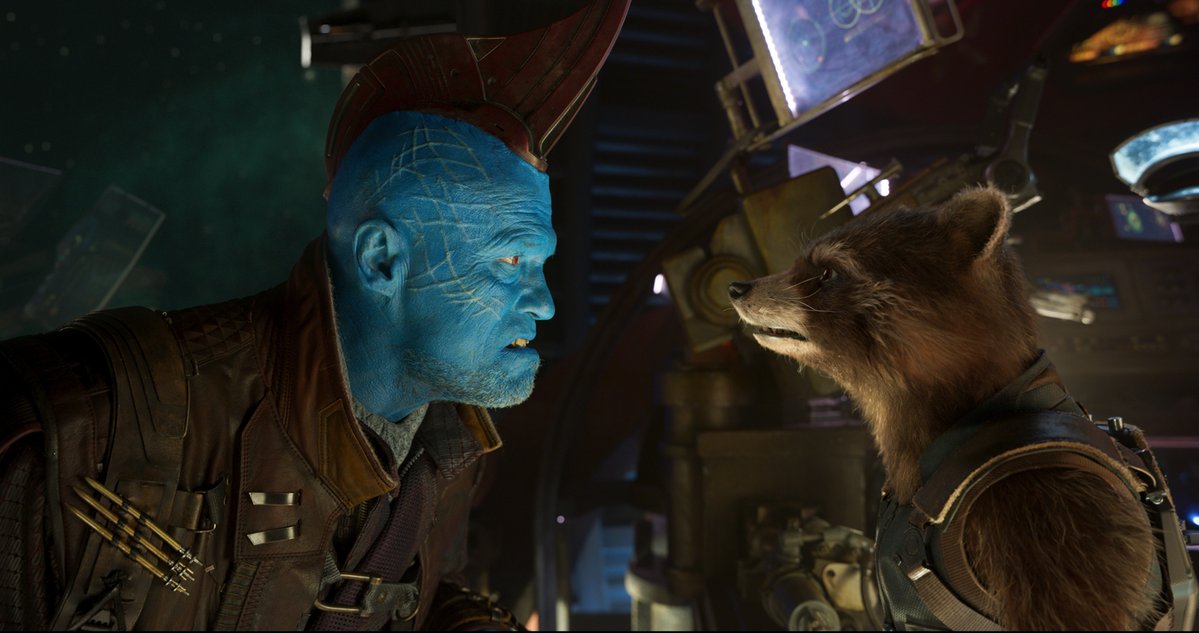
Gillian), screaming mad and desperate for revenge, Ravager captain Yondu
(Michael Rooker), now exiled from his fellow space pirates for child
trafficking and looking to find Starlord for purposes he himself likely
doesn't know, or an entire host of gold-painted douchebags called the
Sovereign, who want to lay waste to the Guardians because they are
assholes (and because Rocket, in perfect raccoon style, stole everything
of theirs that wasn't nailed down. A lot of these subplots exist
simply to give some of the other Guardians something to do for most of
the run-time, but I'm hardly going to complain about that, resulting as
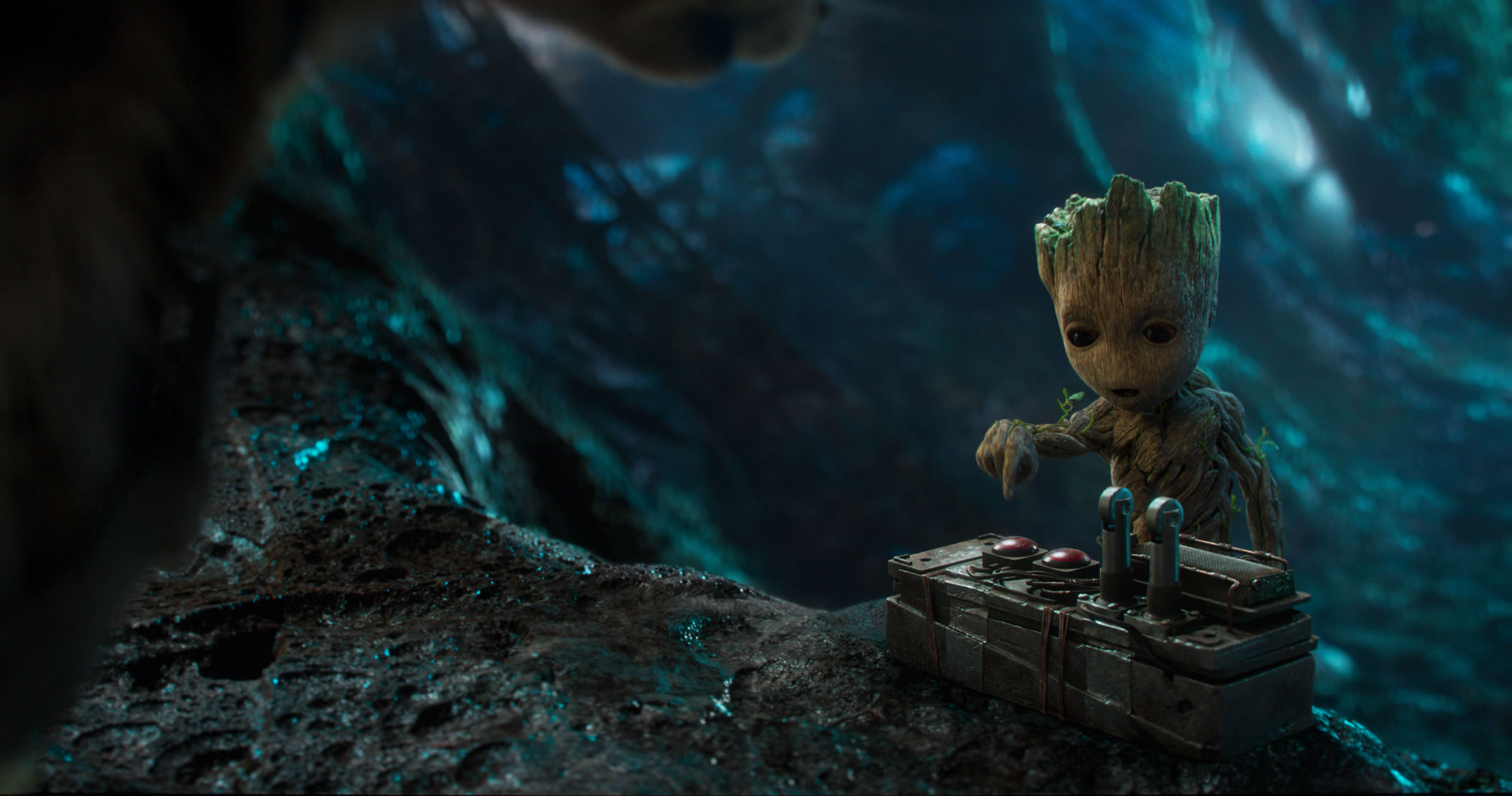
it does in things like an opening battle sequence filmed completely
offscreen as a backdrop to the adventures of baby Groot's misadventures,
David Hasselhoff cameos, two enormous battle sequences where one of our
heroes disposes effortlessly of so many heavily-armed ravagers that the
sequence becomes gut-bustingly funny, and best of all,
Sylvester Stallone
making an appearance as a Ravager admiral with ties to Yondu. Sly
seems to be sending up his performance in Judge Dredd, which given the
tone of this movie, is beyond hilarious, and if this leads to him
appearing in future Marvel films, so much the better.
Honestly
though, the focus this time isn't on the zaniness but the characters,
which is not exactly what I expected from Guardians of all movies, but
looking back is probably the correct move. Starlord's lingering
abandonment issues from having lost his mother and having been kidnapped
by space pirates as a kid continue to haunt him, while both Gamora and
even Rocket, of all people, get some excellent moments circulating
around their place in a misfit surrogate family like the Guardians, and
the distance between what they claim their place is and what it actually
is. The film never moves into telling instead of showing, but it's
plain that Gunn is more comfortable with the characters this time, and
more willing to explore the dynamics between them in greater depth than
the previous movie, five-way-origin-story as it was mixed with a
galaxy-devouring threat, had time to do. The core theme of the film
though is fatherhood, surrogate or otherwise, as evidenced by Kurt
Russell trying to make up for lost time with his demigod son, Yondu's
remarkably complex relationship with Starlord, one explored throughout
the course of the film with surprising depth and even pathos, Nebula and
Gamora's shared experience being raised by an abusive monster in
Thanos, and even Sly's own semi-father relationship with Yondu (okay,
I'm stretching here, but I wanted to shoehorn the fact that Stallone is
in this film into the review once more).

So does this mean that
Guardians of the Galaxy, Vol. 2 is just as good as its predecessor?
Well... no. It's not far off, to be fair, but with this much emphasis
on secondary characters and on the sentimental possibilities of certain
characters' stories, someone kind of has to get the shaft. Both Dave
Bautista's Drax and Zoe Saldana's Gamora have very little to do in this
film save for sitting around commenting on the actions of other
characters, including those of Pom Klementieff's Mantis, a fairly
forgettable throwaway who doesn't bring enough to the film to justify
her existence there. The writing isn't quite as sharp as it was last
time, the film needing to spell more of its emotional core out rather
than let it flow organically. The difference is one of degrees, but
it's there, palpable in that the sequel to a movie that created a
surrogate family without once using the word 'family' now has to
actually hammer the point home with considerably less finesse. There's
also the question of the missing humor. Not that Guardians 2 isn't
funny mind you, it's just not
as
funny as the last film, in part because the movie is concentrating on
other matters, but also because the simple fact that the characters
embody their archetypes is no longer good enough. Rocket being
homicidal despite being a furry little procoynid, or Drax speaking in
utterly literal statements all the time is no longer good enough to
carry the film. In fairness to Gunn, it's clear he and the cast knows
this, but nevertheless, some of the edge that carried Guardians through
the original minefield of sentiment and saccharinity has clearly been
lost, and will need to be freshly honed in the sequel.

All that
being said, Guardians of the Galaxy's second chapter is a really good
film, the best superhero movie of the year so-far, and a worthy addition
to the illustrious Marvel canon. It may be a little less fresh than
its predecessor and it may feel unavoidably like filler at points, but
when the filler is this good, it's hard to get upset.
Final Score: 7.5/10
o-o-o-o-o
Your Name
Alternate Title: Freaky Friday the 13th
One sentence synopsis: A young man in Tokyo and a girl in the Japanese countryside begin
spontaneously switching bodies, and struggle to discover who each other
are.
The Verdict: I will not pretend to be the biggest anime fan around. Oh don't get me
wrong, I've nothing against Japanese animation, and I've seen the
classics, like Spirited Away, Princess Mononoke, Naussica, Akira, Ghost
in the Shell (not
that one), Howl's Moving Castle, to name a few. But
beyond the Miyazaki canon and a handful of other films or series that
have crossed my path, Anime and I have a fairly cool, if cordial,
relationship. It's not that I dislike it, it's just that the cultural
conventions of the art form, from the stammering male protagonists to
the unsubtle upskirt shots of the female ones, just really aren't my
thing overall. Still, that sort of objection has never prevented me
from catching a good movie when one presents itself, and so on the back
of several absolutely glowing reports from friends of mine who
do appreciate Anime, I decided to go and check out our latest import from our friends in the Far East.
Your
Name comes to us from the CoMix Wave Films studio, a studio whose
pedigree is second only to the legendary Studio Ghibli itself, and not
by much at that. Though nowhere near as well known in the States, CoMix
Wave is responsible for several classic masterpieces of the Anime film
world, including 5 Centimeters per Second, The Place Promised in Our
Early Days, and The Garden of Words. The majority of CoMix Wave's
films, including the aforementioned three classics and Your Name itself,
come from director Makoto Shinkai, CoMix' Miyazaki (though he disputes
this characterization). Shinkai's specialty has always been
labyrinthine films with complex, philosophical plots, rather than the
more artful fantastical fare that Ghibli focuses in, and Your Name is no
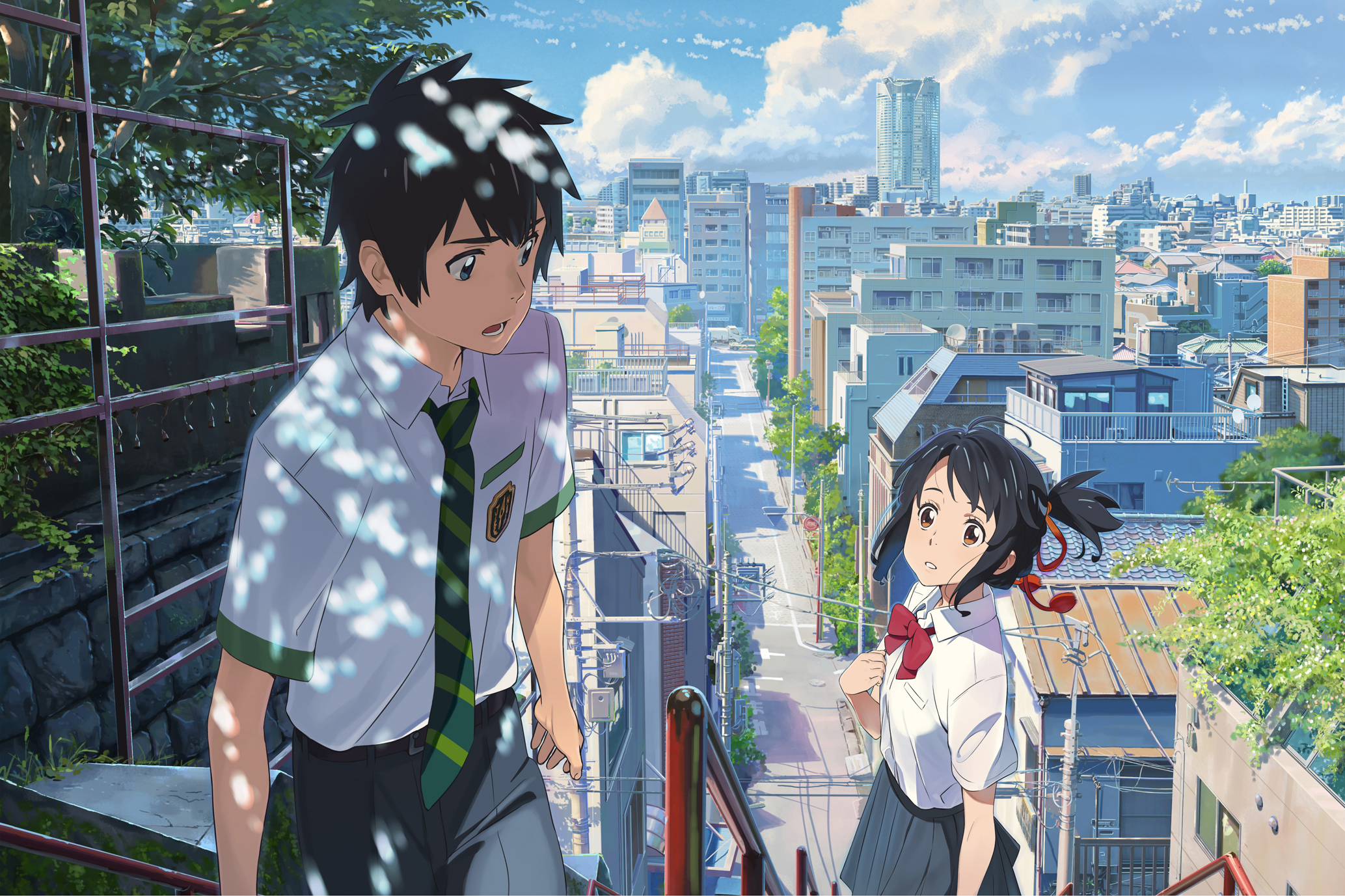
exception. At its core, the film is about two young people, Taki, a
university student in Tokyo, who works nights as a waiter to make ends
meet, and Mitsuha, a high school student from a small town in rural
Japan, who serves as a shrine priestess in the local Shinto temple, and
who is otherwise bored stiff by her small town's limited horizons. For
reasons neither of them can understand, the two begin body swapping one
day, waking up in one another's lives for a day at a time.
Communicating with one another by leaving text messages on their
smartphones, the two try and puzzle out what's happening without
actually having physically met, at least until...

... well never
mind the until, really. Let's just say the plot gets real complex real
fast, as Taki and Mitsuha try and discover what seems to be happening
here, and why. All of this, however, takes place before the backdrop of
gorgeous animation, classical in style for anime, though not if one is
only used to the Ghibli films. The focus here is on quotidian
animation, fireflies at night, the glint of torchlight on painted faces,
a weed-filled vacant lot near the outskirts of a town, cramped Tokyo
apartments, that sort of thing. It's a far cry from the hyper-extended
fantasias of films like Paprika or Spirited Away, but no less beautiful
for the lack. The characters, as well, are more subdued than the
customary anime stock types, less explosive screaming and sweat drops
than the typically-madcap pace of Anime allows for (I don't want to
paint with too broad a brush here, but Anime
does
have its tendencies). The characters are well written, and sharp
enough to follow along with the twists of the plot, and the film overall
has a charming, romantic quality to it that translates well out of
context, cultural and otherwise.
Unfortunately, the need to
translate out of context is pretty vital, because Your Name, for all its
charming simplicity at points, is a tremendously complicated film,
involving not only body swapping but time travel, astrophysics,
spiritualism, hallucinogenic drugs, memory loss, and a pair of
narrators, both of them unreliable. Readers of this blog know that I've
got nothing against a complex plot, I sang the praises of
Cloud Atlas
for years after all, but Your Name stuffs so much intricacy into its
runtime that it is legitimately difficult to follow. This is not an
uncommon problem with more adult-oriented anime (not
that
kind of adult-oriented... well maybe that kind too). Ghost in the
Shell's films and TV shows both involved complex philosophical-political
discussions about everything from cognitive theory to tax policies in
parliamentary governments, smashed into the middle of a modern
techno-thriller. Your Name, though, is supposedly a lightweight
romantic drama, which periodically gets so dense that the audience is
expected to simultaneously keep track of intricate animation, complex
subtitles, and explanatory
super-titles
used to illustrate untranslatable subtleties of grammar and wordplay
within the sub-titled dialogue. Watching a film while reading two books
at the same time is a tall order for anyone, and it's for that reason
that, contrary to all of my snobbish tendencies, my recommendation for
those who do go looking for Your Name is to find a dubbed copy, and
reduce the parallel tracks you have to simultaneously juggle to two or
so.

Honestly, Your Name is quite a good film, though its
indulgence of far too much complex gamesmanship keeps its from being a
great one. It bears very little in common with most of the popular
anime which we of the non-Otaku world encounter, but it's no less of a
film for it, a highly-complex telling of a very simple story, done
without the melodrama and artifice that such stories would normally be
lathered with, either in Japan or here. And given the number of people I
know who absolutely adore this film, I'd bet that if you're willing to
put work into decoding it, Your Name may just wind up surprising you.
Final Score: 7/10
o-o-o-o-o
Megan Leavey
Alternate Title: The Arf Locker
One sentence synopsis: A marine with a troubled past bonds with her bomb-sniffing dog while deployed to Iraq.
 The Verdict:
 As longtime readers of this project already know, some weeks do not
offer a lot of choice when it comes to what to see, weeks that offer
either a slate of movies I've already seen, or things like Alien:
Covenant (Prometheus did not warrant a sequel) or The Mummy (now with
90% less fun!). As such, I went to see Megan Leavey despite my
ambivalence towards both subject and cast, in the hopes that, as has
happened many a time, the movie would prove better than my expectations
allowed for.
It did not.
Admittedly, it didn't prove much
worse
either. Megan Leavey stars Kate Mara, older sister of Rooney Mara, and
an actress I have never, despite all the stuff I keep seeing her in,
decided if I like or not. Marta plays the titular character of Megan
Leavey, a washed up kid from some dead-end town on the Atlantic seaboard
who joins the Marines due to a lack of options beyond overdosing on
drugs, and through a series of misadventures, winds up assigned to the
K-9 corps, working with an "incorrigible" German Shepherd named Rex.
They don't like one another at first, they bond, they go to Iraq, they
get into combat and perform heroically, they have trouble adjusting to
civilian life back home, you've seen this song and dance before, both
better and worse, in a hundred other movies. So what makes this one
different?

Well... not much, to be honest. This one has a dog,
certainly, and that's not nothing, as the dog actor playing Rex is the
best actor in the movie (animal actors often are, I find, mostly because
they have better lines). True, the film has the usual problem wherein
they get the dog to bark a few times and then expect the audience to
pretend that it's a 'wild, uncontrollable beast', but I suppose there's
limited options for getting a nice dog to appear fearsome. There are,
admittedly, a couple of nice lines relating to the business of dogs in
Iraq, such as the one where a soldier tries to scare Megan with tales of
how the insurgents will kidnap K-9 dogs and strap bombs to them before
sending them back to their handlers, only for Megan to respond that,
given that Rex can tear a man's arm off with his jaws at her command,
she's not overly concerned about that possibility (there's a really
awesome action movie to be made here somewhere).
There's also the
cast, which is somewhat more exalted than one might normally find in
movies like this, though the film does not exactly take full advantage
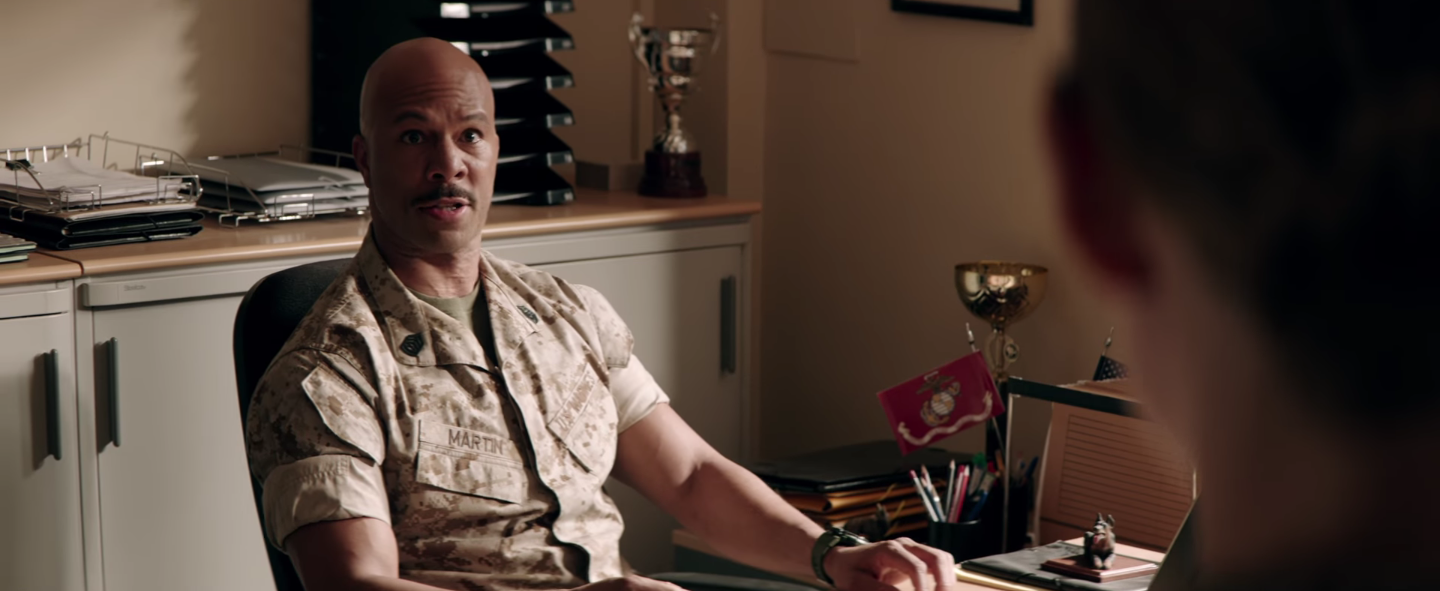
of that fact. Common, who I'm finding increasingly ubiquitous in my
filmgoing experiences, plays Megan's tough-but-with-a-good-heart
sergeant at the K-9 corps, but while on paper this should seem to be a
perfect choice, the fact is that Common is not a particularly good actor
when forced to play things straight, being wooden and inflexible in all
the wrong ways. Granted, there are movies where he can work around
this (John Wick 2 for instance), but here he goes into his Selma/Timothy
Green style of direct unemotional declarations of his lines, and it
just doesn't work. Tom Felton, of the Harry Potter series, has a small
role as a veteran dog handler, which seems to have been added to the
movie purely to make the young girls coo (which several of them
literally did upon seeing him in my screening), while veteran stars Edie
Falco and Will Patton get to play Megan's mother and step-father, the
former as a bubble-headed shrew, the latter practically without lines.
Neither has much chance to do more than play stereotypes. At least they
get a better shot than Bradley Whitford though, who is horrifically
mis-cast as Megan's blue-collar working stiff father. I love Whitford, I
have for years, but he's about as authentically blue collar as Donald
Trump, and has about the same ability to pretend as much, and his
attempts to portray a salt-of-the-earth character are just embarrassing,
given his polished accent and upper-crust mannerisms. Whitford works
great in films like Get Out or The Cabin in the Woods, not in this.

Ultimately, Megan Leavey isn't a
bad
film. The dog is always entertaining, and Mara is actually pretty
decent given the material, underselling everything heavily, which is the
right call in a story that can easily slide into melodrama. But the
movie overall is really nothing special, a re-hash of American Sniper
with dogs, and of about the same level of quality. Unless you're one of
those who absolutely has to see every movie involving the military out
of some misplaced sense of patriotism (or if you're punishing yourself
with a weekly film schedule), there's just no reason to run out for this
one. If you've seen the trailers, you've already seen the entire
production.
Final Score: 5/10
Next Time: We kick off the heart of the summer blockbuster season with style.
 Things Havoc liked: The original Sicario, back in 2015, was a truly great film, as well as
being my first introduction to Taylor Sheridan, a man who has gone on to
dominate my best of the year lists with films such as Hell or High Water and Wind River. He wrote the original Sicario, a bleak, gritty,
wonderfully-made film about the quasi-legal components of the battle
against the Drug trade in the US and Mexico. Though Sheridan has become
a world-class director as well as writer, he has returned to just the
writing duties for this one, teaming up instead with Italian crime drama
director (and former war zone news cameraman) Stefano Sollima. With
pedigrees like that, you could not have gotten me into the theater fast
enough.
Things Havoc liked: The original Sicario, back in 2015, was a truly great film, as well as
being my first introduction to Taylor Sheridan, a man who has gone on to
dominate my best of the year lists with films such as Hell or High Water and Wind River. He wrote the original Sicario, a bleak, gritty,
wonderfully-made film about the quasi-legal components of the battle
against the Drug trade in the US and Mexico. Though Sheridan has become
a world-class director as well as writer, he has returned to just the
writing duties for this one, teaming up instead with Italian crime drama
director (and former war zone news cameraman) Stefano Sollima. With
pedigrees like that, you could not have gotten me into the theater fast
enough. So how's the sequel? It's good. Not great, but good,
principally because so many of the original team are back for another
round. Front and center is Benicio del Toro, reprising his central role
as the lawyer-turned-hitman Alejandro Gillick. This is the role that
brought del Toro to my good graces, and he's very good in it, dialing
things back to a low burn as he takes on another job to make life
difficult for the cartels that ruined his life. He's not as good,
however, as the increasingly ubiquitous Josh Brolin, this time reprising
the role of CIA fixer and hatchetman Matt Graver, the man who runs the
circus which Gillick is a part of. Brolin is absolutely at home with
this material, with a relaxed, sure approach that comes with the
territory, as his character is the consummate military and wet work
professional. Both actors dance through the weighty material they've
given as though it's all just another day at the office, which it
manifestly is. Younger actors, such as Isabella Moner and Elijah
Rodriguez, play teens caught up in some aspect of the drug war and the
cartels' business, the former as the conceited daughter of a cartel
lord, who winds up becoming the fulcrum of events, the latter as a
high-school kid from Texas who gets drawn into the web of Cartel human
smugglers ferrying people into the US. All sides are covered in dirt
here, as special forces and cartel assault teams comb the trackless
wastes of Northern Mexico in search of their targets, and civilians are
left to do the best they can in between the bombs.
So how's the sequel? It's good. Not great, but good,
principally because so many of the original team are back for another
round. Front and center is Benicio del Toro, reprising his central role
as the lawyer-turned-hitman Alejandro Gillick. This is the role that
brought del Toro to my good graces, and he's very good in it, dialing
things back to a low burn as he takes on another job to make life
difficult for the cartels that ruined his life. He's not as good,
however, as the increasingly ubiquitous Josh Brolin, this time reprising
the role of CIA fixer and hatchetman Matt Graver, the man who runs the
circus which Gillick is a part of. Brolin is absolutely at home with
this material, with a relaxed, sure approach that comes with the
territory, as his character is the consummate military and wet work
professional. Both actors dance through the weighty material they've
given as though it's all just another day at the office, which it
manifestly is. Younger actors, such as Isabella Moner and Elijah
Rodriguez, play teens caught up in some aspect of the drug war and the
cartels' business, the former as the conceited daughter of a cartel
lord, who winds up becoming the fulcrum of events, the latter as a
high-school kid from Texas who gets drawn into the web of Cartel human
smugglers ferrying people into the US. All sides are covered in dirt
here, as special forces and cartel assault teams comb the trackless
wastes of Northern Mexico in search of their targets, and civilians are
left to do the best they can in between the bombs. I shouldn't
have to tell you, then, that Taylor Sheridan's script is still as punchy
as ever, with brutal action sequences alternating with the banal
aspects of fighting this undeclared war on human traffickers and drug
smugglers. Sheridan, the grand dean of modern westerns nowadays, turns
this one into a parable-free tale of deception and bloodshed, keeping
the polemics down in favor of a simple story of bad men doing bad things
in a bad place. Though I had never heard of Sollima, the Director, he
draws on a bountiful background in war reporting and crime drama to put
this one together, and creates a film that feels effortlessly real
throughout.
I shouldn't
have to tell you, then, that Taylor Sheridan's script is still as punchy
as ever, with brutal action sequences alternating with the banal
aspects of fighting this undeclared war on human traffickers and drug
smugglers. Sheridan, the grand dean of modern westerns nowadays, turns
this one into a parable-free tale of deception and bloodshed, keeping
the polemics down in favor of a simple story of bad men doing bad things
in a bad place. Though I had never heard of Sollima, the Director, he
draws on a bountiful background in war reporting and crime drama to put
this one together, and creates a film that feels effortlessly real
throughout.
 So how's the sequel? It's good. Not great, but good,
principally because so many of the original team are back for another
round. Front and center is Benicio del Toro, reprising his central role
as the lawyer-turned-hitman Alejandro Gillick. This is the role that
brought del Toro to my good graces, and he's very good in it, dialing
things back to a low burn as he takes on another job to make life
difficult for the cartels that ruined his life. He's not as good,
however, as the increasingly ubiquitous Josh Brolin, this time reprising
the role of CIA fixer and hatchetman Matt Graver, the man who runs the
circus which Gillick is a part of. Brolin is absolutely at home with
this material, with a relaxed, sure approach that comes with the
territory, as his character is the consummate military and wet work
professional. Both actors dance through the weighty material they've
given as though it's all just another day at the office, which it
manifestly is. Younger actors, such as Isabella Moner and Elijah
Rodriguez, play teens caught up in some aspect of the drug war and the
cartels' business, the former as the conceited daughter of a cartel
lord, who winds up becoming the fulcrum of events, the latter as a
high-school kid from Texas who gets drawn into the web of Cartel human
smugglers ferrying people into the US. All sides are covered in dirt
here, as special forces and cartel assault teams comb the trackless
wastes of Northern Mexico in search of their targets, and civilians are
left to do the best they can in between the bombs.
So how's the sequel? It's good. Not great, but good,
principally because so many of the original team are back for another
round. Front and center is Benicio del Toro, reprising his central role
as the lawyer-turned-hitman Alejandro Gillick. This is the role that
brought del Toro to my good graces, and he's very good in it, dialing
things back to a low burn as he takes on another job to make life
difficult for the cartels that ruined his life. He's not as good,
however, as the increasingly ubiquitous Josh Brolin, this time reprising
the role of CIA fixer and hatchetman Matt Graver, the man who runs the
circus which Gillick is a part of. Brolin is absolutely at home with
this material, with a relaxed, sure approach that comes with the
territory, as his character is the consummate military and wet work
professional. Both actors dance through the weighty material they've
given as though it's all just another day at the office, which it
manifestly is. Younger actors, such as Isabella Moner and Elijah
Rodriguez, play teens caught up in some aspect of the drug war and the
cartels' business, the former as the conceited daughter of a cartel
lord, who winds up becoming the fulcrum of events, the latter as a
high-school kid from Texas who gets drawn into the web of Cartel human
smugglers ferrying people into the US. All sides are covered in dirt
here, as special forces and cartel assault teams comb the trackless
wastes of Northern Mexico in search of their targets, and civilians are
left to do the best they can in between the bombs. Look, I'm not a fool. A lot of shady shit
goes down in the drug war, on all sides. This isn't about morality, or
me objecting to how villainous the actions of our characters are or are
not, it's about scenarios that just don't make sense. Mexico is not
Somalia, not in the real world, and so armed military invasions of large
portions of its territory are the sort of thing that doesn't fit with a
scrupulously ripped-from-the-headlines sort of movie. A general action
movie would have no trouble getting away with some of the things that
occur in this film, but this is Sicario, this is the "real" war on
Cartels right here, and so events like a PMC flying armed helicopters
full of special forces to and fro across the border on a regular basis
just don't fly. It turns the movie from a plausible one into a violent fairy tale, at least in parts, robbing it of some of what made the original Sicario so great.
Look, I'm not a fool. A lot of shady shit
goes down in the drug war, on all sides. This isn't about morality, or
me objecting to how villainous the actions of our characters are or are
not, it's about scenarios that just don't make sense. Mexico is not
Somalia, not in the real world, and so armed military invasions of large
portions of its territory are the sort of thing that doesn't fit with a
scrupulously ripped-from-the-headlines sort of movie. A general action
movie would have no trouble getting away with some of the things that
occur in this film, but this is Sicario, this is the "real" war on
Cartels right here, and so events like a PMC flying armed helicopters
full of special forces to and fro across the border on a regular basis
just don't fly. It turns the movie from a plausible one into a violent fairy tale, at least in parts, robbing it of some of what made the original Sicario so great.  Final thoughts: Day of the Soldado is a perfectly good film, though not the triumph
that its predecessor was, a tense, gripping crime and violence-drama
punctuated with just a little too much action and just a little too much
suspension of disbelief to measure up to its illustrious predecessor.
Still, with the year having been mostly a dud so far, there are far
worse things to see in the theaters. Especially when it comes to
subjects like drugs or illegal immigration, about which nobody has the
slightest intention of speaking sense.
Final thoughts: Day of the Soldado is a perfectly good film, though not the triumph
that its predecessor was, a tense, gripping crime and violence-drama
punctuated with just a little too much action and just a little too much
suspension of disbelief to measure up to its illustrious predecessor.
Still, with the year having been mostly a dud so far, there are far
worse things to see in the theaters. Especially when it comes to
subjects like drugs or illegal immigration, about which nobody has the
slightest intention of speaking sense.  Look, I'm not a fool. A lot of shady shit
goes down in the drug war, on all sides. This isn't about morality, or
me objecting to how villainous the actions of our characters are or are
not, it's about scenarios that just don't make sense. Mexico is not
Somalia, not in the real world, and so armed military invasions of large
portions of its territory are the sort of thing that doesn't fit with a
scrupulously ripped-from-the-headlines sort of movie. A general action
movie would have no trouble getting away with some of the things that
occur in this film, but this is Sicario, this is the "real" war on
Cartels right here, and so events like a PMC flying armed helicopters
full of special forces to and fro across the border on a regular basis
just don't fly. It turns the movie from a plausible one into a violent fairy tale, at least in parts, robbing it of some of what made the original Sicario so great.
Look, I'm not a fool. A lot of shady shit
goes down in the drug war, on all sides. This isn't about morality, or
me objecting to how villainous the actions of our characters are or are
not, it's about scenarios that just don't make sense. Mexico is not
Somalia, not in the real world, and so armed military invasions of large
portions of its territory are the sort of thing that doesn't fit with a
scrupulously ripped-from-the-headlines sort of movie. A general action
movie would have no trouble getting away with some of the things that
occur in this film, but this is Sicario, this is the "real" war on
Cartels right here, and so events like a PMC flying armed helicopters
full of special forces to and fro across the border on a regular basis
just don't fly. It turns the movie from a plausible one into a violent fairy tale, at least in parts, robbing it of some of what made the original Sicario so great.