Showing posts with label Mystery. Show all posts

Saturday, September 30, 2017

Wind River


Alternate Title:  Home on the Range
                                                                                                                                                            
One sentence synopsis:  A professional hunter and an FBI agent try to solve a brutal murder on an Arapaho reservation in remote Wyoming.


Things Havoc liked: As anyone who listens to my end-of-year podcasts already knows (and that is all of you, right?), last year was a pretty dismal year for movies. It happens. But one of the shining exceptions was the neo-western crime thriller Hell or High Water, a superb film set in the bleak landscape of the West Texas plains, about a pair of brothers robbing banks to try and save their family's farm, while being pursued by Texas Rangers. I waxed eloquently over the virtues of Hell or High Water twice, once during the review itself, and once during the best-of-the-year Havoc Awards, but what I did not know when I was waxing-so was that the writer of that film, a man named Taylor Sheridan, who also wrote Sicario, was in the process of making the leap from writer to writer-director of another windswept neo-western, this time a murder mystery set in the magnificent desolation of North-west Wyoming.

And it's amazing.

Wind River is one of the best films of the year, a staggeringly-good and unflinching character-and-setting study mated with an excellent murder-mystery. Like Hell or High Water before it, it is a film with a tremendous sense of place, specifically in this case the Wind River Arapaho Reservation of Wyoming, a place which, in the dead of winter, is not particularly conducive to human life. Also like Hell or High Water, it is a quiet, subtle film, taking the time to languish over its setting and characters, indulging in the magnificent desolation of the wintry mountains, and punctuating things when necessary with scenes of brutal violence. I was always a fan of Sheridan's writing, his pedigree alone demanded that, but with this film he has vaulted himself into the ranks of excellent writer-directors, a perilous perch that few can ever attain.

Wind River stars Jeremy Renner, an actor I have long admired, as Cory Lambert, a Fish & Game agent who works in the remote Wyoming mountains. Lambert is white, but his ex-wife, and thus his son and daughter are or were Arapaho Indians, and his job as a predator hunter places him in close contact with the inhabitants of what everyone calls "The Rez". I say 'are and were' because Renner's daughter is dead, killed in unknown circumstances, as so many Native American women are, and found in a remote area with no evidence as to how she came to be there. As such, when he discovers the body of another young woman in the snow, raped and dead of exposure, the daughter of a friend of his, he throws himself into the task of finding out what happened to this one girl with the aid of anyone he can find. Make no mistake, this is a tricky role, as it would be very easy to appear as the typical "white savior", or follow the Dances with Wolves trope of the white man being purged of his evil white guilt by becoming an Indian, but the film is too well-made, and Renner too good an actor to fall into these pitfalls. A standout scene early on in the movie has an FBI agent (Elizabeth Olsen) inadvertently insult the grieving parents of the murdered girl through ignorance and officiousness, only for Renner to show up moments later to ask more or less the same questions, but with a completely different attitude and level of experience with the culture he's dealing with and the people he's talking to. Lest I sound like I'm picking on Olsen, though, she's excellent as well, a fresh-faced FBI agent who knows next-to-nothing about the situation she's been dropped into except for the fact that she knows next-to-nothing about it, which is the most important fact of all. Aware that the only reason she was sent to the Reservation was because crimes there are considered unimportant, she does her level best, conscious of her inadequacy for the task, because nobody else is coming.

But while Renner and Olsen are both very, very good, it's the supporting cast that really sells the film. Gil Birmingham, of Hell or High Water (and the Twilight series, though we'll forgive him for that), plays the aforementioned father of the aforementioned murder victim, a small role that is nonetheless fantastically-well-done, combining existential-grade grief with a practical side generally missing from roles like this one. Graham Greene meanwhile, one of my favorite character actors working,
plays the Reservation Police Chief, whose task it is and has been for years to try and police an area the size of Connecticut with six men. As this is manifestly impossible, Greene's character, like everyone else, simply does what he can do, despite everything, and Greene is exceptionally good at showcasing someone whose choices are cynicism or doggedness, and whose chooses the latter with open eyes despite all evidence to the contrary. There is also an extended flashback sequence involving Kelsey Chow and Baby Driver and Fury's Jon Bernthal as Natalie, the murdered girl, and Matt, her boyfriend, both of whom are superb, as are a host of other more minor actors such as James Jordan. This sequence, though difficult to watch (it involves murder and rape, among other wholesome pursuits), is one of the best scenes of the sort that I have ever seen, a sequence that showcases, without histrionics or dramatic irony, just how the most heinous of crimes can come about through a combination of alcohol, testosterone, group dynamics, and unrestrained escalation. Were the film nothing but this scene, it would justify its existence, but as it stands, it is the jewel in the film's crown.

Indeed, the entire film is remarkably well-made, from the gorgeous cinematography and understated
score, to the brief, brutal flashes of violence that erupt without warning. It calls back, quite consciously, to westerns and crime dramas like Unforgiven, Collateral, or Heat, using referential shot selection and self aware stylism. The soundtrack is all mood-music, western-influenced electronica and rock, primarily scored together by legendary musicians Warren Ellis and Nick Cave (the latter of whom holds the most awesome nickname in history as "Rock Music's Prince of Darkness", bestowed on him by Johnny Cash of all people). The pacing is slower than any of Sheridan's previous works (probably an effect of him directing, this time), but the result is a sombre, windswept, dramatic piece that doesn't luxuriate in darkness or give in to rabid polemic. It's a balancing act that gets more impressive every time I think about it. It's close to being a masterpiece.


Things Havoc disliked: Honestly, there's not much wrong with Wind River whatsoever, at least nothing that isn't clearly done for effect as opposed to sloppiness. Some of the predator/prey symbolism is a bit on the nose for my taste, but that's the risk that comes with shooting movies in the American West, an area rich with scenic mythology and symbolic landscapes. There are also a handful of plot cul-de-sacs that are reasonably well-established before being dropped unceremoniously, such as Renner's relationship with his son, ex-wife, and in-laws, all of whom get time devoted to their setup, all of whom are forgotten about in the aftermath of the film's payoff. I'd be lying if I said there wasn't a bit of tonal whiplash on occasion, as the film oscillates between hyper-realistic murder-mystery and sudden, explosive gun battles (I'm not quite sure what the end-game of someone who decides to start a shootout with six cops and the FBI is). But overall, none of these issues mar the film's qualities beyond the occasional quizzical moment.


Final thoughts:   In case I've somehow been unclear, Wind River is a phenomenal film, one of the best neo-westerns I've ever seen, and a strong contender for the best film of 2017. I absolutely love and unhesitatingly recommend it to anyone even casually interested in westerns, thrillers, mysteries, or any one of the fine actors that appear within it. As for myself, I will be watching Taylor Sheridan closely for whatever he does next, as a new filmmaker capable of producing a movie this good can only either continue to make spectacular movies, or can take the Michael Cimino/Tod Browning route, and follow up their breakout hit with a movie so off-kilter that it bankrupts their studio and gets them blacklisted from Hollywood forever.

Either way, it'll be fun to watch.

Final Score:  8.5/10


Next Time:  And now we consider another sober and reasonable film in which Taron Edgerton beats a man with his own arm.

Wednesday, May 3, 2017

Ghost in the Shell


Alternate Title:  Whites in the Film
                                                                                                                                                            
One sentence synopsis:  A special forces operative with a cyborg body confronts the truth of her own past in a techno-futurist Tokyo.


Things Havoc liked:  Anime is not, by and large, my thing. Oh I've seen the classics, Akira, the Miyazaki films, Paprika, and so forth, but the conventions and cultural stamps of Anime just aren't really what appeal to me, absent a handful of exceptions. One of the biggest of these exceptions, however, was Ghost in the Shell, an animated series (and pair of films) about an anti-terrorist unit in nano-tech-era Tokyo, one that not only included excellent action and cool technological gadgets, but also involved byzantine political plots, and lengthy discussions on the ethics, philosophies, and new questions brought about by the logical extremes of the information age. Though, as I mentioned, the series spawned its own animated films, rumors of a live action Hollywood adaptation have abounded for years. And now they've been finally brought to fruition, albeit in a form guaranteed to piss off a huge segment of the population that would naturally be inclined to see the movie. Well done, you geniuses of Hollywood, well done.

So let's start with what works, shall we?

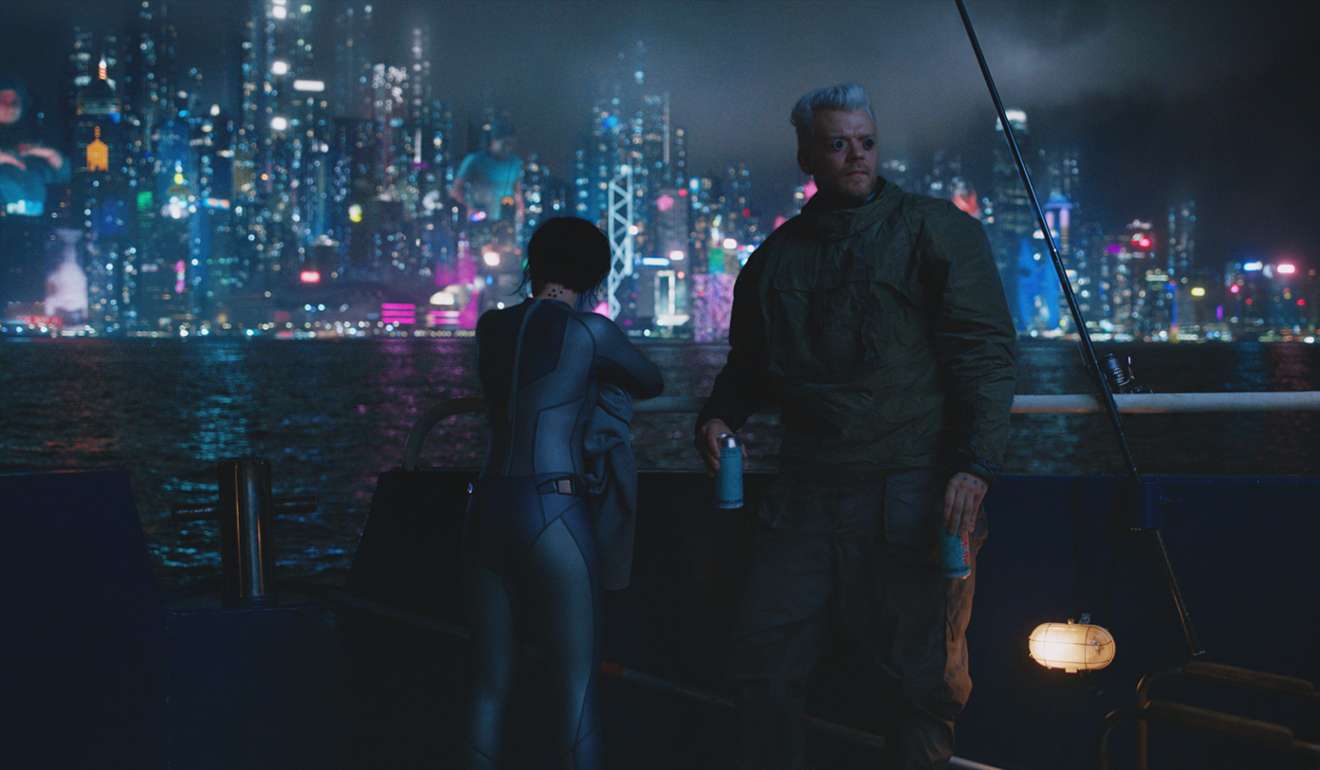
Ghost in the Shell, directed by Snow White and the Huntsman alum Rupert Sanders, is first and foremost a gorgeous film, stunningly beautiful in sequence after sequence. Much of the credit for this belongs rightly to veteran cinematographer Jess Hall, of Brideshead Revisited, Hot Fuzz, and a handful of other films. It showcases a futurist society in all its splendor and sleaze, but unlike the usual cyberpunk ultra-metropoli that one encounters occasionally in the movies, this one is filmed (usually) in the full light of day, or the sharp neon-tinted glow of a lit night. It's as if Wes Anderson decided to re-shoot a Ridley Scott film, it's that stylistically impressive, with a full color palate and plenty of set-piece imagery drawn, not merely from someone's vibrant (or depraved) imagination, but also from the anime itself. Indeed, several shots and even whole scenes are re-created from the original anime film shot for shot, including a couple of the most visually memorable ones from the entire enterprise, including a battle between a gun-wielding terrorist and an invisible assailant, filmed on a flooded street, and a sequence inside a ruined zen-temple-turned-arena featuring the aforementioned assailant and a walking tank designed to resemble a spider. The color palate is rich and deep and vibrant, with garish imagery that could have been rotoscoped off of a high-quality cartoon, contrasted with inky shadows and stark relief shots. Given that most cyberpunk seems to take place entirely within a New Jersey trash dump at three in the morning during Hurricane Sandy, this sort of thing is a welcome addition to the genre. So gorgeous was the imagery in this film, that I broke a cardinal rule of mine and saw it in IMAX 3D (the fake kind), and was not disappointed, though as always the 3D merely served to not suck the life out of the film, rather than adding much.

There are other matters of use here as well. The score, by veteran film scorer Clint Mansell, is superb, an electro-choral orchestral soundtrack that sets a techno-futurist patina on the entire proceeding. I've been a massive fan of Mansell's work since Requiem for a Dream, and he does not fail to deliver here, particularly during intense action sequences, which are not scored with pulse-pounding thriller beats, but with strange ethereal music, as though the action were but the surface elements of the true depths being portrayed. The actors themselves, meanwhile, vary widely in quality and usefulness, but particular mention should go to Danish actor Pilou Asbæk, who plays Batou, the second in command of the counter-terrorist unit the movie circulates around, as well as legendary Japanese actor/filmmaker "Beat" Takeshi Kitano, who plays the Section chief of the selfsame organization. Asbæk's character is not quite (or at all) the same as the one in the show I so loved, but I've never permitted myself to condemn a film for not being like another film I would have preferred to see, and his portrayal is actually fine, in keeping with the style of the movie this is, a monotone professional soldier and world-weary loner who keeps to himself and watches his teammates' back. As to Kitano, his character of Chief Aramaki was my favorite in the show, an old man whose experience in penetrating political and terrorist conspiracies to get to the truth of the matter was unparalleled. Kitano doesn't get to do a lot of that sort of thing, but he still gets several awesome sequences in his own right, where the movie laboriously reveals that he was five steps ahead of his opposition all along. It's nothing revolutionary, but I just so enjoy watching Kitano do his thing, that I couldn't help but enjoy every moment he was on screen.


Things Havoc disliked: Let's talk about the elephant in the room here.

Motoko Kusinagi, the main character of every version of Ghost in the Shell that there is, is Japanese. Scarlett Johansson, the actor who was selected to play her in this movie, is white. Not surprisingly, this has attracted a hell of a lot of criticism from a number of sources accusing the studio of whitewashing the movie to suit their own racist, or at least mercenary, ends. This is not the first film I've come across that has done such a thing. Both The Flowers of War and Doctor Strange were pilloried for supposedly placing white actors in Asian roles, to say nothing of the furor that erupted over Cloud Atlas. With all three of the aforementioned films, I denounced this interpretation, in the first case because it was bullshit (the character in question was white), in the second case because the movie could not have been made without making a change of the sort (such is the reality of PRC censorship), and in the third because the very purpose of the movie was to break the laws of race and gender. I believe I consequently have plenty of standing as not being some sort of easily-offended keyboard warrior looking to show off my progressive credentials to my echo chamber. And as such, I'd like you all to gauge my criticisms in context when I say that casting Scarlett Johansson as Major Kusinagi in a Ghost in the Shell movie is utter bullshit.

Forget, for a moment, that Scarlett Johansson is simply not a good actress, or at least is a very limited one. Forget that her vaunted "cyberpunk credentials" are based around a set of godawful movies that start with Lucy and get worse from there. Forget the thin excuses about whether a movie that didn't have a recognizable name at the top of the marquis would appeal to American audiences (because Lord knows the one we got with that name still managed to bomb severely). This casting decision is bullshit because it is not the only one in the movie. Not only is the main character of the film switched over inexplicably from a Japanese character to a white one, but so is everyone else in the goddamn film. The main villain, the secondary members of the squad, the scientists and businessmen at the heart of the conspiracy, everyone with a speaking role has been re-cast from their original race. In fairness to the filmmakers, not all of the re-casts are with white actors, yet somehow, as if by accident, all the characters that have nothing to do with anything, the bit characters that barely have lines or any purpose in the film, those are the ones with black and Hispanic and Asian actors, while all the actual roles, including multiple major characters from the original series/films, all just happen to have white people in them. Trying to play this off as nothing more than a co-incidence is worse than simple run-of-the-mill racism, it's the sort of racism that insults your intelligence while it's doing it.

And you know what's worse? The movie knows all this. Why else would they have basically built the entire plot of the story around the question of Kusinagi's origins, and how it is that she came to look like Scarlett Johansson, throwing out all of the byzantine plots, political intrigue, and cyber-philosophy that was at the core of the original series. Horrible as I found this decision, it isn't in and of itself a bad thing. There are movies (World War Z comes to mind) that have entirely discarded their source material and still made something great, and there is a version of this film I can imagine wherein the fact of casting a white actress to play a Japanese role would be used as an examination of the fetishization of white women in Japan. But this film is written by none other than Ehren "Fucking" Kruger, one of, if not the worst writers in all of Hollywood, and given that Tyler Perry and Adam Sandler still have careers, boy is that saying something. The writing in this film is consequently terrible as one might expect from the pen of the auteur of such works as Transformers 2, 3, and 4, The Brothers Grimm, and The Ring Two. Every line in the film is stilted, robotic, and entirely functional, serving to inform the audience that a certain character is the designated evil business leader, or the designated conflicted scientist, or that the plot is about to enter action section 4b (sub-paragraph nine). An example midway through the film comes when Johansson inexplicably walks into the home of an older Japanese woman, who, without prompting, invites her to have a cup of tea, and talks about how she rarely has visitors now that her daughter, who would be about Johansson's age, disappeared under circumstances that nobody knows about, and how much she misses how she used to do things that Johansson also does. WHERE COULD THIS PLOT POSSIBLY BE GOING, THE WORLD WONDERS?! As a result of all this, the entire film feels flat and empty, a soulless exercise in violence and pretty pictures, where every scene serves simply to get us to the next scene along the painfully pre-established "revelations" that anyone with half a working brainstem will have figured out five seconds into the film, and must then spend the next hour and forty-six minutes waiting for the movie to catch up. We get no sense of the character of the Major, of the villain, of anyone really, for the simple reason that nobody preparing the script had the skill to give them any.


Final thoughts:   Ghost in the Shell is a frustrating film, far more so than it really deserves, to be honest. It would be easy to dismiss it as the product of studio-sanctioned racial games, along the lines of the abortion that was The Last Airbender, or even simply as a low-rent animesploitation flick like Ultraviolet. But the sad part is that the movie does have virtues locked away inside it, namely its gorgeous style and distinctive visual world, one realized in loving, painstaking detail by aficionados of the genre and the source material. Yet all the efforts of a great many talented people have been committed in service of a film that is, when you get past the outrage, simply bad, a victim of awful writing, poor scripting, terrible casting, and hackneyed production overall.

At time of writing, Ghost in the Shell is in the process of losing Paramount roughly 60 million dollars, which is only appropriate given what it is. And yet what gets me is that the nominal argument for doing all of this crap has always been that in order to attract an audience, such films need to whitewash simply to get a big name actor. Leaving aside the question of whether this is a moral act or not, the fact that the movie did this and then lost a pile of money anyway, just like all the other movies that have done this (Last Airbender, Gods and Kings, 21, Aloha) should serve to torpedo this particular line of argument. Of course Hollywood is a place where people need a long time and a lot of failures to learn their lessons. But if Ghost in the Shell can serve as a stepping stone in that particular path, then maybe there was a point to the entire exercise after all.

And if not, well, maybe the DVD version will let you mute the dialogue.

Final Score:  4.5/10


Next Time:  A daring and fearless look into the philosophical nature of man.

Sunday, March 27, 2016

Zootopia

Alternate Title:  Hop Fuzz

One sentence synopsis:    A rabbit police officer and fox con-man team up to solve a mysterious series of violent assaults by the "predator" minority of the animal metropolis Zootopia.


Things Havoc liked: Disney has been on something of a tear in recent years, a full on third Renaissance for a studio which seems unable to do wrong either in whole or in part. The recent burst of quality includes a whole host of top quality animated films such as Tangled, Frozen, and Big Hero 6, all the of which were excellent films worthy of being considered alongside the best work of their counterparts at DreamWorks and Pixar. And so it is that this year, during a period generally bereft of quality for film in general, Disney has graced us with another would-be masterpiece, a light-hearted children's animated romp involving such fun, wacky subjects as racism, police brutality, and the ways in which politicians can use the media to engender fear and hatred.

Yeah...

Zootopia, a fun animated film in the traditional style of modern Disney movies, is a film with a whole lot going on, a mish-mash of styles, themes, and genres including everything from 80s caper flicks to classical Disney fare like The Fox and The Hound. It's a towering edifice of a film, packed with in-jokes and subtext, thematic complexity and high-velocity situational gags. Directed by Rich Moore (of Wreck-it Ralph) and Byron Howard (of nothing in particular), it is, without mincing words, a staggeringly good movie, one that tackles a whole series of complex issues in all their glorious complexity and makes an engaging, funny, compelling story out of them, all without simplifying the situation down for the kids in the audience or preaching dogmatically to the adults. It's not unusual to see animated movies tackle difficult subjects these days, nor is it some kind of revelation, in a post-Pixar world, to discover that kids movies can have something to say to adults. What is both unusual and revelatory, is a movie by a major studio that manages to do these things this well, and wrap it all together in a Disney-style animated romp full of humor, adventure, wonder, and engaging characters.

The premise, familiar to anyone who's seen the trailers, is relatively simple. Mammalian species of every type are, sentient, bipedal creatures, who live in and around a gigantic, modern metropolis known as Zootopia, a fully modern city with assorted amenities to cater to the vastly different sizes and preferred climates of its denizens. Arriving in this megalopolis of purported peace and tolerance is Judy Hopps (Ginnifer Goodwin) a newly-minted ZPD police officer, the first rabbit to become a cop in the history of the city. Struggling against prejudice against a rabbit as a policeman, she winds up embroiled in a complex missing persons (animals?) case, roping a con-artist fox named Nick (Jason Bateman) into the investigation through threats and blackmail. If this story sounds familiar to you, it may be because you remember the 1982 Eddie Murphy/Nick Nolte action-comedy 48 Hrs, the movie that essentially invented the "buddy cop" genre as we know it today, and which Zootopia takes, of all things, as its clear plot inspiration. Given the purpose the movie puts this plot to, which is to explore the dynamics of prejudice and racism in more or less explicit detail, this is an odd place to draw from, but then Zootopia is an odd movie, part screwball comedy, part crime mystery, and part somber message movie on the need for tolerance.

By now, I'm sure everyone is aware that I have very little tolerance for message films, particularly polemical ones raging about some worldview that is proper and showcasing the various ogreish personality flaws of those who do not abide by it. It therefore comes as a surprise to me as much as anyone that Zootopia, the animated Disney film about bunnies and foxes, is one of the most rational, nuanced, and even-handed movies on the subject of prejudice that I have ever seen. In a film that, for all its weird premises, is clearly based around our modern society, the movie dispenses with cheap villains, mustache-twirling racists, and even the easy lure of simple allegory, wherein elephants would equate to black people or whatnot. The primary dynamic at work in Zootopia is one of Predator and Prey animals, with intersecting elements of prejudice based around size or species, and yet nowhere in the movie can one draw a direct parallel, though references to the real world abound. At one point it seems like the dynamic is that of the larger and more powerful Predators exerting societal dominance over their Prey counterparts, only for the film to shift subtly around to where the majority Prey population exhibits fear and hate towards the Predator minority, all while the film navigates a blisteringly complex web of interconnected stereotypes, prejudices, and racial (speci-al?) hangups. Yet unlike a movie like Crash, whose message was that everyone is an equally noxious racist who should be condemned for their lack of enlightenment, Zootopia's position is far more nuanced, recognizing that everyone is capable of judgmental, even prejudiced actions, particularly when there exist people willing to suborn our baser fears so as to generate division, mistrust, and power vacuums.

But if all of the above sounds like a particularly well-made after-school-special about racism, then don't worry on that account, for despite all of the social complexity that the film carries, at its core, it is a superlative Disney adventure-mystery film. Both of the leads are sharp, well-drawn characters, wickedly funny in their own right, with spot-on voice acting and perfect character design, giving them unparalleled expressiveness, whether in a layered dialogue scene or a frenetic chase. The film is layered with puns (*groan*), in-jokes, and background gags, most of them too funny to spoil here, and further comes with a superb supporting cast, including the incomparable Idris Elba playing the "stern black police chief" as a Cape Buffalo and the immortal J.K. Simmons bringing his J. Jonah Jameson best to the role of Zootopia's mayor, while lesser parts go to everyone from Alan Tudyk and Maurice LaMarche (playing a Vito Corleone-style crime lord who is also a shrew), to Bonnie Hunt and Tommy Freaking Chong. The film's animation is spotless, with the animals' movements a perfect blend of actual animals and Disney archetypes, with the shots of even the most action-packed sequences easy to follow, while the style of the metropolis of Zootopia itself is dazzling in its futuristic-utopian grandeur. Even if you care nothing about the societal value of a particular movie, Zootopia can be enjoyed as nothing more than another classic Disney comedy, and that, most likely, is the secret to its success.


Things Havoc disliked: Of course, some bits of the film work better than others. The addition of Shakira, embodied as a pop-singer gazelle named (creatively) "Gazelle" isn't used for much beyond a cheap joke or two, and the cutaways to her benefit concerts and protest sit-ins regarding prejudice and racism are far more on the nose than the movie requires. Without spoiling too much, the entire coda to the movie is taken up by one of the aforementioned concerts, and while I usually refrain from criticizing a film for its credits sequence, the song in question isn't that good, and the entire affair feels like stunt casting to appease a performer's ego, rather than something derived from the movie internally.


Final thoughts:     In an age full of polemic, Zootopia is a marvel, a movie that neither sells out the seriousness of its allegorical premise, nor weights itself down with sermonizing. I cannot possibly do it more justice than the Daily Telegraph, which described it as "the most existentially probing talking animal cartoon of the year," albeit in a review that managed to fall all over itself in missing the point by declaring that Zootopia somehow "proved" that girls who like frilly dresses or girly things should be publicly shamed for being everything that is wrong with society. Indeed, despite my minor nitpick above, the main thing I would complain about with Zootopia is the reaction it seems to have engendered from the rest of the critical set, with large numbers of critics managing to read it as a full-throated endorsement of every noxious, divisive, stereotyping opinion that they choose to slather onto their review pages, from a claim that it will "finally put the PC-thought police set in their place", to arguments that it represents a call to "sterilize the brainless zombie-hordes of Trump supporters" (though admittedly, the Chinese Army's declaration that the movie represents a Western plot to overthrow traditional society is kind of amazing, as is the Globe & Mail's claim that the movie is sexually perverted because it doesn't explicitly address cross-species romance). Only in Hollywood could a movie about the complexities inherent in our quest for equality and tolerance be interpreted as an excuse to air the most vile assumptions about millions of people we don't know, but I cannot, in all good conscience, hold the film responsible for that. The world is, as the film reminds us, imperfect, as are we all, and yet it keeps on spinning.

Ultimately, Zootopia is a fine movie, a worthy successor to the many other fine movies that Disney has graced us with. And whatever the reactions of the rest of the world, a timely, well-crafted, and entertaining reminder that it is everyone's responsibility to try and get along is no bad thing.

 
Final Score:  8/10


Next Time:  Maggie Smith as a Bag Lady?  Sign me up!

Sunday, October 19, 2014

Gone Girl

Alternate Title:  Genesis  3:16

One sentence synopsis:  The wife of a philandering bar owner disappears without a trace, leading to suspicions that he may have murdered her.


Things Havoc liked: "I'm excited to see that new Ben Affleck movie," is one of those statements that I never expected to be saying in all earnestness ten years ago, not in the dog days of films like Gigli or Daredevil. But then we live in a strange world these days, where people speak of things like "Academy Award Winner Matthew McConaughey", and "this year's cinematic masterpiece from Marvel comics", so perhaps I should be less surprised. It is still perhaps saying something that my first thought on hearing about this film was grave concern that Affleck was merely acting in this movie, and not taking on the director's duties, but one takes what one can get when it comes to serious dramatic films with serious dramatic casts.

Gone Girl, based on the book by Gillian Flynn (who also wrote the screenplay), and directed by the incomparable David Fincher, whose resume includes such films as Se7en, Zodiac, Fight Club, The Social Network, and The Girl With the Dragon Tattoo, is the first real sign I've seen that the September slump is behind us, and that we've finally entered Oscar Season. Oscar Season, for those who have not been keeping up with my barely-comprehensible ramblings concerning the yearly film calendar, is the third of the three major seasons into which the year is divided, a time between mid-October and the end of December, wherein the studios release their big-ticket Oscar-prospects, the movies they believe and hope will generate awards for them during the award ceremonies that recap the year between January and March. Not every film that comes out around this period qualifies as an Oscarbait film of course, but Gone Girl, with its accomplished cast, its all-star director, and its dramatic, "serious" subject matter, is almost a perfect example thereof. Lest I sound critical however, Oscar Season is a time I look forward to with great anticipation, as all of a sudden the studios disgorge a plethora of excellent prospects before me, and ask only that I, like the rest of the critics, find something in them that we like.

Well I'm always game for seeing the bright side of things. Let's start, as always, with the actors. Ben Affleck, like other former-pretty-boy actors before him, has made the transition from a critical joke to a critical darling mostly by putting his reading glasses on when reviewing scripts, taking on films that offer greater dramatic range while relying on his instinctive charisma to carry him through the role. McConaughey did the same thing when he made his right-turn into relevance, and Affleck, even when not directing, knows exactly how to deliver a performance like this. He plays Nick Dunne, a failed writer who has become something of a layabout in a small town in Missouri, to which he has moved himself and his wife to be closer to his family. Affleck plays the role distantly, like a playboy who is no longer young enough to get away with such antics, and does not seem to know what else he is supposed to transition into for the remainder of his life. His marriage with Amy, his wife who goes missing early in the film, is highly strained, believably in both of their cases, and Affleck does an excellent job of provoking suspicion from both the audience and the rest of the cast without ever transcending the bounds of reason or lacking for a plausible explanation. It's not easy to balance on the edge of a mystery like this, but Affleck is easily up to the challenge, and never once slips back into the bad habits he demonstrated for the first fifteen years or so of his career.

But Affleck is a rank amateur compared to the real revelation of the film, Rosamund Pike, an actress whose resume previously included such "wonderful" films as Die Another Day, Jack Reacher, and Wrath of the Titans, and who is on a completely different level in this film. Describing the various things that Pike does in the movie would be to spoil the entire thing, but her performance here is absolutely electrifying, an order of magnitude beyond anything I have seen of her before. Through all the tribulations that the movie involves her in, Pike manages to portray everything from quotidian concern to frustrated anger to horrific victimization to... well that would be telling. Her performance anchors the entire film, whether in flashbacks to her and Affleck meeting in New York, to more recent flashbacks to their troubles in Missouri, to the events that actually touch the plot off, and with it, she has instantly elevated herself in my mind to the A-list of Hollywood actresses. This is the sort of performance that Oscar nominations are made of, a riveting, twisting role that can make or break the actor or actress in question.

And the good times don't stop there, indeed this movie was a rather stunning revelation for me, not merely because of Pike, but because of a number of different actors for which I've had no use previously, and found one here. One of these actors is Kim Dickens, a main character on HBO's Deadwood (one of the best television shows of all time), who has previously been decidedly underwhelming in everything I've seen her in, but not here. She plays Detective Boney, the only member of the local police force unable to make her mind up instantly about Affleck's guilt or innocence, whose investigation parallels that of others, as the audience tries to piece the truth together. But the one that surprised me the most, unquestionably, was of all people, Tyler Freaking Perry, once described to me as the least-intimidating six-foot-four black man in America. Perry, a purveyor and star of absolutely terrible movies for the last decade or so, here plays the first serious role I've ever seen him attempt (I contrived to miss 2012's Alex Cross), as a high-priced, high-profile defense attorney specializing in media circuses, and to my abject shock, plays the role perfectly, a sober, collected expert who knows precisely how the currents of public opinion and media cycles function, and advises his client on the best way to avoid shipwreck. Perry is not a caricature, nor an exaggerated farce, and the realism with which he portrays the role actually cements the film's central narrative about the facetious gossip-mongering that the rest of the media and legal system is mired in.


Things Havoc disliked: Given the above, and the effusive praise I have lavished upon so many actors of this film at such length, you might expect that I would have little to complain about, and that this movie was one I was preparing to strongly recommend. And indeed I must admit that when I first emerged from the theater and analyzed my feelings on the film in general, that was precisely what I was preparing to do. Normally my first impression from a film proves to be pretty close to my final thoughts, but in this case, I decided to give the film a little time to percolate before making a final decision, so that I might come to terms with some of the more disquieting elements that the movie left within me.

My conclusion? I hated this film.

Everything I said above, praise for Affleck and Pike and Dickens and Perry, all these things I stand by, as the problem with the movie is not the acting. It is not, by and large, the direction, nor the cinematography, the former of which is at least serviceable, the latter of which is expertly-done by long-time Fincher-collaborator Jeff Cronenweth. No, the problem with the film is something much deeper, much more troublesome, something rooted in but not precisely equivalent to the writing. An accusation that all of you know, by now, that I do not make lightly, and in fact almost never make at all. The major problem with this film is, indeed, something I feel fairly uncomfortable even bringing up, knowing as I do how quick I am to reject such statements as issue-questing and axe-grinding when it is made of other films. But the fact remains that the problem with this film is that it is deeply, pervasively, stunningly misogynistic.

You all know me. You all know I do not press that button of all buttons casually. And yet I have no choice here but to hammer it home because this film is staggering in its contempt for women, all women (with a couple customary exceptions) over the course of its narrative. They are shrewish, empathy-less, judgmental harpies. They are evil, conniving, psychopathic murderers. They are twisted monsters disguising themselves effortlessly from the honest, simple, true-hearted men that surround them, whose virtuous, trusting natures prevent them from seeing the webs of iniquity and vitriol that are being spun around them. Not one woman is portrayed this way, but ALL of them, even when their characters must make right-angle turns in order to support this narrative, even when the plot groans under the weight of contrivances just to squeeze that much more evil out of the female species, even then the film is relentless in hammering home the fundamental decrepitude of women as a whole, to the point where my viewing companion suggested that the film was beginning to resemble an MRA propaganda piece, and I was getting flashbacks to St. Bernard's medieval panegyrics denouncing the race of Eve as sinful, duplicitous monsters.

The typical hypocrisies associated with bigotry of any stripe are front and center here. Some women are ditzy or brainless or simply stupid, such as the majority of the Stepford-analogues in the bedroom community that Affleck and Pike are living in, vapid people with shallow interests and a grotesque inability to empathize. A throwaway character early on in the film, a woman who approaches Affleck after he has lost his wife to a violent kidnapping for which he himself is suspected, presumptuously takes a Selfie with him for no reason whatsoever, and then reacts to his requests to delete or at least not share the picture as an inexplicable and creepy request from a selfish dick, informing him that she will share the picture with whoever she wishes and storming off as if wrongfully abused. Later that very image appears on a talk show run by an evil, shrewish Ann-Coulter analogue played by veteran actress Missi Pyle (who I'm sure is a very nice person, but whose misfortune has always been to have a face that naturally screams "bitch"). What benefit does this mystery woman draw from this act? Nothing. She's simply a stupid ditz who ruins Affleck's life for no reason and can't even realize she's done wrong. Similarly Affleck's mother-in-law, a bitter, sniping woman who publicly denounces Affleck any chance she gets, and his mistress (more on that later), a dumb college student who seduces Affleck with her bubble-headed sexiness only to turn around and put on a virgin's cowl when it's time to tearfully denounce him while being manipulated by other women. Yet on the other hand we have other women who are sublimely clever, twisted, masqued murderers and sociopaths, who delight in destroying men's lives for the fun of it, or for the crimes of having paid insufficient adoration to themselves. Women able to construct the most exquisite frame jobs, fake everything from rape to physical abuse, spend years establishing the pieces only to bring the unknowing men down just so that they can have the pleasure of watching them burn. It's not just Affleck this happens to of course, for these are man-eaters, misandrists of a sort that exist only in the depraved fantasies of men who feel themselves wronged. One man, late in the film, admits to having had his life destroyed by a woman who set him up as a rapist for the crime of not committing to her, while another (played by a surprisingly flat Neil Patrick Harris), showers a woman with money and attention, only to be the victim of a hideous crime largely out of convenience. I have literally known men who were falsely accused of sexual assault in real life, something which is vanishingly rare, and even I was unable to simply accept something like this wholeheartedly. In a film that employed ONE of these characters, such as Jennifer Lawrence's sollopsistic passive-aggressive maniac in American Hustle, I would have had no problem. But this film throws in every stereotype they can find, makes up a few more, and then afflicts them all on the thankless, aw-shucks simple man of virtue that is Ben Affleck, and expects us to accept that this is the stuff of real drama.

And maybe this all would have worked in a film that explored the deep-seated hypocrisies of seemingly-normal people, a Peyton Place-style unveiling of the hidden darkness within everyday people, but the movie refuses to play fair, because Affleck, the afflicted man at the center of this tempest, can do no wrong. Sure, he's a shiftless layabout who sponges off his wife's trust fund, but trying to be a writer is hard, guys, and he needs some time to himself. Sure, he throws his wife into a wall in anger, but she probably made that up as part of a Machiavellian plot to get back at him. Sure he, cheats on his wife with a student half his age, but she was just so goddamn sexy that he had no way to control himself! Just ask his twin sister Margo (played by Carrie Coon, whom I mistook until five minutes ago for Scott Pilgrim vs. the World's Aubrey Plaza), who almost alone among the women of the film is portrayed as neither stupid nor conniving, mostly because she has absolutely no reason to exist, either in the script or in the world of the film, save as an adjunct to Affleck's character. She has no life of her own, no family, no boyfriend, no hints of anything else going on except the ability to bear witness to Affleck's travails and fume against his tormentors. At one point late in the film, when asked if she is "with" Affleck, she responds that she was with him before they were born. She exists to complement him, which promotes her to 'honorary guy', something I don't usually mind with female characters, save when that promotion exists purely to distinguish the character in question from the dreaded curse of femininity that otherwise runs through the movie.


Final thoughts:   This review project of mine has been a weird exercise in many ways, but this, for me, is one of the weirdest. I never in my life thought I would wind up denouncing a movie with good acting, excellent cinematography, and at least decent directing (Fincher has a bad habit of stopping the film for ten-minute expo-dumps periodically, but that might be unavoidable considering the subject matter), let alone for reasons such as this, but there are occasions when one must, upon seeing a spade, call it a spade. I know this film has been praised to the skies by every critic known to man. I know it was written by a woman (Gillian Flynn, who also authored the book it was based on). I know David Fincher is a superb director who has done very little wrong in the last fifteen years, and made films of greatness and grandeur, something he will hopefully do again. I know this movie may even show up next March when it comes time to hand out Oscars. But this is my goddamn blog with my goddamn reviews on it and I cannot, and will not praise a movie this badly compromised by a deep-seated sense of misogyny as some kind of daring exploration of the nature of our modern world. I do not require that all men who philander be regarded as satanic and evil, or that all women be virtuous or kind or even sane. But I will not accept a movie that so blatantly gender-codes its roles in such a way and then turns around and tries to pretend to me that it is some sort of deep-rooted mediation on reality and its flaws. If a movie was made this way about men (and there have been some), I and others would be trumpeting outrage to the skies. It is only elementary consistency that leads me to do the same here.

A good movie can be made about any subject, but only if it is made with honesty. This movie is made with cruel and crude simplification and then gathers airs of depth and innovation because of its many virtues of acting and pedigree. I leave it to the other critics this time to praise its glories. For me it is a shallow, ugly thing, that in all honesty, I would simply sooner forget.

Final Score:  3.5/10

Wednesday, May 2, 2012

The Raven

Alternate Title:  The Plot and the Pandering


One sentence synopsis:  Edgar Allen Poe must catch a serial killer inspired by his own work.


Things Havoc liked:  There is a scene in this film where Edgar Allen Poe, broke and in desperate need of a drink, thunders into a bar and announces who he is, only to be met with ridicule and non-recognition, to which he responds by exploding and calling his audience 'philistines'. These are the sorts of bribes that movie directors put in their films when they really want me to like them.'

John Cusack is something of an acquired taste, and I've never really bought most of his forays outside of the romantic comedy genre in which he got his start. That said, he's a decent enough actor, and in this movie tries to infuse his character with all the blinding Gothic madness he can muster. I'm not sure the result is terribly accurate historically, but it certainly provides a bit of interest in a film that would otherwise be very procedural. His Poe is not the real Poe, but it's an interesting enough character (possibly more so than the real one would be), and he enlivens the movie more than he detracts from it with his attempts to channel Nicholas Cage.

Also coming out on the positive side of the line are veteran Irish actor Brendan Gleeson and Brit Kevin McNally, both of whom are fine actors here playing various cantankerous old men (Poe's love interest's father and his publisher, respectively). Neither one has a particularly rounded character to play, Gleeson hates Poe for wooing his daughter and the McNally despairs of Poe ever offering him another masterpiece, but they do manage to infuse both roles with a modicum of interest. Gleeson's character even manages to play against type later in the film, a spark of imagination in an otherwise pedestrian script.


Things Havoc disliked: I didn't even get three paragraphs before I had to start on this stuff, did I?

The Raven is a very formulaic film, aping the style and concept of police cat-and-mouse games like Seven, Zodiac, or Copycat, to name some of the better examples. The serial killer sends clues to Poe and the police detective (Luke Evans), daring them to catch him in a game of wits. We've all seen this plot a hundred times before, and better executed, yet the film seems to think that this idea is fresh and new, and that the audience will be shocked by the very notion of a killer who dares send clues to the very people trying to catch him. I played a video game last week made in 2003 wherein a man pitches a script very similar to this one to a Hollywood studio and is laughed out the door for being an unimaginative hack. That should suffice to explain my objection here.

But even an old story can be done well. Sadly, the acting generally lets this script down. Evans, as the police detective, is a complete cypher, speaking in a persistently gruff, "serious" voice and without any character points save that he is determined to catch the killer. We get no hints from the actor as to a deeper motivation (not that a phoned-in one would have helped much, but anything would be nice), no clues as to his personality and character, nothing but the bare minimum required to proceed with the plot. A similar fate befalls Alice Eve, who plays Poe's love interest, kidnapped (of course) by the killer in circumstances that are flimsy even by the standards of this film, and who appears to be acting under the influence of heavy sedatives. When captured by a raving serial killer and buried alive in a coffin, she can barely muster enough interest to raise her voice.

The plot, meanwhile, is not worth the sacrifice of characterization. While I won't spoil everything, I will note that the killer in this case claims to be a criminal mastermind, yet his master plan requires that all of the many dozens of bullets fired in his direction over the course of the film somehow contrive to miss, that none of the people he gruesomely murders look upwards at any given moment, and that the incredibly wealthy man whose daughter has just been kidnapped will not, in fact, hire large numbers of armed men to escort him as he rides to a location at which he expects to encounter the kidnapper. Moreover, some elements simply don't make sense. At one point, the killer fools the police by escaping out of a window that has a spring mechanism built into it that only unlocks when the correct button is pressed. The problem being that the killer is escaping from his victim's apartment, meaning he was lucky enough to select a victim who happened to build an elaborate escape hatch into her own windows drawn from a sketchy reference in an Edgar Allen Poe story. Simple issues like this point to a script that was not properly thought out.


Final thoughts:    This isn't an awful movie, by any stretch, but it is strictly mediocre in almost every way. Though Cusack may do his best, the material here leaves him nothing to work with, and his performance, odd though it is, simply isn't quirky enough to carry the interest of the audience. While the film isn't exactly predictable, the only reason it's not is because the logic to the movie makes no sense at all, and the revelations about the killer's identity and motives seem to come from left field, leaving us (or at least me) wondering what the point of the whole exercise was.

Final Score:  4/10

Thursday, December 29, 2011

The Girl with the Dragon Tattoo


Alternate Title:  A Moose once Bit my Sister


One sentence synopsis:  A convicted libelist and an anti-social hacker try to solve a murder mystery in rural Sweden.


Things Havoc liked:   Normally in these reviews, I start by going on at length about the actors I love in the films. And I could easily do that here, as this movie has, among others, Daniel Craig, Stellan Skarsgaard, and Christopher Plumber, all three of whom are awesome, badass actors whom I love to watch, and do a wonderful job here. But I'm not going to extol these men as much as I normally would, because, before anything else, we need to talk about Rooney Mara.

Who is Rooney Mara? She is the actress who plays Lisbeth Salander, the aforementioned Girl with the Dragon Tattoo, and she is, without question or doubt, the best thing in an amazing movie. It is rare, in this day and age, to see a character in a film that actually feels unique, different from everything else that one has seen before. Most characters, even excellent ones, are related to others that have existed before them. This is not a bad thing, it simply is. I however have never met anyone in any movie quite like Lisbeth Salander before, and most of that, I think, is due to Rooney Mara's acting.

Lisbeth is basically a walking case of Asperger's syndrome, but not in any way you've seen before. Anti-social she is, no doubt, to the point of misanthropy, strange of look and manner to the point of repulsion, yet also possessed of what appears to be an almost eidetic memory (though this is never elaborated upon), as well as an almost monomaniacal capacity for concentration and focus. Though there is clearly something 'wrong' with her, never is she portrayed as some kind of Rain Man savant genius, merely as a woman whose disinterest in everything besides her current task is total and absolute. Yet lest she appear to be a simple bitter librarian type, she is given full opportunity to be anything but. Sexual and dispassionate, violent and yet completely controlled, she is an incredibly interesting person to spend several hours watching. It helps of course that she gets several scenes wherein she gets to be completely, balls-to-the-wall, awesome in inflicting terrible retribution against characters who manifestly deserve it. Really, the only person she ever forms any sort of bond with in the entire film, is Daniel Craig's character, a (much more normal) journalist currently in disgrace who hires her to help him solve a set of serial murders and a disappearance that dates back forty years. He seems to get something out of her by simply taking her as he finds her, a refreshing approach in a movie landscape where most films would have him try to "fix" her somehow.

I could go on about this character at length, but I must speak to the rest of the film, which is violent, brutal, and yet tremendously watchable despite (or because of) it. Craig and Mara's characters are hired to research the disappearance of the niece of an industrial magnate, whose family owns a private island in the north of Sweden, upon which all of them live in separate mansions. The landscapes are cold and stark, suiting the mood of the film, and the settings are almost sterile in a very (forgive me) Ikea way, punctuated periodically by interruptions of terrible brutality. Rape, incest, murder, torture, psychopathy, and other such fun topics enter into the film, yet it never turns into a slasher movie or a gorefest, because the overall level of production and acting is so high, and the bloody stuff is intercut with sequences of mystery and research, covering great amounts of detail and conveying vast bodies of information to the audience, all done without ham-fistedness or "designated exposition".

Additionally, though this movie is not short (more than two and a half hours), the pacing in it is lightning fast. It moves with speed and poise from scene to scene, never giving us a chance to get bored or to guess what might be coming. Enormous amounts of stuff happen in this movie, be it simple plot, or complex character development. Never however does it feel rushed, never does it feel like we're being hustled along without time to determine what's going on, nor do any of the characters feel like they were shortchanged for time and not given room to grow and develop. The movie simply has a lot to say and show, and allocates its time perfectly, giving us time when we need it, and cutting anything we don't. I don't think I've ever seen a movie whose pacing was this rapid and yet this good before, and I may never again.


Things Havoc disliked:  For an American watching a movie about Swedish characters, I admit that the names get tied up in my head. I very quickly lost track in this movie of who was who and who was related to whom in what way. Fortunately it didn't matter too much, but it got confusing at a few points.

Unfortunately, what was less forgivable was the ending, which I shall not spoil here. I grant that, as an adapted film, the movie has to sort of go where the book took it, but the entire last half-hour or so, while still good stuff, felt somewhat tacked on, as the main thrust of the film had already been achieved. Again, the pacing never slows in the ending (if anything it gets faster), so it's not like it was a bore, but I don't know that its inclusion, at least in the form it took, helped the film much.


Final thoughts:  Honestly though, the above concerns are just nitpicks. This is a fantastic movie, memorable and interesting from opening sequence (a trippy CGI wierd-out set to Led Zepplin), to ending credits. Not often do I encounter 150+ minute movies that I would gladly watch another two hours of if only they would give me more of the characters in it. Given, however, that the book has several sequels, I expect that's exactly what I will be receiving in a year or two.

Final Score:  8.5/10

The General's Post Summer 2018 Roundup

Let's get back into the swing of things, shall we? The General's Post Summer 2018 Roundup Ant-Man and the Wasp Alternate Ti...